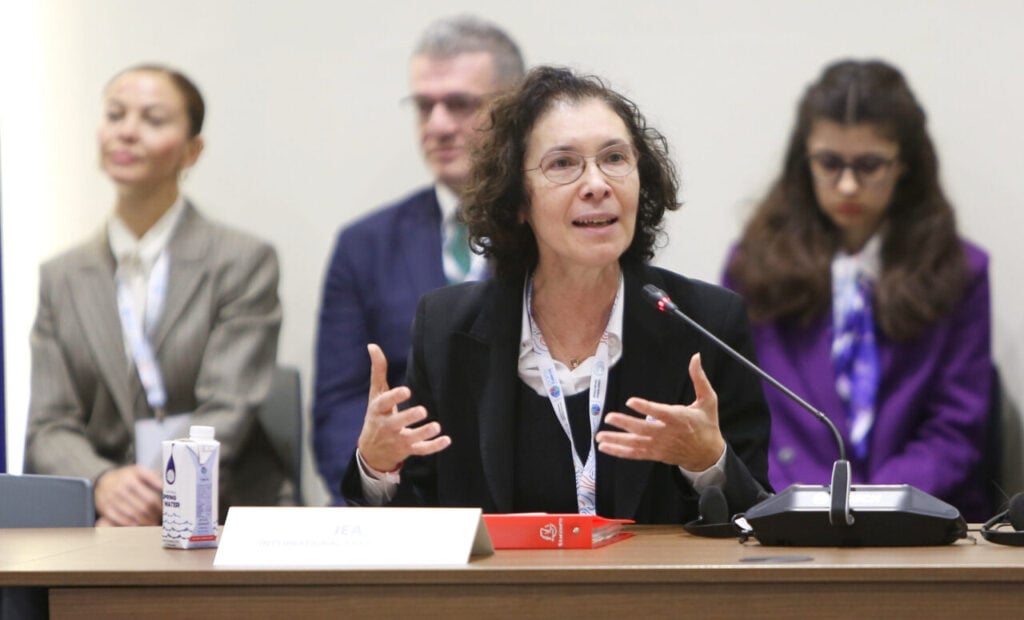
“Across all scenarios solar becomes the largest source of electricity generation in the mid-2030s,” said International Energy Agency (IEA) director of sustainability, technology and outlooks Laura Cozzi, at a webinar held this morning to launch the IEA’s flagship ‘World Energy Outlook 2026’.
Cozzi is one of the report’s authors, and discussed the increase in demand for and deployment of solar PV in the coming years outlined in the report.
Try Premium for just $1
- Full premium access for the first month at only $1
- Converts to an annual rate after 30 days unless cancelled
- Cancel anytime during the trial period
Premium Benefits
- Expert industry analysis and interviews
- Digital access to PV Tech Power journal
- Exclusive event discounts
Or get the full Premium subscription right away
Or continue reading this article for free
The IEA describes a number of potential scenarios for the future of the global energy sector: the Current Policies Scenario (CPS), which considers the impacts of policies that are currently in place; the Stated Policies Scenario (STEPS), which includes the impacts of policies that have been announced but not yet implemented; and the Net Zero Emissions Scenario (NZE), which includes the steps necessary to deliver on the goal of limiting global warming to 1.5 degrees Celsius set by the Paris Agreement.
Each of these scenarios is more ambitious than the last—the NZE scenario anticipates 3.6 times the renewable energy capacity to be in operation by 2035 than was in operation last year, compared to an increase of 2.4 times in the STEPS scenario—and renewable energy generation is expected to grow notably in all scenarios, as shown in the graphs below.
Across all scenarios, solar PV is the largest contributor to global electricity generation by 2050, up from accounting for less than one-tenth of generation in 2025, and accounts for around one-quarter of generation by 2050 in the CPS scenario, the least ambitious one.
The NZE scenario makes for the most encouraging reading, as coal and oil are expected to be removed from the global energy mix entirely by 2050, and the expected global solar PV generation of 31,831TWh is more than double that of the CPS outlook. Indeed, in this scenario, solar PV and wind alone account for more than half of global electricity generation as early as 2040.
However, Cozzi noted that the likelihood of realising this scenario is not high, saying that: “We still have a very, very significant gap towards achieving net zero emission globally by 2050.”
As a result, Cozzi said that, while solar would be an important part of the global energy mix in the years to come, it is likely to be one of several renewable energy technologies that collectively shift the balance of electricity generation.
“There is not a unique fuel or technology that’s being pushed forward, but what we’re seeing is that the direction of travel is shifting from importing energy to building energy domestically,” said Cozzi, in reference to the idea that an increasing number of countries are investing in domestic renewable energy generation, rather than relying on overseas fossil fuel imports, as that is the more resilient source of electricity.
Cozzi went on to describe what the IEA calls the Additional Response Case (ARC), a scenario in which the global energy mix is more radically altered than the STEPS scenario, but is more feasible than the NZE scenario; she described this outlook as a “very significant structural change” to the energy sector.
“We would see a very sharp decline in the share of oil and gas imports in importing countries, that reminds us of what happened in the 1970s,” Cozzi explained. “Those policies that being discussed around the world could shave off around five million barrels of oil a day in global trade, and around 300 billion cubic metres of natural gas. That is a significant difference between STEPS and this case that we’ve analysed.”
Strait of Hormuz closure has been a ‘big shock to the energy world’
Much of the impetus for such a dramatic change in the global energy mix comes from the sheer number of energy crises that the world has endured in recent years, most recently the closure of the Strait of Hormuz earlier this year.
In May, IEA executive director Fatih Birol said the conflict could “reshape” global energy investment strategies, and echoed that sentiment this morning during his presentation at the webinar, describing the closure of the strait and the fallout from the disruption to global oil and gas shipments “a big shock to the energy world”.
In response to this crisis, he said that the world has turned to a number of solutions, including diversification of energy supply and a greater emphasis on domestic electricity generation, as was highlighted by Cozzi.
This latter response has been reflected in new policy directions, which have largely sought to incentivise the use of clean energy components and products manufactured domestically. The Trump administration has kept some of the manufacturing incentives from the Biden-era Inflation Reduction Act (IRA) intact, despite rolling back other renewable energy policy support; and India’s Approved List of Models and Manufacturers (ALMM) has been updated frequently to ensure that a plethora of domestically-produced cells and modules are available to asset managers.
“The IEA is right that energy security and the energy transition have never been more closely aligned, and solar and battery storage’s growth is the clearest proof,” said Sonia Dunlop, CEO of the Global Solar Council (GSC), who pointed to the role that solar PV, in particular, has to play in this shift towards domestic electricity generation.
“It lets countries generate their own power, quickly and cheaply, which is why it posted the third-largest annual increase ever recorded for any energy source last year,” Dunlop added.
Birol went on to highlight Asia as one of the regions that has placed the most emphasis on domestic electricity generation. The governments of Singapore and Thailand both announced new solar deployment targets last month, as “home-grown energy” is increasingly sought after.
“The region to watch is Asia, because Asia is at the forefront of this crisis,” said Birol. “We’re seeing in Asia, and many other energy importing countries, looking more and more at home-grown energy.
“Renewables come very strongly here—especially solar, I should say—[as] in the last nine months, when we look at the financing of solar projects in Southeast Asia, they see an incredible increase of 40% compared to previous years, mainly driven by energy security concerns and increasing domestic energy production,” he added.
Potential for low-cost oil could create difficult questions
However, Birol noted that the long-term relationship between fossil fuels and renewables is challenging to predict, as supply of one affects the price of the other, and securing an affordable and reliable supply of power remains of critical importance.
When faced with the prospect of lower-cost oil in the future, Birol said that it would be difficult for buyers to stick to the ideas of sourcing power from a variety of sources, including domestic renewable energy generation, as became more popular in the immediate aftermath of the closure of the Strait of Hormuz.
“If there was a full and unconditional opening of the Strait of Hormuz, this would change the oil markets significantly,” he explained. “Lots of oil coming from the Middle East, and significant increases coming from the Americas—the US, Canada, Brazil, Guyana and Argentina—may mean that the oil markets will turn to be the market of buyers and put downward pressure on the prices, which would be a welcome relief for the energy importing countries.
“But, of course, in this case, there will be a competition between the policy lessons that countries drew from this crisis and lower oil and gas prices; which way to go?” Birol asked. “Will countries stick to the new policies, or would the low oil and gas prices be a question mark for these new policies?”