Since the beginning of the decade, the solar manufacturing industry has experienced fast growth outside China and Southeast Asia, with new hubs emerging in the US, Africa and India, among others.
As these new facilities are built, more often than not by new players, they bring with them technical, quality and operational challenges that need to be addressed and that don’t necessarily appear with older factories.
Try Premium for just $1
- Full premium access for the first month at only $1
- Converts to an annual rate after 30 days unless cancelled
- Cancel anytime during the trial period
Premium Benefits
- Expert industry analysis and interviews
- Digital access to PV Tech Power journal
- Exclusive event discounts
Or get the full Premium subscription right away
Or continue reading this article for free
Technical advisor Kiwa PI Berlin recently published a white paper and held a webinar examining these new facilities across the globe – which it described as having been operational for fewer than two years – and comparing their results with those of more mature ones. The paper is based on data gathered by the company from its quality control work over the past few years.
“Today we find ourselves in a position with a few years of meaningful and recent data from working in dozens of new and mature factories the last few years, and with the opportunity to leverage that data on behalf of our customers who are going to continue to be buying from new factories at least in the near future,” explained Chris Gabel, account manager at Kiwa PI Berlin and one of the authors of the white paper.
“Overall, the quality diligence approach has not changed in recent years very much for new factories, apart from perhaps performing some additional production oversight.”
More factories, more problems
For its paper, Kiwa PI Berlin collected quality audit data from more than 60 manufacturing facilities, which showed a clear difference in operational maturity between newer and older factories.
The results underline what Cherif Kedir, CEO of the US-based Renewable Energy Testing Center (RETC) told PV Tech in an interview published yesterday: “Every single time a manufacturing plant moves, quality tanks, and it doesn’t matter where they go.”
Kedir explained that this came down to the mechanics of setting up a new line: tuning equipment, stabilising process and temperature controls and, critically, ensuring a freshly trained workforce can catch problems before they escalate.
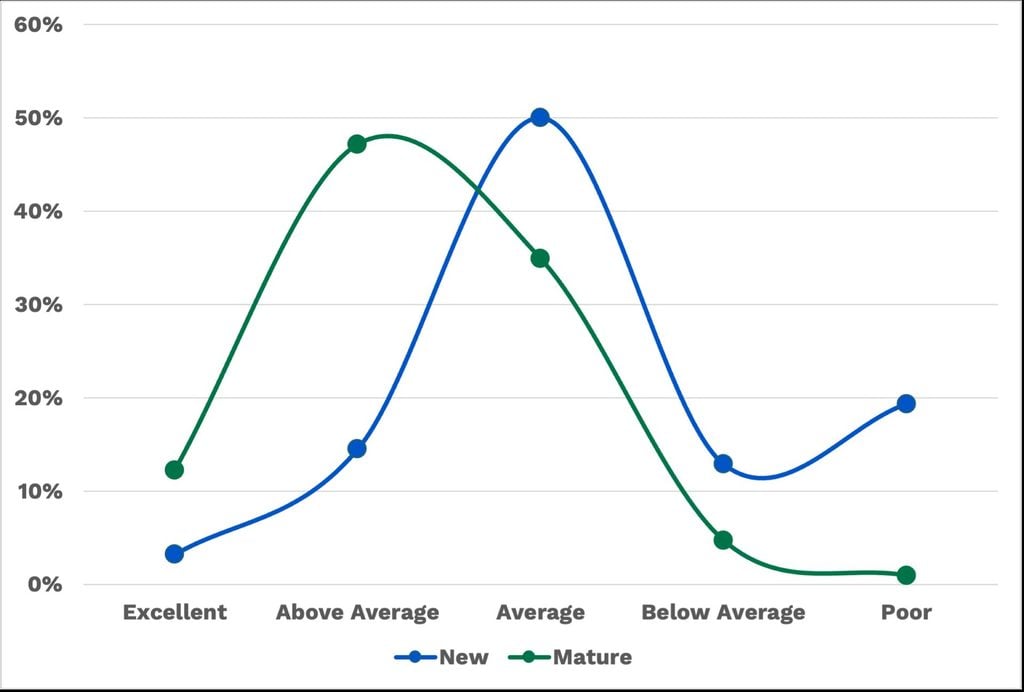
These mechanics end up creating enough of a difference between a new factory and an older one as shown in the chart below, there is a non-negligible difference between newer factories and more established ones. More than half of the mature factories had a grading of excellent or above average, while percentages for newer factories with these gradings were less than 20%. However, half of the new factories had an average grading, but also one in five of the newer factories had a poor grading.
Another major difference between newer factories and longer-running ones is in the relative frequency of production oversight findings, with new factories accounting for the majority of critical findings. More than 90% of critical findings came from new factories. Kiwa PI Berlin defined them as those that may pose a safety hazard or cause early-life product failure or significant performance loss in the field.
Gabel explained that there are two probable reasons for that wider gap between newer factories and more mature ones. Many of the critical findings were due to a lack of UL safety certification, which Kiwa PI Berlin classifies as a critical finding because factories need the certification in order to sell a product in the US and validate its safety.
The second one is that there are relatively few critical findings in mature factories, which helps explain the gap shown in the chart below.
“Mature factories have had time to get their certifications in order, and they’ve also had time to be audited by Kiwa PI Berlin, and others. In some cases, multiple times to be able to identify and address those critical findings,” said Gabel.
When looking at production oversight quality findings, a similar trend emerges: new factories generally have 21% more findings than more mature ones across all severity levels. Kiwa PI Berlin results showed that critical findings were 12 times more likely for newer factories; however, there are slightly fewer minor findings for newer factories than mature ones.
Buyers shouldn’t avoid new factories
Despite newer factories showing more major and critical findings and a higher percentage of them having below-average and poor gradings than mature factories, module buyers should not discard buying from these new facilities, as half of them had an average grading.
During the webinar session explaining the white paper’s findings, Gabel emphasised that the takeaway should not be that buyers should avoid new factories.
“On the positive side, we did find that approximately one in six new factories did get a rating of either above average or excellent.
“I don’t think that would be practical or fair [to avoid new factories]. Some of them are doing well. The point is that, in general, the quality risk is elevated, and that buyers should be proactively managing that risk,” said Gabel.
When asked about what module buyers can do to make sure that the quality of the modules acquired from newer facilities doesn’t get affected by these critical findings Kiwa PI Berlin found, Gabel told PV Tech that “buyers can limit the impact on the product they actually receive by adjusting the intensity and structure of their normal quality control tools rather than avoiding the factories”, adding that the main practical steps are:
- Apply heavier oversight and inspection coverage early in production, then taper it once there is evidence of stable, conforming results
- Use smaller-than-normal pre-shipment inspection batch sizes for the first several batches. This limits the quantity that would need to be quarantined or investigated if a batch fails and forces a more focused root-cause analysis. Batch size can be increased to normal levels after a few clean batches or once production rate and process stability are demonstrated
- Closely track planned versus actual production rates and key material inventory levels. Consistent shortfalls against the production plan are often an early signal of process or material constraints that can also affect quality
- Confirm factory-specific certifications and perform a detailed audit of the actual lines and processes before production begins and make sure any differences in critical equipment or process controls (relative to prior testing) are addressed through additional testing if needed
“These measures shift more of the ramp-up risk back onto the manufacturer instead of onto the buyer’s modules,” explained Gabel.
Emerging trend in cell spacing
Among the critical findings the company has seen across several facilities is cell spacing.
When asked about that emerging trend, Gabel told PV Tech that: “Adequate cell spacing is critical to module safety. Cells that are too close within a module can cause short circuits that lead to thermal and electrical damage. In the worst case, they can lead to a fire. Because of this, UL safety standards regulate minimum cell spacing through something called ‘minimum creepage and clearance distances’.”
You can read more on the creepage issue in the article published earlier today on PV Tech.
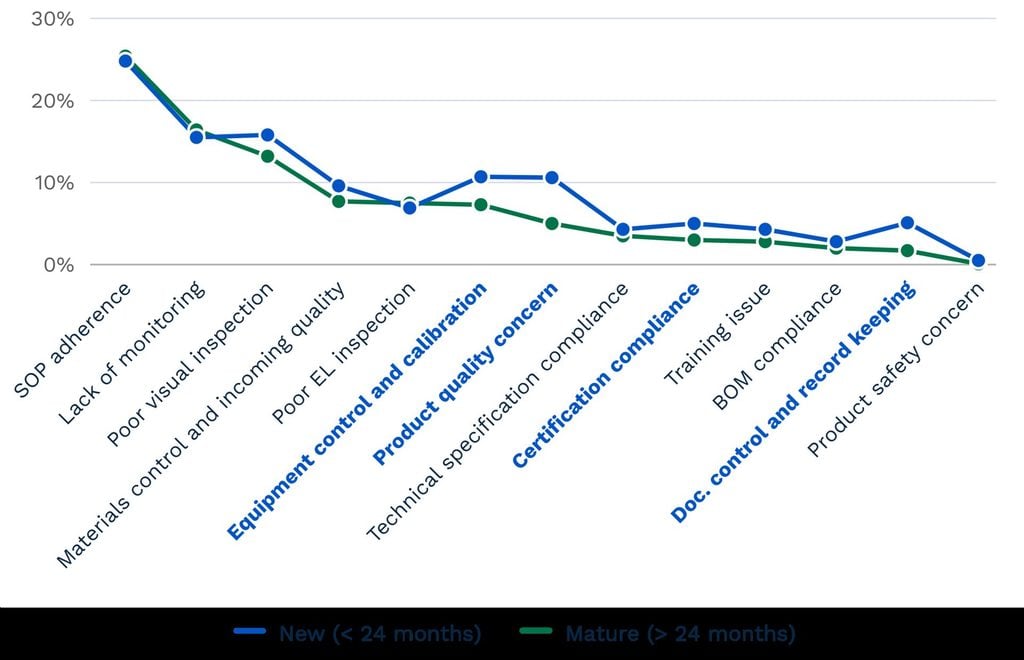
As the chart above indicates, there are a few areas where new factories are underperforming in terms of production oversight. These are equipment control and calibration, product quality concern – which here means a directly observed quality deficiency on the product line – certification compliance and documentation control and record keeping.
Same BOM, different factory
Another key aspect covered by Kiwa PI Berlin’s paper is that even when a bill of materials (BOM) is identical and manufacturing is done under the same brand, simply producing a module in different locations and with different equipment will yield different outcomes.
Mahyar Mohammad Nezhad, principal PV module consultant at Kiwa PI Berlin and one of the authors of the white paper, highlighted how different laminator equipment and process conditions in two separate factories resulted in one module having no defects and being recognised as a top performer for damp heat testing under Kiwa PVEL’s Product Qualification Program (PQP), while the other factory had bubbles and delamination issues.
“We cannot transfer the test result from one factory to another. It can be a reliability test result, PQP, or any other result. We have to validate and qualify each factory separately,” explained Nezhad.
For that reason, Kiwa suggests that at least one BOM combination be submitted for PQP testing when there are new factories with different equipment – be it stringers, laminators or junction box soldering equipment.
Due diligence on the site, not the company
Another recommendation Kiwa highlighted for module buyers was to do site-specific factory audits and technology due diligence.
“What that means is that on the product side, you want to diligence the product design, the bill of materials, and especially so with newer technologies with limited manufacturing or field history.
“Similarly, on the factory side, you need to understand which factory is going to be used to build the product and qualify it through a detailed audit process, looking at process controls, quality procedures, equipment capabilities, lab infrastructure, material management, etc. And lastly, while a specific product may have the necessary UL or IEC certificates, they need to be factory-specific,” explained Brett Barclay, director, project management at Kiwa PI Berlin.
When asked which three key aspects a module buyer should include in a contract for a new factory that wouldn’t necessarily be included for a more mature one, Barclay told PV Tech the following:
- Factory location, specific BOM, and QCP are fixed, with a defined change-control process. The contract should name the exact factory (and lines if relevant), the BOM, and the quality control plan. Any later change should require a documented process and the same level of diligence as the original qualification.
- Reliability/PQP testing applicability is factory- and process-specific. Even if the manufacturer supplies test reports on the same BOM, those results are not automatically fully applicable if the modules were built in a different factory or if critical process equipment or controls (stringers, laminators, junction-box soldering, etc.) differ. The contract should spell out when additional testing is required.
- Payment milestones are tied to completion and acceptance of the required testing, certifications, and related documentation. Treating the testing, traceability and certification package as an essential part of the deliverable gives the buyer leverage to ensure these items are actually completed and accepted rather than deferred after production has started.
“These three provisions, together with clearly defined remedies for non-conformance, make the extra risks of a new factory contractually actionable. These are important for all factories and projects, but even more so with a new factory and the gaps we have seen in them,” explained Barclay.
Commercial pressure for US solar manufacturers
One of the markets that has seen a proliferation of new module and solar cell factories in recent years is the US. Nezhad mentioned that one of the main challenges for new facilities in the US is the commercial pressure to start production and product delivery before establishing and developing several critical system and operations development tools. This includes looking at equipment, processes, quality systems, material control, traceability and workforce.
“While it’s a challenging undertaking to establish a new factory, the recipe is not a secret. Hire experienced personnel and then give them the time and resources to do the job well. Most of the quality issues we see in our industry are not due to a lack of competence but rather the result of short-term pressures winning out over long-term outcomes,” explained Nezhad.
At this year’s PV CellTech USA Conference, US-based solar PV manufacturer Imperial Star said it was hiring and training an additional 20% of staff in key engineering, quality, and operational roles ahead of its nameplate capacity expansion at the Tomball module assembly plant in Texas.
“They gain hands-on experience in the existing factory so they’re ready to lead as we bring Phases 2 and 3 into production. That gives us an experienced team in place before the new lines start and ensures a smooth ramp-up to 5GW in 2027,” explained Marvin Yang, sales and business development manager at Imperial Star.
In a market where domestic module annual nameplate capacity already outpaces demand, manufacturers that “have a reputation with their customers for delivering quality modules will have an advantage over their competitors”, concluded Nezhad.