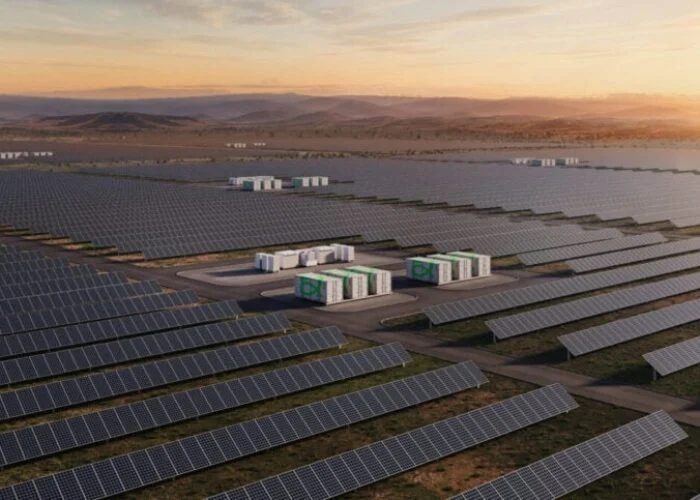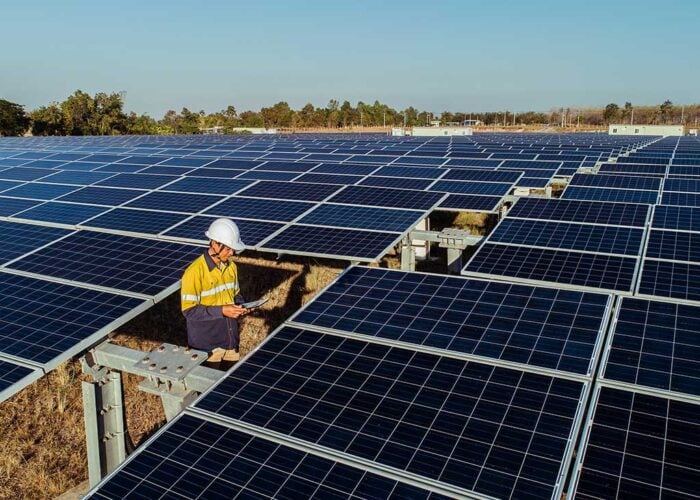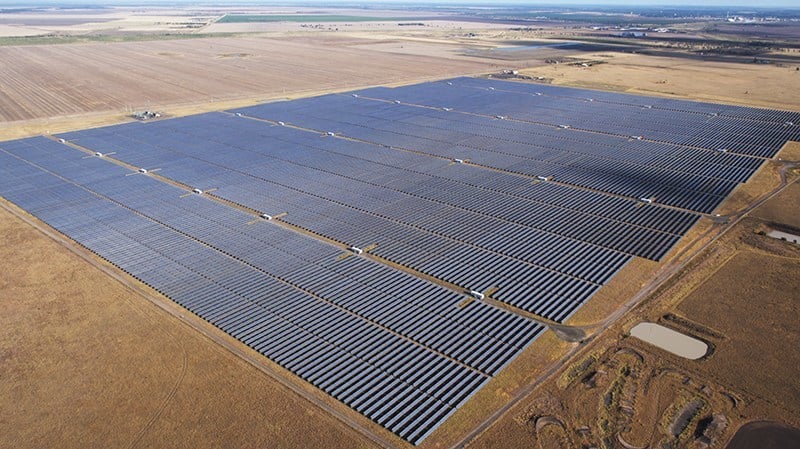
Western Australia has become the second state to sign a Renewable Energy Transformation Agreement with the Federal government, aiming to support renewable energy generation technologies, such as solar.
The agreement will see the Federal government underwrite developers to build a minimum of 6.5TWh of new wind and solar projects in Western Australia and 1.1GW of new storage to help keep the electricity grid stable.
Try Premium for just $1
- Full premium access for the first month at only $1
- Converts to an annual rate after 30 days unless cancelled
- Cancel anytime during the trial period
Premium Benefits
- Expert industry analysis and interviews
- Digital access to PV Tech Power journal
- Exclusive event discounts
Or get the full Premium subscription right away
Or continue reading this article for free
Chris Bowen, Australia’s minister for climate change and energy, said the agreement marked “an important day for Western Australia” and would deliver “certainty and progress, and cheap, clean, reliable energy to the market and households”.
“Through our Renewable Energy Transformation Agreement, we’re collaborating to lower the remaining obstacles to delivery of energy infrastructure and ensuring progress continues seamlessly across jurisdictions,” Bowned added.
With Western Australia set to retire its state-owned coal-fired power stations by 2030 and replace them with utility-scale renewable energy generation projects, the agreement will support the state in ensuring grid stability is maintained throughout the transitional period.
Indeed, energy storage will be a key aspect of the energy system, as evidenced by the number of large-scale projects being developed, such as Synergy’s 500MW/2,000MWh Collie battery energy storage project.
The government of Western Australia also intends to maintain reliability through its Reserve Capacity Mechanism, which sets requirements two years ahead for generation capacity in the South West interconnected system (SWIS). This system links urban areas such as Albany, Bunbry, Perth, Merredin, Kalgoorlie, and Geraldton in Western Australia.
Reece Whitby, Western Australia’s minister for energy, environment and climate action, highlighted the need for additional energy storage reserves to maintain the grid’s stability.
“The procurement of additional storage will be critical for firming wind and solar power during peak demand, complementing existing public and private investment in big batteries in Collie and Kwinana,” Whitby said.
As reported by PV Tech, Western Australia becomes the second state to sign such a deal, with South Australia being the first in early July. South Australia’s agreement will see the Federal government underwrite at least 1GW of wind and solar, as well as 400MW of energy storage capacity. This is designed to increase investor confidence in the state’s growing renewable energy sector.
Registration opens for Western Australia’s first Capacity Investment Scheme tender
Alongside this announcement, the Federal government confirmed that Western Australia’s first Capacity Investment Scheme (CIS) tender opened yesterday (22 July). The tender aims to secure 2GW of clean dispatchable capacity across the Wholesale Electricity Market (WEM).
Dubbed the CIS Tender 2, projects must have a minimum storage duration of two hours, a minimum size of 30MW, and meet all the eligibility criteria. The tender will close on 12 August 2024.
The recent first CIS auction, which took place in the National Electricity Market (NEM), covering Australia’s southern and eastern states, received interest from more than 40GW of solar and wind projects, despite seeking just 6GW of capacity.
Whitby highlighted the potential of the CIS tender whilst reiterating the Western Australian government’s commitment to scaling renewable energy generation technologies.
“The Cook Labor government is already investing more than AU$5 billion in new solar, wind and battery developments, with the Capacity Investment Scheme set to further bolster Western Australia’s decarbonisation efforts,” Whitby said.
Salim Mazouz, head of the Capacity Investment Scheme branch office for policy and engagement at Chris Bowen’s Department of Climate Change, Energy, the Environment and Water (DCEEW), said the scheme was designed to reduce downside risk for investors in an uncertain market environment.
“Fundamentally, what we found, both for storage and variable renewables, is that there’s a high level of uncertainty currently in the market, including about prices,” Mazouz told our colleagues at Energy-Storage.news Premium in a recent interview.
“We sought to ensure that there is downside risk protection for investors. So, we went in with the design of the Capacity Investment Scheme to ensure that, for example, debt has more of a chance of being harnessed in the context of these kinds of investments because increasingly, equity holders were finding it difficult to get debt coverage due to… the risk levels.”