Developer Western Green Energy Hub (WGEH) has signed a Feasibility Phase Agreement with SANY International Development and South Korean entities to advance Stage 1 development of its 70GW renewable energy project in Western Australia.
The agreement enables full feasibility and pre-FEED studies for Stage 1, which targets approximately 6GW of hybrid wind and solar capacity producing up to 330,000 tonnes per year of green hydrogen.
Try Premium for just $1
- Full premium access for the first month at only $1
- Converts to an annual rate after 30 days unless cancelled
- Cancel anytime during the trial period
Premium Benefits
- Expert industry analysis and interviews
- Digital access to PV Tech Power journal
- Exclusive event discounts
Or get the full Premium subscription right away
Or continue reading this article for free
SANY International Development, the Chinese equipment manufacturer, will contribute renewable energy technology, including battery energy storage systems (BESS), solar installations and hydrogen production facilities.
Meanwhile, the undisclosed South Korean partners will bring engineering, procurement and construction capabilities to the collaboration.
Ray Macdonald, WGEH CEO, said the agreement partners the project with recognised leaders in renewable energy and industrial technology.
“SANY brings world-class equipment, battery systems, solar and hydrogen facilities, while the South Korean entities contribute deep EPC capabilities – giving us the strength to take WGEH into delivery,” Macdonald stated.
The collaboration provides detailed analysis on costs, schedule and design to build a business case ahead of the targeted 2029 Financial Investment Decision, according to Macdonald.
Frank Edwin, General Manager of SANY International Renewable, described WGEH Stage 1 as “truly global in scale,” with hydrogen production of around 330,000 tonnes per year. Edwin added that the partnership would help Australia advance its decarbonisation objectives.
The feasibility agreement builds on existing memorandum of understanding (MoU) arrangements between WGEH and Korean Electric Power Corporation (KEPCO), which have supported early collaboration in project design, technology, construction, service provision and offtake arrangements.
WGEH inked the collaboration agreement with KEPCO in September 2024 before submitting the project to Western Australia’s Environmental Protection Authority in November 2024.
It was then submitted to the Australian government’s Environment Protection and Biodiversity Conservation (EPBC) Act in January 2025.
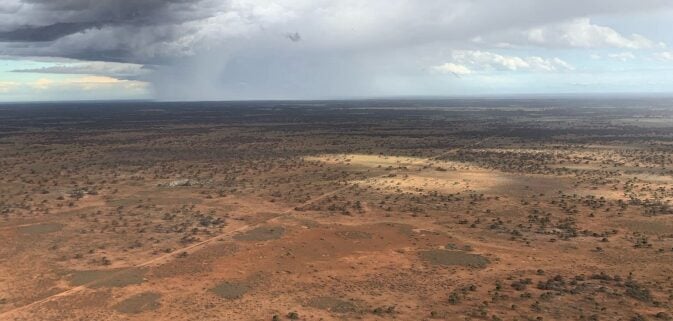
The estimated AU$100 billion (US$70 billion) project represents one of Australia’s largest renewable energy developments, with the full WGEH project now targeting 70GW of generating capacity across 2,268,015 hectares of land in the Shire of Dundas, up from 50GW.
The project would cover an area larger than Wales, incorporating around 3,000 wind turbines and up to 35 solar PV power plants using approximately 60 million solar modules.
WGEH will adopt a nodal approach by clustering 2-3GW of wind and solar capacity with 1.5GW electrolysers and data centres at each node location.
The developer plans to construct around 35 nodes across the project site, with annual energy production expected to exceed 200TWh – comparable to Australia’s current total generation capacity.
The project sits on Western Australian Mining Native Title-determined land and has received environmental criteria guidance from the state’s Environmental Protection Authority. The Western Australia EPA set environmental criteria for the development, establishing framework conditions for the massive renewable energy installation.
Who owns the 70GW Western Green Energy Hub?
WGEH is majority-owned by InterContinental Energy, a global leader in mega-scale renewable hydrogen developments and the creator of the P2(H2)Node architecture.
InterContinental Energy’s Australian portfolio includes the 26GW Australian Renewable Energy Hub in the Pilbara, which secured AU$21 million in funding from the Australian Renewable Energy Agency (ARENA) for green hydrogen development last week.
Isaac Hinton, head of Australia for InterContinental Energy and WGEH Chair, described WGEH as a cornerstone of the company’s Australian portfolio alongside the 26GW Australian Renewable Energy Hub.
“This Feasibility Phase Agreement moves WGEH closer to delivery and reflects strong international confidence in Australia’s growing green hydrogen economy,” Hinton said.
The Australian Renewable Energy Hub targets 26GW of solar and wind generation capacity across a 6,500-square-kilometre Pilbara site, with expected production of 1.6 million tonnes of green hydrogen or 9 million tonnes of green ammonia annually at full capacity.
The project received ‘Major Project Status’ from the Australian government in May 2024, granting access to federal approval assistance after earlier environmental challenges.
Other WGEH shareholders include Mirning Green Energy Limited, a commercial subsidiary of WA Mirning People Aboriginal Corporation, and CWP Global, an integrated renewable energy developer with international project experience.
Stage 1 of the WGEH project’s 6GW capacity positions it among Australia’s largest planned green hydrogen facilities, addressing growing international demand for clean energy carriers.
The 330,000 tonnes per year hydrogen production target serves emerging Asian market demand, leveraging Western Australia’s strategic geographic position and abundant renewable energy resources.
The feasibility studies will examine technical specifications, economic viability and infrastructure requirements for Stage 1 implementation.
Partners will then assess supply chain logistics, grid connection requirements and hydrogen export infrastructure development as part of the comprehensive analysis.
The Energy Storage Summit Australia 2026 will be returning to Sydney on 18-19 March. It features keynote speeches and panel discussions on topics such as the Capacity Investment Scheme, long-duration energy storage, and BESS revenue streams. ESN Premium subscribers receive an exclusive discount on ticket prices.
To secure your tickets and learn more about the event, please visit the official website.