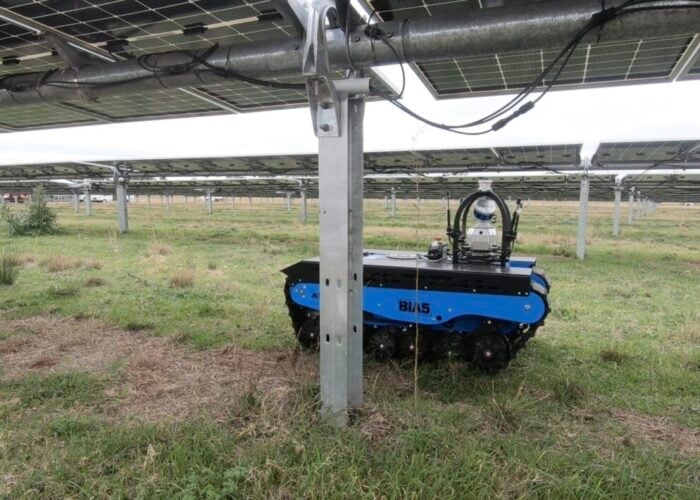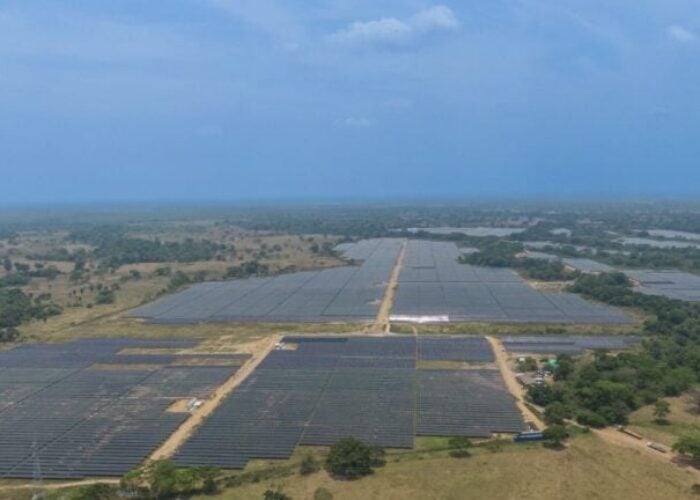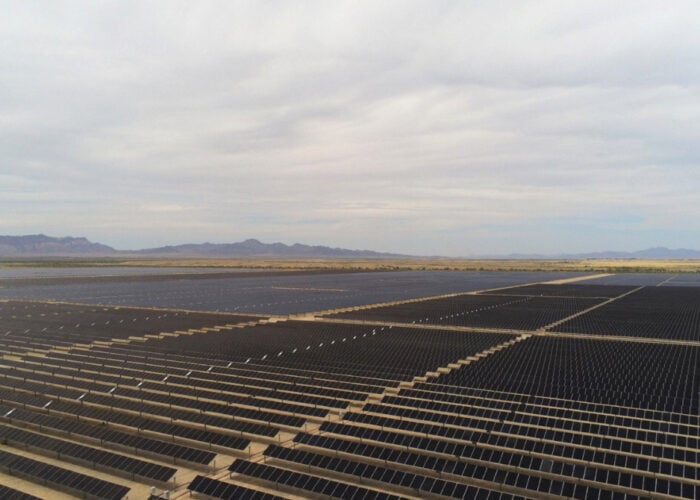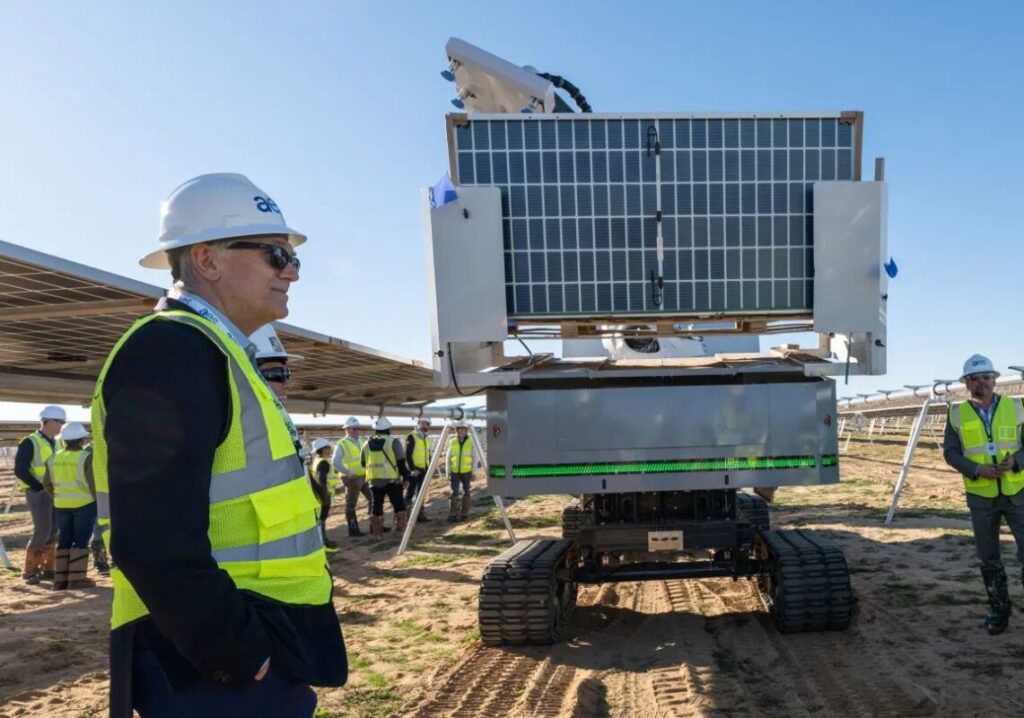
This week, solar robotics company Maximo, which was incubated by US utility AES Corporation, completed the installation of 100MW of solar PV panels in the US.
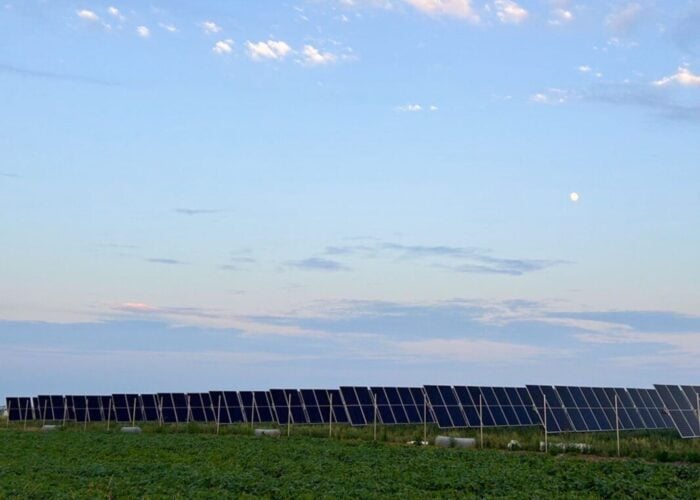
The installation milestone achieved at the Bellefield complex—a 1GW solar PV and 1GW energy storage project from US utility AES—in California shows that the use of robotic solar panel installation is no longer a question of lab testing but is increasingly being deployed on large utility-scale projects.
Try Premium for just $1
- Full premium access for the first month at only $1
- Converts to an annual rate after 30 days unless cancelled
- Cancel anytime during the trial period
Premium Benefits
- Expert industry analysis and interviews
- Digital access to PV Tech Power journal
- Exclusive event discounts
Or get the full Premium subscription right away
Or continue reading this article for free
“Most of the deployments are in relatively small test scenarios. It’s either been done at the lab, or if it’s done in the field, it’s maybe one robot. You’re looking at a couple hundred, maybe 1,000 modules installed,” Nick Hegeman, chief commercial officer at Maximo, says to PV Tech Premium.
Hegeman adds that: “In robotics, you don’t really get the value until you do the entirety of the project. And this is the most significant step for us, and also what we’ve seen in the market in terms of demonstrating the credibility and capability of robotics working at scale.”
One good example of this is that, through the installation of solar panels at the Bellefield project, Hegeman says Maximo has introduced four technological variations into its Maximo robots.
According to the company, the current iteration of its Maximo units (3.0) has a technical performance rate consistently surpassing one module per minute, with crews installing as many as 24 modules per shift hour per person, nearly double the output of traditional installation methods in the region.
Not only that, but the company is currently working on the upcoming release of its new version (4.0), which builds on the accomplishments achieved at Bellefield. Hegeman teased that the upcoming version will bring a “significant improvement to the current efficiency and installation rates compared to 3.0”.
AI innovation in the solar field
Alongside the innovation in the Maximo units during the installation of the solar panels at the Bellefield project, the company has partnered with tech companies NVIDIA and Amazon Web Services (AWS) for the project’s AI and data components.
In the case of AWS, it helped power the development, deployment and operation of Maximo’s AI-driven field systems, while NVIDIA technologies—including its AI infrastructure, its Omniverse libraries and the Isaac Sim open robotics simulation framework—supported the development and readiness of the Maximo robotic fleet deployed in the California project.
Maximo said that the combination of AI, vision, robotics and simulation-driven engineering reduced development and validation timelines and increased confidence in field performance as the robotic fleet scaled.
“Physical AI is a powerful force for accelerating real world energy infrastructure,” said Marc Spieler, senior director of energy at NVIDIA. “By combining AI infrastructure, simulation, and edge AI platforms like Maximo demonstrate how physical AI can help accelerate solar panel installation while maintaining high reliability in complex environments.”
Furthermore, the knowledge, or more precisely the data, gained from utility-scale projects of that size is also an important asset and learning tool for future projects. Hegeman explains how collecting data from 180,000 installation cycles and feeding it into an AI model helps create a base case with detailed information that can continue to feed future projects with different models of trackers and modules.
The constant collection of data helps build on the foundational model, says Hegeman, adding: “That’s why you’re going to see an acceleration of adoption rates, just because the robots themselves are accelerating how quickly they can be proficient at a variety of tasks, whereas before that was going to have to totally change your development cycle that you’d be looking at years out just for a simple module change. And that happens all the time.
“The fact that we’ve got that data makes it really much easier for us to translate the success of one project to another.”
Easily scalable for bigger projects
One of the advantages shown in the Bellefield project is that Maximo’s system, being modular by design, means that scaling up from 500MW to 1GW is only a question of adding robots. For instance, in the Bellefield project, the company scaled from using a single robot to a coordinated fleet of four Maximo units operating in parallel.
As more companies like Maximo and AES integrate the use of robotics for the installation of solar panels at a utility-scale level, Hegeman says there are three main differences between projects that don’t and those that do use robotics. The first one he mentions is consistency, as there might be some differences in productivity between the different crews on a site.
“With our robotic system, you know you’re going to get, and this is with what we deployed, you know you’re going to get four to 500 modules per shift,” adds Hegeman.
The second difference is tied to the ramp-up time that can often be staggered between two and three months, whereas with the robotic system, this is shortened to a matter of weeks. And the third difference, according to Hegeman, is related to the fact that the output is more consistent.
Moreover, Hegeman says that the use of robotics doesn’t mean that it will replace the labour force, but rather helps deliver the project on time and with fewer delays, as well as making it safer.
“These modules are 75 to 100 pounds, and doing overhead lifts of that for eight to ten hours a day is not good from a safety standpoint, and so we’re able to eliminate that. It’s making it safer, more effective and really helping the overall project schedule as a result.”
Robotics trends in solar PV
When asked more in general about trends in robotics and AI, Hegeman mentions the improvements made in the user interface with robotics, which have made it easier to train people on these systems.
“People are proving to be a lot more adapted [to robotics] than I think was assumed to be the case in the past. And as robotics becomes more prevalent on the construction site, that means you’re going to see a lot more adaptation and integration of robotics into the sites themselves, just because the labour force is really embracing robotics in a way that is a little bit ahead of where we thought we’d be.”
He adds that he expects the use of robotics to become more common as developers look to move from lab or small field tests to large utility-scale solar PV projects, simply out of necessity. Installation timelines are getting tight and labour shortages continue to be a challenge.
Given that engineering, procurement, and construction (EPC) contractors will have to go through different types of robots for each process that they want to automate, Hegeman says the sooner a company gets involved in its first robotics integration, the better.
“We have to integrate technology into the construction site out of necessity,” he says. “You’re going to see not only from the technology companies themselves, but also from the EPCs and developers looking for ways and methods that we can accelerate production timelines.”
“Each one of those solutions has a different workflow, and so you’ve got to integrate that with your current workflow. That may change how you plan. That may change your daily cadence with your production team, your planning teams, your purchasing teams, and your on-site logistics. And so going from not doing that at all to having to do that with ten different partners simultaneously is impossible.
“The biggest recommendation to EPCs is to start with one. Start interacting with a robotic solution provider as quickly as possible, because they need to go through that organisational operation change.”
As more robotic solar companies make the jump from the test phase to commercial projects on a large scale, it is only a question of time before more EPCs and developers start implementing the technology across their portfolio.
This could be particularly significant in the US, where the industry is bracing for a construction spree in the coming years—this year alone, the US Energy Information Administration (EIA) forecasts a record 43.3GW of utility-scale solar PV—as companies begin building projects to secure tax credits.
“We’re getting into a point where deployment in taking it from the lab to reality is shrinking, and you’re going to see a lot more of these, at least from us, over the next 6-12 months,” concludes Hegeman.