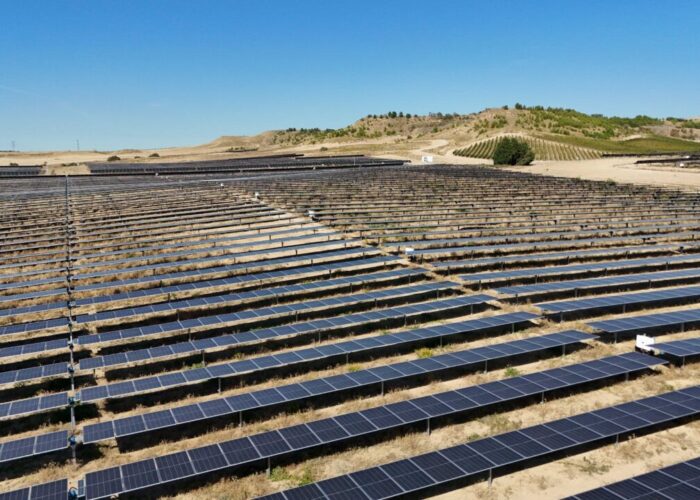
Government support, and perhaps international collaboration, are key components of the Spanish solar sector, according to panellists at Solar Media’s Solar Finance & Investment Europe (SFIEU) event, held this yesterday (31 January) afternoon in London.
The panel, ‘The Long-Term Investment Outlook for Spanish Solar’, saw speakers discuss some of the opportunities and challenges for the Spanish solar sector, with the need for government support a common theme among the panellists.
Try Premium for just $1
- Full premium access for the first month at only $1
- Converts to an annual rate after 30 days unless cancelled
- Cancel anytime during the trial period
Premium Benefits
- Expert industry analysis and interviews
- Digital access to PV Tech Power journal
- Exclusive event discounts
Or get the full Premium subscription right away
Or continue reading this article for free
“Spain is a challenging market, we have had issues in recent years at a local level,” began Cristina Torres-Quevedo, financial and regulatory director, Unión Española Fotovoltaica (UNEF), the country’s largest trade body. “We have 17 different communities, which have their own regulations. It’s a challenge, but also an opportunity for developers.”
Of course, the scale of these concerns owes much to the considerable potential for the Spanish solar sector. Marta Valien, the head of asset management at the Foresight Group, who moderated the panel, noted that Spain is aiming to expand its operational capacity to 57GW by 2030, which would require the sector to add 5.5GW of new capacity a year until the end of the decade.
“Spain has access to the high radiation solar resource, [which will] drive down the levilised cost of electricity (LCOE),” said Iciar Rivier, vice president of origination and execution at InfraRed Capital Partners. “There are not many European countries that have access to that cheap, green electricity.
“[This] will decarbonise all the sectors that use electricity, and all the hard-to-electrify sectors will take advantage of that, and the key example of that is in green hydrogen,” added Rivier, noting how Spain’s considerable solar potential could impact its broader energy mix, to its benefit. “Here in Spain, having access to clean, cheap electricity puts Spain in a very strong position.”
Spain’s green hydrogen potential is well-documented, with energy company Cepsa announcing plans to build a 200MW solar plant in the country to power green hydrogen production, and the panellists were optimistic that a more impactful solar sector could help drive change in Spain’s energy mix more broadly.

Grid connection challenges
However, the Spanish solar sector has been beset by grid connection issues in particular. Indeed, there are concerns regarding the potential of the Spanish engineering, procurement and construction (EPC) sector to meet this growing demand for solar power, and this bottleneck looms large in the minds of Spanish investors and developers.
“For sure, we’ll have EPC struggles and transmission system operator (TSO) problems, because TSOs won’t be able to assure all the projects at the same time because of a bottleneck,” added Torres-Quevedo.
These concerns are not limited to Spain’s borders, either, with Spain’s grid being connected to its French counterpart since 2015. The connections allow for 2GW of electrical capacity to be moved from one grid to another, and while this has helped alleviate some of the concerns pertaining to dispatchability in both countries’ energy mixes, it could lengthen already-cumbersome lead time for new projects, as they need to be integrated into the energy grids of two countries.
“Interconnections are the key, and to speed up liquidity in the electricity market,” said Peer Piske, managing partner at Alantra Solar. “We’re not just talking about electricity connection now, but potential hydrogen connection too. The most relevant aspects in the next years [include] political support, not only from the Spanish government but also from the French government.”