There is money to be made in the gaps of the US solar supply chain. Module and cell production have boomed in recent years, with capacity for the former now sufficient to meet domestic demand and the latter on track to expand over the next few years. ACI Materials, a California-based silver paste producer, and its senior executive fellow, Dana Hankey, are hoping to meet the needs of those new customers.
ACI Materials is restarting its silver paste business for the solar industry, reworking and reintroducing the technology it developed “years ago”. Hankey himself has 40 years of experience producing silver pastes for the solar industry, he tells us, having worked at US metals firm Ferro Electronic Materials before it sold its solar paste business to German firm Heraeus. He started ACI Materials in 2013.
Try Premium for just $1
- Full premium access for the first month at only $1
- Converts to an annual rate after 30 days unless cancelled
- Cancel anytime during the trial period
Premium Benefits
- Expert industry analysis and interviews
- Digital access to PV Tech Power journal
- Exclusive event discounts
Or get the full Premium subscription right away
Or continue reading this article for free
Over the years, Heraeus sold the solar paste business it bought from Ferro to China’s Haitian Water Group, and Delaware-based chemical giant DuPont phased out its solar paste production during a sale to Texas-based materials and chemicals firm Celanese. As China came to dominate global solar manufacturing at the start of the last decade and all of these sales and changes took place, the upshot was that the US lost the ability to produce silver pastes for solar.
“A friend of mine, who I’ve been buying precious metal powder from for 40 years, was at PV CellTech last year, and he came back and said ‘Dana, why aren’t you guys doing solar with this big push for reshoring?’,” Hankey recounts. “Quite frankly, you know, I’ve kind of had my eyes closed to it.”
But the company secured investment from the Saudi deep-tech investment fund Capital K, run by the King Abdullah University of Science and Technology (KAUST), which came with an offer for Hankey to move from CEO to a senior fellowship position and head up the company’s re-entry into the solar industry.
“At this point, I’m close to retirement, I’m thrilled. We started the solar programme back up!” he says. There is certainly industry pedigree in the company and in Hankey’s contacts, with connections to the University of New South Wales (UNSW) in Australia and Georgia Tech in the US, which, along with decades of experience, he says, means that he and ACI Materials “understand the market [and] understand the Chinese competition”.
Silver paste ‘secret sauce’

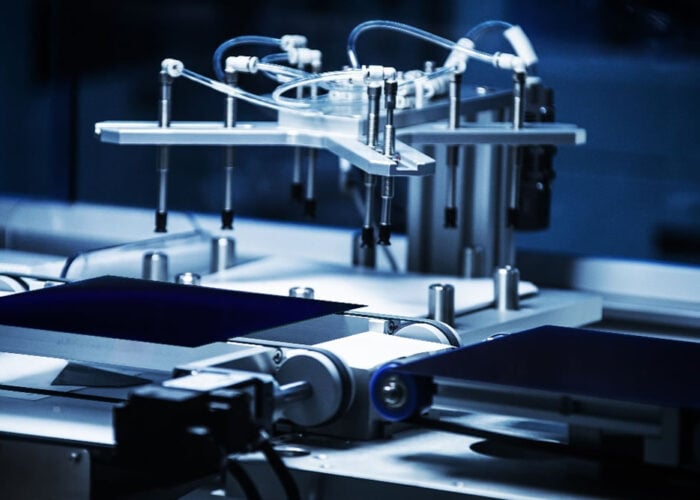
Hankey says that ACI’s “secret sauce” is its machinery and equipment—“that gives us a competitive edge,” he insists. The company uses machines that “are about the size of a desk,” which Hankey says can each produce around ten metric tonnes of silver material per year.
That silver paste—or ink—is produced using a process called cavitation, which involves rapidly creating and then collapsing vacuum bubbles on the surface of the material. The chemistry is complex, and the result is something that Hankey claims is the “most conductive material on the market” that uses “30 % less paste” to get the same performance from solar cells. He says the company has five patent “families” with 31 issued patents, “almost all on the platform technology.”
When restarting the company’s solar business, some of the processes had to be refined and updated to meet modern requirements. Now he says the company has a silver paste that is “very competitive” for PERC solar cells and will be launched to the US market in “early Q4”. Products for TOPCon and ultimately perovskite tandem cells will follow suit, he suggests.
Targeting PERC production lines may be a smart commercial move as well as a natural step before moving to more advanced and efficient cell technologies. The raft of legal disputes over TOPCon have made it largely unviable to produce the technology in the US, pushing some new entrants to build PERC production lines at a time when TOPCon has become the dominant technology elsewhere.
Reducing silver use in solar
Reducing the amount of silver used in solar cell production has become a talking point in the industry. By some estimates, expanded solar production and deployments could use up all of the world’s silver reserves in the next five years (subscription required), and the IEA PVPS has said that responsible management of material supplies and metal recycling processes will be key to sustainably growing the technology.
Hankey seems unfazed by the trend. He says he has contact with scientists working on using copper on the back side of TOPCon cells, and would look to work with them in combining copper and silver in future products. His claims that ACI is using 30% less silver than other production processes also help.
“I think there’s a lot of work to be done on the long-term reliability of copper in the solar cell,” he says. “Copper has the oxidation issue that it’s always going to have an equilibrium layer of oxygen on the copper particles.”
He says that manufacturers are currently approaching him for silver without much concern for copper, and that seems to be where his interest lies. “Right now, we’re going forward with silver, or possibly silver-coated copper … [copper] may be accepted in the long run by the manufacturers, but I think a lot of it really depends on the overall reliability.”
US manufacturing boom
ACI Materials has yet to go to market with US-made silver paste, but Hankey claims that there are already US manufacturers who are “very anxious to get the material.” He suggests that major players in the industry would put their cash behind domestic silver paste, just as other supply components like steel frames, racking and glass have attracted interest.
The US solar industry faces a laundry list of tariffs, restrictions and other trade and policy challenges, all purportedly to wrest control of the solar supply chain from China. On paper, these mean that the more domestic components you can get your hands on as a manufacturer, the better. Silver isn’t subject to as many restrictions as polysilicon products, but the principle still stands.
Manufacturers reportedly told Hankey “We want a supplier that’s coming out of the USA or Europe because we want these materials to be able to be imported into the US and we don’t want to have to pay tariffs.” He also said that the “modular” nature of ACI Materials’ equipment means “we can set up shop right next to the manufacturers.”
Dana Hankey will be speaking at the PV CellTech USA conference in San Francisco later this month. The event will bring together stakeholders from across the US manufacturing industry in high-level presentations, panel debates and dedicated networking breaks.