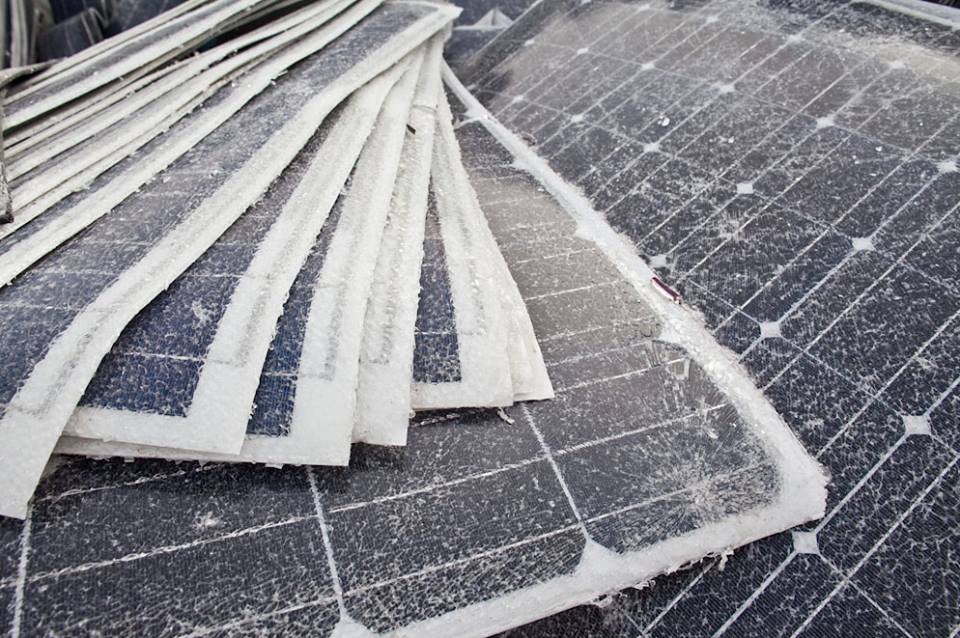
A new report has found measurable improvements in PV module recycling performance, based on updated data drawn from commercial and pilot-scale recycling operations in the US and Europe.
The report, published by International Energy Agency Photovoltaic Power Systems Programme (IEA-PVPS) Task 12 shows higher material recovery rates, improved process yields and increased output purity across crystalline silicon (c-Si) and thin-film PV recycling.
Try Premium for just $1
- Full premium access for the first month at only $1
- Converts to an annual rate after 30 days unless cancelled
- Cancel anytime during the trial period
Premium Benefits
- Expert industry analysis and interviews
- Digital access to PV Tech Power journal
- Exclusive event discounts
Or get the full Premium subscription right away
Or continue reading this article for free
The analysis is led by IEA-PVPS Task 12, with contributions from industry and research partners including US-based recyclers Solarcycle and SPR, Italian pilot-scale operator 9-Tech, EU-funded Photorama project, and thin-film manufacturer First Solar.
The report highlighted mechanical recycling as the dominant commercial method for c-Si modules due to its scalability and cost-effectiveness, while combined thermal and chemical processes are increasingly delivering higher recovery rates and purities for silicon, silver and other metals.
Furthermore, it finds that SPR reported up to 98 weight (wt.) % silicon recovery using mechanical processes, while 9-Tech achieved 95 wt.% silicon recovery through a hybrid mechanical, thermal and chemical system. Silver recovery reaches nearly 92 wt.% at Solarcycle, while SPR reported around 99% copper recovery. First Solar reported more than 90 wt.% recovery of semiconductor materials and other metals in its thin-film systems.
The improvements are driven by the need to increase circularity in PV supply chains, reduce dependence on virgin raw materials and enhance the economic viability of end-of-life solar assets as global PV waste volumes rise.
Advances are being achieved through optimised mechanical separation, thermal processing and chemical refinement, alongside emerging technologies such as flash lamp separation and water jet cleaning. These approaches also improve material purity, with Photorama reporting 5N-grade silicon and over 2N silver purity.

Despite progress, the report flags persistent gaps in electricity consumption data, material quality reporting and system boundary harmonisation, calling for greater transparency and collaboration across the recycling value chain to inform future circular-economy decisions.
“Updated life cycle inventory data reveal measurable advancements in PV recycling processes while also highlighting where improved data transparency is still needed,” said Cara Libby of the Electric Power Research Institute in the US, author of the report.
Effective end-of-life management and recycling are becoming increasingly important for the PV industry as global deployments grow, driving the need to recover valuable materials, reduce waste, and support a circular economy for solar energy materials.
In a recent interview with PV Tech Premium, Fortunato Villamagna, president of Comstock Metals Corporation in the US, highlighted the scale of value embedded in PV waste streams, noting: “Today 12–13% of the world’s mined silver goes into solar panels, a figure that sounds alarming given how much value it embeds in PV waste. Extracting such metals at scale can reduce dependence on mining and imported raw materials.”