Australia has announced the results of Capacity Investment Scheme (CIS) Tender 7, awarding 19 projects that will deliver 7.8GW of renewable energy generation across the National Electricity Market (NEM), exceeding the original 5GW target by more than 50%.
The tender, which opened in October 2025, attracted 53 bids totalling 18.6GW of capacity.
Try Premium for just $1
- Full premium access for the first month at only $1
- Converts to an annual rate after 30 days unless cancelled
- Cancel anytime during the trial period
Premium Benefits
- Expert industry analysis and interviews
- Digital access to PV Tech Power journal
- Exclusive event discounts
Or get the full Premium subscription right away
Or continue reading this article for free
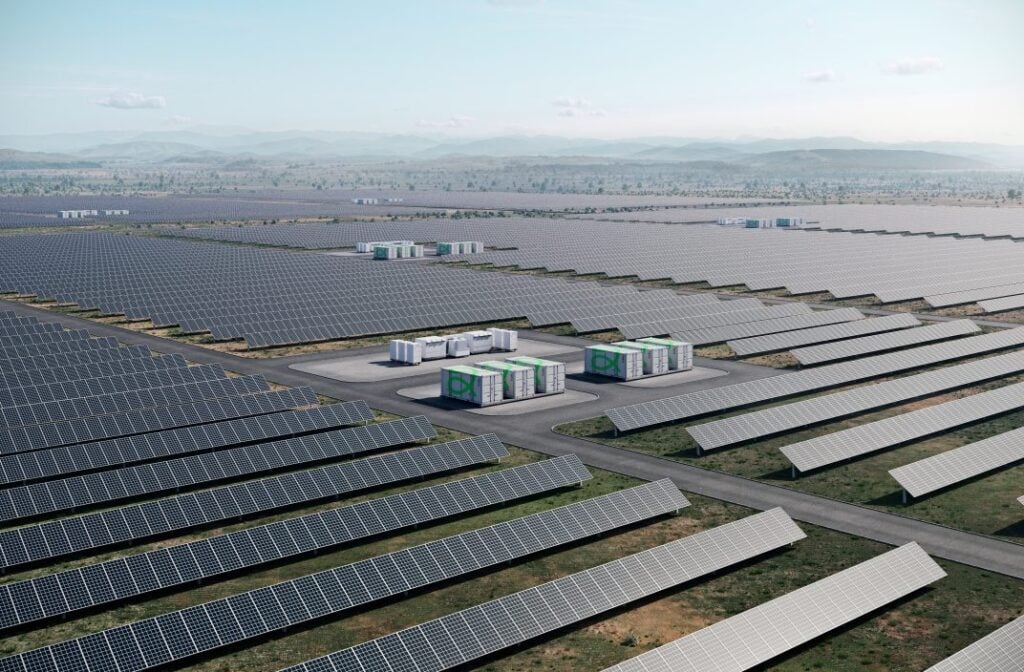
Eight of the 19 selected projects are hybrid developments, combining wind or solar generation with battery storage to deliver over 2GW/7.9GWh of storage to the grid.
The hybrid projects reflect the continued trend toward integrated renewable energy systems that can provide dispatchable capacity, addressing grid stability concerns as Australia transitions away from fossil fuel generation.
According to ASL, the tender represents the largest allocation to date under the CIS framework, surpassing Tender 4’s 6.6GW outcome, which attracted 84 bids representing 25.6GW of capacity.
The organisation noted that the overallocation in Tender 7 suggests increased urgency from the government to meet its emissions-reduction targets, with wind projects accounting for 4.8GW of the awarded capacity, compared to 3GW for solar.
New South Wales (NSW) secured the largest share of awarded capacity, with nine projects totalling approximately 3.9GW of generation and 6.4GWh of storage. Queensland followed with five projects delivering 2.7GW of generation and 1.5GWh of storage.
The tender marks the final round in which NSW projects are eligible, as the state has now reached its maximum allocation under the CIS framework. New South Wales launched its biggest renewable energy tender in the state’s history earlier this year, running in parallel with federal initiatives. Victoria, Tasmania and South Australia also secured projects under the tender.
| Project | Proponent | Technology | State | Capacity (MW) | Storage Capacity (MWh) |
|---|---|---|---|---|---|
| Yanco Delta Wind Farm | Origin Energy | Wind | NSW | 1,498 | N/A |
| Bungaban Wind Energy Project | Windlab | Wind (Hybrid) | QLD | 1,150 | 1,400 |
| Theodore Wind Farm | Theodore Energy Development | Wind | QLD | 1,022 | N/A |
| Birriwa Solar | ACEN Australia | Solar (Hybrid) | NSW | 600 | 2,400 |
| Baldon Wind Farm | Goldwind / Omni | Wind (Hybrid) | NSW | 346 | 132 |
| Cellars Hill Wind Farm | Gamuda Renewables and Alternate Path | Wind | TAS | 341 | N/A |
| Willatook Wind Farm | ENGIE | Wind | VIC | 338 | N/A |
| Gundary Hybrid Facility | Lightsource BP | Solar (Hybrid) | NSW | 320 | 1,391 |
| Bullawah Wind Farm Stage 1 | BayWa | Wind | NSW | 300 | N/A |
| Dinawan Solar Hybrid | Spark Renewables | Solar (Hybrid) | NSW | 300 | 1,200 |
| Gunning Solar Farm Hybrid Project | Zero-E / Grupo Cobra | Solar (Hybrid) | NSW | 290 | 542 |
| Whyte Yarcowie Wind Farm | EDF Power Solutions | Wind | SA | 289 | N/A |
| Banana Range Wind Farm | EDF Power Solutions | Wind | QLD | 228 | N/A |
| Weasel Solar Farm | Gamuda Renewables and Alternate Path | Solar | TAS | 200 | N/A |
| Wattle Creek Solar Hybrid | Spark Renewables | Solar (Hybrid) | NSW | 180 | 720 |
| Moranbah Solar Farm | Zero-E / Grupo Cobra | Solar (Hybrid) | QLD | 171 | 100 |
| Bullyard Project | European Energy Australia | Solar | QLD | 97 | N/A |
| Kayuga Solar Farm and BESS | European Energy Australia | Solar | NSW | 85 | N/A |
| Woolsthorpe Wind Farm | ICA Partners | Wind | VIC | 72 | N/A |
Solar projects with integrated storage are prominent among successful bids. ACEN Australia’s 600MW Birriwa Solar project in NSW includes 2.4GWh of battery storage, while Spark Renewables secured two hybrid solar projects in the state: the 300MW Dinawan Solar Hybrid with 1.2GWh of storage and the 180MW Wattle Creek Solar Hybrid with 720MWh of storage.
The prevalence of hybrid projects mirrors outcomes from Western Australia’s CIS Tender 5, which awarded 1.9GW of renewables with battery storage forming a core component of successful bids.
Wind projects dominate the awarded capacity, with the 1.5GW Yanco Delta Wind Farm operated by Origin Energy in NSW representing the largest single project and Australia’s biggest wind development to date.
Queensland’s Bungaban Wind Energy Project, developed by Windlab, will deliver 1.15GW of wind generation alongside 1.4GWh of battery storage, making it one of the largest hybrid developments in the tender.
The projects are expected to support more than 19,000 jobs during construction and more than 1,500 operations and maintenance positions over their lifetime.
Subject to final contract execution, developers have committed an estimated AU$504.6 million (US$361 million) in community-shared benefits, AU$678.7 million in First Nations benefits, and AU$257 million in Australian-made steel.
The CIS scheme provides revenue certainty through Capacity Investment Scheme Agreements (CISAs), which underwrite projects against agreed-upon revenue floors and ceilings.
This mechanism helps attract investment by mitigating financial risk for developers, ensuring projects can secure financing and reach commercial operation. The scheme offers both generation and storage support, with successful projects receiving capacity payments that complement wholesale electricity market revenues.
Australia officially opens CIS Tender 9
Running in parallel, the Australian government has officially opened registrations for CIS Tender 9 today (25 May), seeking an indicative target of 5GW of renewable energy generation across the NEM. Bids will close on 20 July 2026.
However, eligibility restrictions apply: NSW projects are ineligible as the state has reached its maximum allocation through previous tenders, while Victoria has limited solar-only projects to a total capacity of 470MW at the request of the state government.
The outcomes of Tender 8, which focuses on dispatchable capacity in the NEM and seeks 16GWh of storage, are expected to be announced in June 2026. Tender 10, targeting additional dispatchable capacity, is scheduled to open in June 2026.