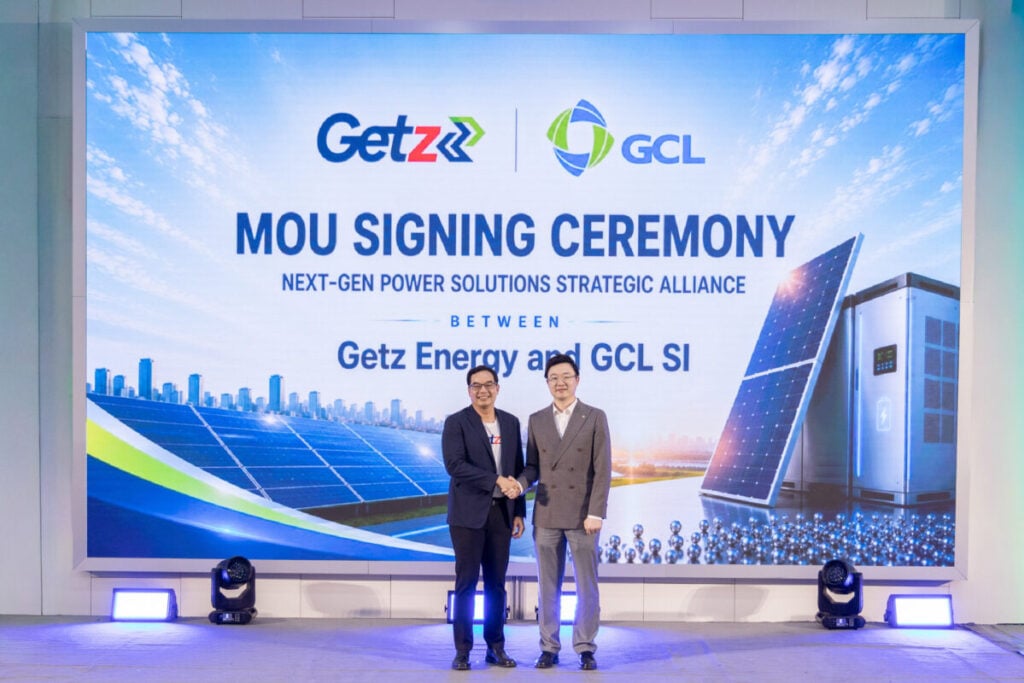
Chinese solar manufacturer GCL SI has signed a 1GW module supply agreement with Thailand’s Getz Energy, a subsidiary of Thai utility Global Power Synergy Public Company (GPSC).
The deal, announced during an event hosted by Getz Energy, will last for three years. Over this period, GCL will supply both PV modules and battery energy storage systems (BESS), although the company did not specify how much of each technology it would deliver, noting that it would supply “up to 1GW equivalent of PV modules”.
Try Premium for just $1
- Full premium access for the first month at only $1
- Converts to an annual rate after 30 days unless cancelled
- Cancel anytime during the trial period
Premium Benefits
- Expert industry analysis and interviews
- Digital access to PV Tech Power journal
- Exclusive event discounts
Or get the full Premium subscription right away
Or continue reading this article for free
Getz Energy’s parent company, GPSC, is itself a subsidiary of state-owned oil and gas company PTT
GCL also did not specify which modules and batteries it would deliver, but showcased a number of products at the Getz event, including the SiRo T series, which includes tunnel oxide passivated contact (TOPCon) modules with a maximum power output of 720W and an efficiency of 23.18%.
The company noted that this series of modules is designed for use in “industrial rooftops” and “large-scale solar installations”, and said that, under the terms of the Getz deal, it would provide the firm with products for utility-scale solar projects.
The majority of Thailand’s solar facilities consist of utility-scale projects—figures from the International Energy Agency (IEA) show that in 2024, Thailand had 6.3GW of operational utility-scale capacity, compared to 3.3GW of operational rooftop solar projects—and this supply deal will further the growth of this sector.
The deal is also significant because Getz Energy itself has a relatively small renewable energy portfolio, with just 290MW of capacity in operation this year, according to GPSC.
Thailand is aiming to reduce its reliance on fossil fuel generation to meet its electricity demand; coal and gas accounted for around 85% of domestic electricity generation in 2024, and the government aims for renewables to account for 51% of generation by 2037.
Last year, a report from think tank Ember argued that the installation of solar and storage—32GW of solar and 15GWh of batteries, in particular—could cut power generation costs by as much as US$1.8 billion. However, in a blog on Energy-Storage.news, PV Tech Research market analyst Charlotte Gisbourne wrote that a “lack of peer-to-peer electricity trading” makes Thailand an unattractive investment destination for potential renewable energy investors, raising questions as to how Thailand can meet its renewable energy deployment goals.