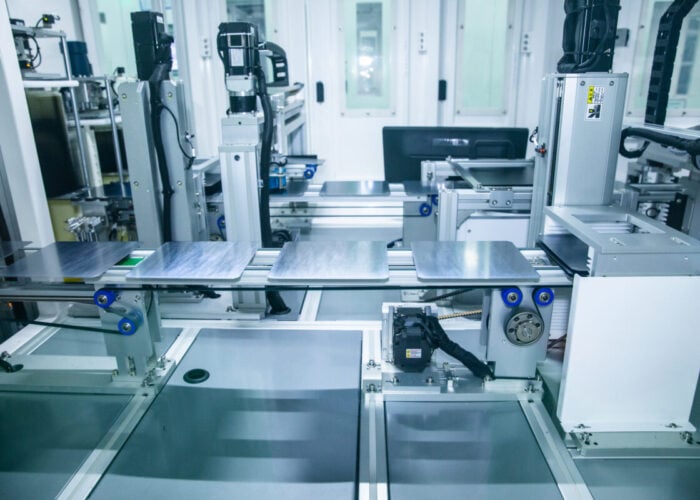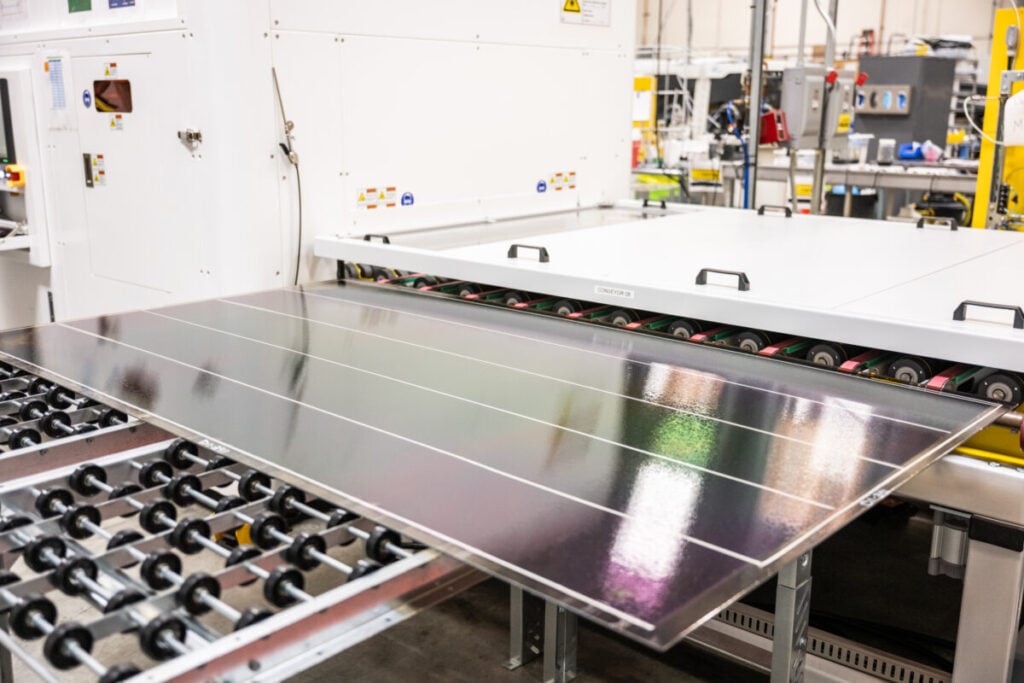
“We’re talking about a step change in module performance without compromising lifetime,” claims Scott Graybeal, chief executive officer of Caelux. The company produces perovskite solar products that are incorporated into solar module glass; a unique approach that allows their technology to fit into existing module supply lines, rather than requiring entirely new production processes to incorporate perovskite thin-film layers directly into a solar cell.
Graybeal is confident that his company’s tech will be part of a fundamental shift in solar technology over the coming years, with perovskite-tandem products being adopted in various forms across the industry. “Every module in the world in the 2030s will have perovskite,” he tells us. A bold prediction, given that so far perovskites have made it into almost no commercially available solar panels because the material is too volatile to sustain years of outdoor use. It can degrade, lose performance and become an unviable prospect for project owners and investors.
Try Premium for just $1
- Full premium access for the first month at only $1
- Converts to an annual rate after 30 days unless cancelled
- Cancel anytime during the trial period
Premium Benefits
- Expert industry analysis and interviews
- Digital access to PV Tech Power journal
- Exclusive event discounts
Or get the full Premium subscription right away
Or continue reading this article for free
We spoke with Graybeal, who is appearing at the PV CellTech USA 2026 conference in San Francisco this October, about Caelux’s technology offering, the company’s recent deals with Indian solar manufacturers and the potential impact of perovskite technology.
‘We want to be viewed as an enabler’
Graybeal’s company offers a different technological solution to perovskite PV than most. Many firms researching or producing perovskite-silicon tandem products focus on a tandem cell, where perovskite films are laid directly on top of silicon base cells and sealed within glass. There are variations within this approach, with two- or four-terminal options and different silicon cell technologies, but the focus remains on building the cell itself.
Caelux puts perovskite material onto the solar glass directly, leaving the silicon cell within the module untouched. The reasons for pursuing this approach are both technical and financial, Graybeal explains.
First, it means Caelux does not have to establish module manufacturing lines or expertise. “One of the metrics we drive the business towards is the return on invested capital,” he says, “And for us, building out a module line to complement what we’re doing here and going to market with new modules did two things. One, it really extended the horizon where we could see revenue. It also increased the costs to the extent that our return on our capital investments…[would] probably never achieve the kinds of levels that we want.”
‘Traditional’ perovskite architecture, with the different materials both within the cell, can offer higher total efficiencies than Caelux’s glass solution, Graybeal admits. “There’s one less layer [in those products] of the transparent conductive oxide than [Caelux] needs, because in our device you need to be able to shine light all the way through it to reach the silicon; in their case it goes through the perovskite, you don’t need an intermediate conductor.”
However, he also claims that if perovskite degrades in a traditional format, the whole product can be compromised, whereas the separation between the perovskite and the silicon in Caelux’s product means the underlying cell can still function.
Graybeal says that the company’s decision to “laser focus” on the perovskite material on solar glass and forego the other aspects of panel making means it has “developed expertise… and then [can] work with folks that make modules day in and day out, harness their knowledge, and use our technology to make their product better.”
He also claims that asset owners value this approach, as it provides “supply chain flexibility, insofar as they’ve got multiple module producers [to choose from].” He even claims that Caelux’s technology has been singled out as “part of a selection decision a couple of years down the road”.
“That’s that’s a good thing,” he continues. “We want to be viewed as an enabler of all these various module players to go and really get to that next level of performance. And so, what we’re talking about is this step change in module performance without compromising lifetime.”

‘There’ll be even more coming down the pipe in India’
This is the approach the company has brought to its recent deals with Rayzon Solar and Navitas Solar in India. Last month, the company announced two 5GW “commercialisation” deals with the two firms, where it will aim to integrate its perovskite glass with the module manufacturers’ n-type TOPCon modules over a five-year partnership.
India is a “key strategic market” for Caelux, Graybeal says. He says the company targets places that “are encouraging regional manufacturing”, and policies like India’s Approved List of Models and Manufacturers (ALMM) and Production Linked Incentive (PLI) fit the bill.
“There’ll be even more coming down the pipe in India as they look to really build out a very comprehensive domestic business, and we want to be a part of that,” he says.
The goal with the Rayzon and Navitas deals is to “build a backlog of business” that will one day justify an investment or co-investment in an Indian manufacturing facility. The partnerships are both aiming to begin producing TOPCon modules with perovskite glass in 2028-29, “which gives us enough time to do everything we need to do to either build a new site or take on a brownfield site that meet our needs,” Graybeal says.
“We’re very proud of the deals with Navitas and Rayzon, and there will be more,” he tells us. Alongside expanding industrial solar manufacturing capacity, Graybeal says that the ecosystem of R&D and cutting-edge technology is growing in India too, despite most of the industry’s technological focus being in the EU, US and China. Indian companies have linked up with European institutes like ISC Konstanz and Fraunhofer ISE, for example.
But while Caelux will expand in India and plans to bring some R&D staff over there, its model focuses on developing processes at its headquarters in Baldwin Park, California and copying those exactly at “satellite” manufacturing locations.
As such, Graybeal confirms to us that Caelux’s first manufacturing location will be in the US, with India likely to host the second.
‘This is a massive improvement’
Graybeal has been in the solar module technology business for 19 years, and sees the coming generation of technology as a “step change.”
We used to grind a 10th of a percent, two tenths of a percent…a half percent would be a huge, huge innovation,” Graybeal says. “This technology is five to six to seven percent absolute efficiency improvement.
“So if you’ve got a 21% [efficiency] PERC device today, with our technology that’s going to be somewhere in the neighbourhood of 26,27,28%. So that’s a big leap forward, and in terms of economics, this is a massive improvement in project IRRs,” he says.
Graybeal believes that every module in the 2030s will contain perovskite. Largely because there “isn’t a path for silicon to have a significant boost in its output,” and the growing demand from electrification across the world will call for more efficient solar installations.
This is impressive on paper, but perovskites have been found wanting when it comes to durability outside of the laboratory. The material degrades very quickly, losing its effectiveness at converting light into electricity and impacting the bottom line for solar projects. Caelux may hold the solution, as may a firm like Oxford PV which claims to have sold its first commercially viable perovskite-tandem modules to a US buyer, but the 25- to 30-year expected lifetimes of modern solar modules have not conclusively been proven possible with perovskite.
“I think there tends to be a pretty broad brush painted over the industry, that ‘perovskites are X’,” he says. “I think that’s like saying a Bentley and a Toyota Camry are both cars.
“We’ve done a lot with the fundamentals of the chemistry, whether it’s through additives, different structures or different process techniques, which has enabled us to really achieve the durability results that we have been able to talk to people about,” he continues. He claims that the company is “already in the process of qualification and certification of the technology,” and that its tech today can “support 25-year ‘lifetimes’”. By way of an anecdote, he says that Caelux has deployed its perovskite material outdoors and has “not observed any degradation” over six weeks.
At its root, Graybeal seems to suggest that Caelux’s difference is its focus on the bottom line and the end use case for perovskite. “You’ve got to understand the problem you’re trying to solve. And for us, it’s about economic generation. That’s it. How do we make this cost-effective, and how do we just make it better?”
Innovations in US solar manufacturing will be explored in detail at our annual PV CellTech USA conference in San Francisco on 13-14 October 2026. For full agenda and booking details, click the link above.