Certain defects in silicon solar cells appear to improve their performance, according to research by scientists at the US government's National Renewable Energy Laboratory.
Published yesterday in a paper for Applied Physics Letters as part of a research programme funded by the Department of Energy’s SunShot Initiative, the findings run counter to conventional wisdom, according to NREL lead researcher Paul Stradins.
Try Premium for just $1
- Full premium access for the first month at only $1
- Converts to an annual rate after 30 days unless cancelled
- Cancel anytime during the trial period
Premium Benefits
- Expert industry analysis and interviews
- Digital access to PV Tech Power journal
- Exclusive event discounts
Or get the full Premium subscription right away
Or continue reading this article for free
So-called deep-level defects in silicon solar cells are generally regarded as undesirable because they can recombine charge carriers, decreasing the efficiency of the device.
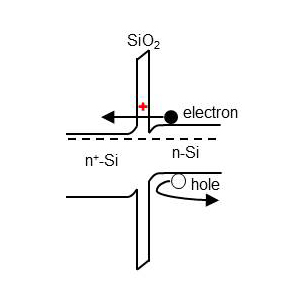
But the NREL research has revealed that defects with deliberately engineered properties can in fact enhance carrier collection out of the cell or improve surface passivation of the absorber layer.
The NREL team ran a number of simulations on the lab’s supercomputer to add impurities to layers adjacent to the silicon wafer in a solar cell. Specifically, they introduced defects within the thin tunnelling silicon dioxide layer, which forms part of the passivated contact for carrier collection, and within the aluminium dioxide surface passivation layer next to the silicon cell wafer.
In both cases, defects with specific energy levels were identified to be beneficial by enhancing the transport of the majority carriers through the cell and/or repelling minority carriers, which could improve overall efficiency, according to the study.
The NREL simulations removed certain atoms from the oxide layers to adjacent to the silicon wafer, replacing them with an atom from a different element, thus creating a virtual “defect”. For example, when an oxygen atom was replaced by a flourine atom it resulted in a defect that could potentially promote electron collection.
NREL said finding the right defect was key to the process and that further research was needed to determine which defects would produce the best results.
The programme is part of a research effort being jointly undertaken by NREL, Fraunhofer ISE and the Georgia Institute of Technology under SunShot to develop a record efficiency solar cell.
SunShot’s overall aim is to support innovation that helps drive down the cost of solar.