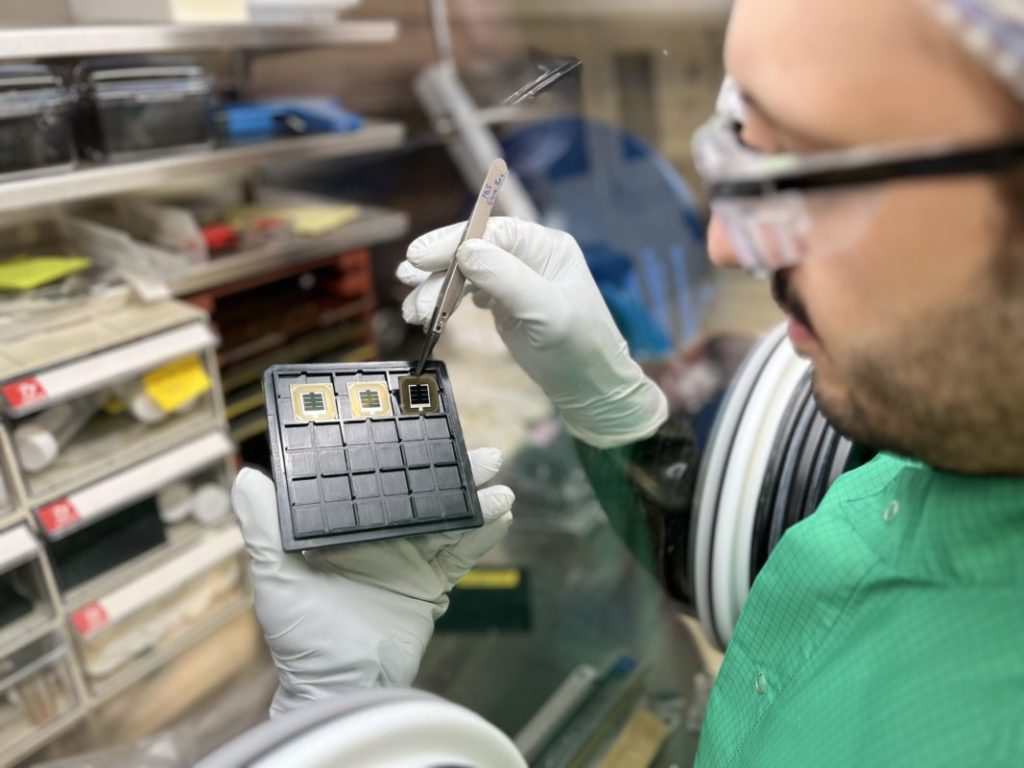
A study from researchers at the King Abdullah University of Science and Technology (KAUST) in Saudi Arabia has shown that the use of a synthetic molecule in the design of a perovskite solar cell can boost its energy efficiency and longevity.
Known as CPMAC (phenylmethanaminium chloride), the molecule improved the energy efficiency of perovskite solar cells by 0.6%, compared to solar cells built with C₆₀, a black solid made of carbon atoms of which perovskite solar cells are typically made. CPMAC is an abbreviation for an ionic salt synthesised from buckminsterfullerene, another name for C₆₀.
Try Premium for just $1
- Full premium access for the first month at only $1
- Converts to an annual rate after 30 days unless cancelled
- Cancel anytime during the trial period
Premium Benefits
- Expert industry analysis and interviews
- Digital access to PV Tech Power journal
- Exclusive event discounts
Or get the full Premium subscription right away
Or continue reading this article for free
Despite being used more commonly, C₆₀ limits the performance and stability of the solar cells, said the researchers. Another difference, according to the researchers, is when CPMAP and C₆₀ cells were exposed to hot temperatures at different humidities for more than 2,000 hours, the CPMAP solar cells showed a drop in power conversion efficiency that was one-third the size of the decline seen in C₆₀ cells.
According to the researchers, the difference between the two types was more apparent when assembling them into modules consisting of four solar cells, with CPMAC reducing defects in the electron transfer layer by creating ionic bonds with the perovskite rather than the weaker van der Waals bonds made with C60.
“For over a decade, C₆₀ has been an integral component in the development of perovskite solar cells. However, weak interactions at the perovskite/C₆₀ interface lead to mechanical degradation that compromises long-term solar cell stability,” said Professor Osman Bakr, executive faculty of the KAUST Center of Excellence for Renewable Energy and Sustainable Technologies (CREST), who led the KAUST contributions to the research.
“To address this limitation, we designed a C₆₀-derived ionic salt, CPMAC, to significantly enhance the stability of the perovskite solar cells,”
The study was published in the Science publication, and can be accessed here.