Optimising existing grid capacity, rather than building the vast network of transmission infrastructure required to bring online the sheer capacity of renewable energy to meet Europe’s energy transition goals, could be the most viable solution to Europe’s long-standing grid capacity challenges.
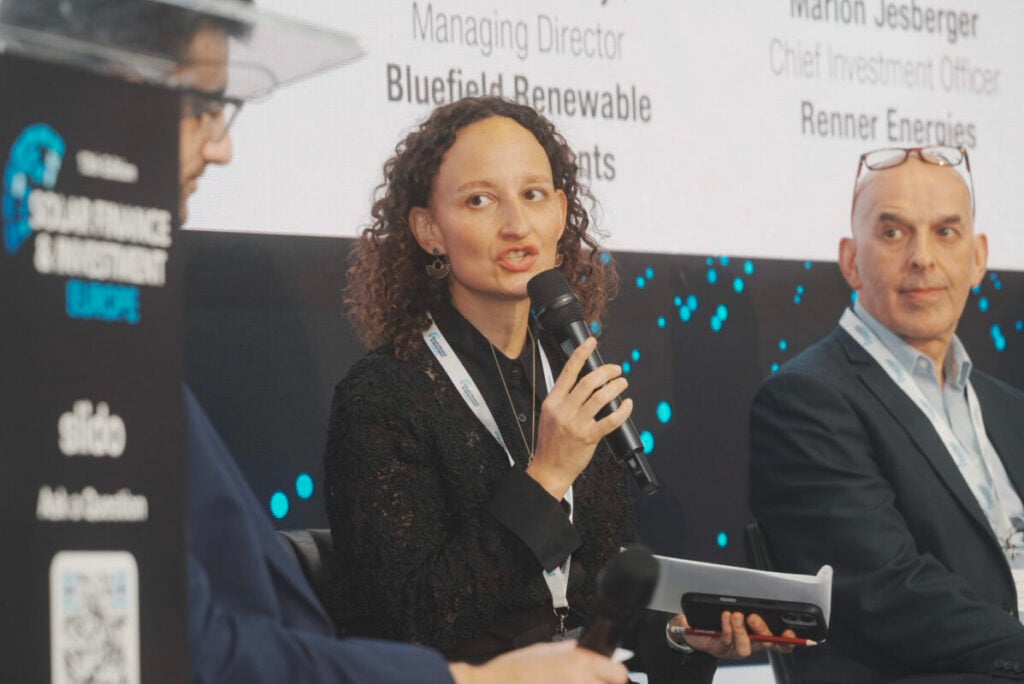
These were the opinions of speakers at a panel this afternoon at the Solar Finance & Investment Europe event, hosted in London by Solar Media.
Try Premium for just $1
- Full premium access for the first month at only $1
- Converts to an annual rate after 30 days unless cancelled
- Cancel anytime during the trial period
Premium Benefits
- Expert industry analysis and interviews
- Digital access to PV Tech Power journal
- Exclusive event discounts
Or get the full Premium subscription right away
Or continue reading this article for free
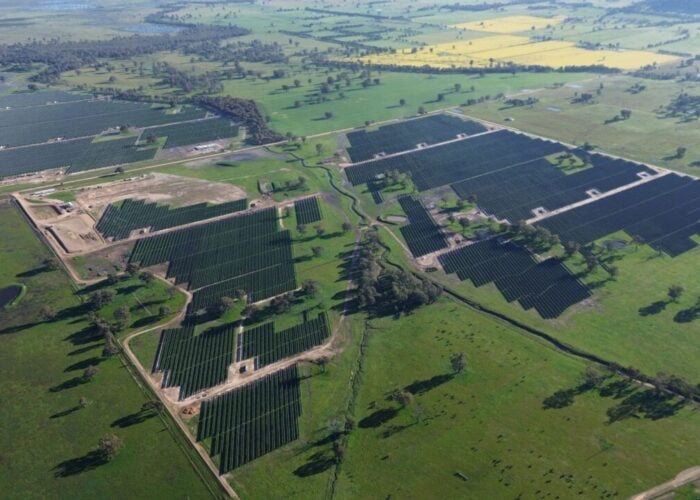
“To give you an example, in the UK, we started developing what we called ‘green energy hubs’, and the idea was to combine different technologies that have different production profiles with one grid connection, so you can optimise how you use the connection,” explained Johana Afenjar, COO at Telis Energy, who acknowledged that the combination of multiple technology types at a single grid connection point is not a novel approach, but one that can be highly effective.
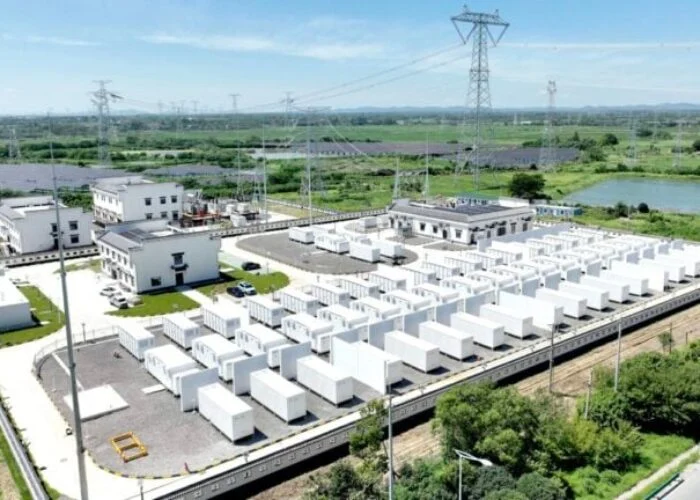
“If you have just a PV project, it will be using the connection for 20% of the time, if you’re lucky, and the rest of the time, the grid connection is not used,” she continued. “If you come back with battery storage and wind, you create a hub of generation and load shifting that helps minimise the grid usage, so that’s one thing that we did from the beginning in the UK.”
Solutions such as these are a more elegant solution to the grid connection issue, where the sheer scale of projects across Europe awaiting grid connections means that simply adding more transmission infrastructure is prohibitively expensive.
Giorgos Antoniou, a climate transition analyst at IIGCC who moderated the panel, said that there are around 1.7TW of power generation capacity awaiting grid connection in Europe, roughly twice the installed generation capacity in operation at the moment, and simply providing capacity for this pipeline of projects was said to be thought to cost €585 billion earlier during the summit.
Meanwhile, Marion Jesberger, CIO at Renner Energies, suggested that expanding and updating the grid to the point where it is more useful is inevitable, but that the next few years would prove challenging for developers.
“We all know that the grid investment will happen—we talked about the data centres and the energy demand—just not right now, while we have the need. The situation is we need to cover these three, five or seven years, or whatever it takes, for the grid to be able to accommodate the increase in demand, and to accommodate the additional supply,” said Jesberger.

“This is where a mixed solution, like hybridisation and trying to optimise the use of the grid, is key,” she added.
Building strong relationships
Jesberger also said that actors in some parts of Europe could learn from the experiences of those in other regions, naming Spain as a country that is “quite far ahead” in its renewable energy transition, and that has already grappled with issues such as curtailment and negative pricing, which could be instructive for grid operators in other countries.
The panellists, one of the last groups to speak over the two-day summit, echoed many of the sentiments expressed at one of the summit’s first panels, also on grids, that greater integration and collaboration of different decision-makers is key. Jesberger suggested this collaboration could extend across national boundaries, while Jonathan Selwyn, managing director at Bluefield Renewable Developments, suggested that a better working relationship between developers and DNOs and TSOs could be key.
“Grid operators are so focused on trying to solve this [capacity] issue and get to the end of the grid reform process, but have created other options,” said Selwyn.
“[Other DNOs] realised, finally, that we can help them solve some of their problems. If they enable us—and despite the regulations that stop us from doing so—to talk to each other [and about] the capital investments we can make together, we’re starting to see that that might be possible coming out of the grid reform process.”
PV Tech publisher Solar Media hosted the 13th edition of the Solar Finance & Investment Europe event in London this week, on 3 – 4 February 2026. This event annually attracts infrastructure funds, institutional investors, asset managers, banks and development platforms at the forefront of European renewables. To read all of our coverage of the summit, please visit PV Tech.