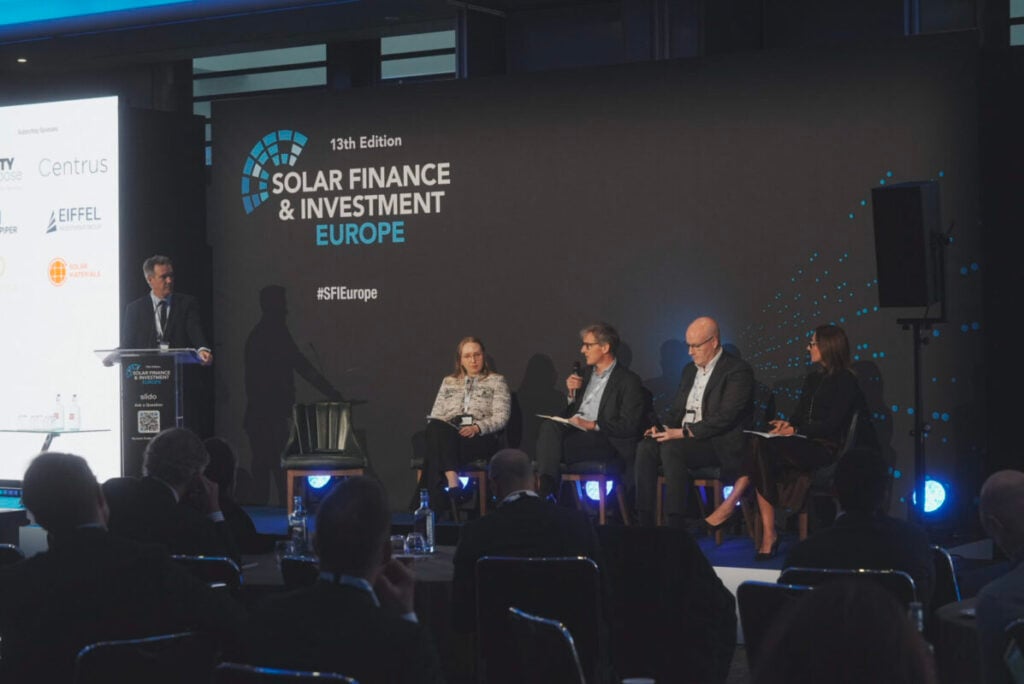
Integrating more private investment into Europe’s grid infrastructure will be a necessity if Europe is to meet its clean energy goals, according to speakers at this morning’s Solar Finance & Investment Europe event in London.
Speaking on a panel discussing grid investment, Larisa Bagyinka, vice president at I Squared Capital, said that hundreds of billions of Euros of investment will be required to meet the goals of the energy transition.
Try Premium for just $1
- Full premium access for the first month at only $1
- Converts to an annual rate after 30 days unless cancelled
- Cancel anytime during the trial period
Premium Benefits
- Expert industry analysis and interviews
- Digital access to PV Tech Power journal
- Exclusive event discounts
Or get the full Premium subscription right away
Or continue reading this article for free
“The European Commission has flagged that around €585bn is needed to invest in the European grid in the next five years,” she said. “There’s a bit of contradictory information in the market, but the scale needed is clear.”
Charles Lesser, partner at the energy and sustainability team at Opus Corporate Finance LLP, said that the sheer scale of money needed demonstrates the “undoubted need for private capital to step in and provide the solutions” to a lack of grid availability.
Panelists argued that private financing can be more flexible than state funds. For example, Lisa McDermott, managing director for project finance at ABN AMRO Bank N.V., argued that the priority should be avoiding investment in new grid construction in the first place, and maximising “the grid that we currently have”.
“There’s lot of the grid not being used—it sits idle most of the year—so technologies such as Smart Wires [which] puts modules on parts of the grids that push electricity down underused wires, is genius. Why are we not investing large-scale in this?”
Combining private and public investment
However, simply opening up more of Europe’s grids to potential private investors is not a straightforward process. McDermott used the example of the Netherlands, where rules concerning grid activity and ownership—such as a requirement for a transmission business to be completely separate from a generation business—have proven to be “quite a deterrent for investment”.
Justin FitzHugh, group CFO at Telis Energy, goes further and said that private investment “really doesn’t belong” in instances where the money is subject to a conflict of interest, or the investment presents a security risk.

“There are a few TSOs in Europe with fundamentally Chinese state money in them, and that’s starting to create more issues than at the time where those investments were made,” explained FitzHugh.
Several panellists, however, suggested that a combination of private and public investment, or at least private investment through more sophisticated public mechanisms such as auctions, could be the most effective answer. “Private capital needs to work together with the state,” said Bagyinka. “Where private capital is very good is managing operational risk, what we’re struggling more with is political risk and regulatory risk, and that’s where the state can come in to help.
“Pure private would make investment too expensive, but pure public would include more risk along delivery timelines, as we know the governments are slower and there would be less discipline around cost management,” she explained.
Indeed, Lesser noted that there is “method” behind the idea of leaving grids as the purview of government investment, but that this “stretches state balance sheets”, suggesting that private support for state investments could help provide the sheer scale of capital needed to effectively expand Europe’s grids.
“For investors like us, we’ve come from wind and solar and done 4GW [of capacity] with that, and it’s all about where we can get win-wins on the grid side to get a better risk-adjusted return for our portfolio,” said Anthony Doherty, CIO at NTR plc. “We’re a sustainability infrastructure investor, but we’re chasing some [cap and floor] investments.”
PV Tech publisher Solar Media is hosting the 13th edition of the Solar Finance & Investment Europe event in London this week, on 3 – 4 February 2026. This event annually attracts infrastructure funds, institutional investors, asset managers, banks and development platforms at the forefront of European renewables. For more details, visit the website.