Energy think tank Ember has published a report into grid connectivity in Europe, and called on the continent’s transmission system operators to build grid infrastructure faster to meet Europe’s clean energy goals.
The report, ‘Breaking borders: The future of Europe’s electricity is in interconnectors’, argues that while the European grid is the world’s largest such network, with more than 400 interconnectors bringing power to close to 600 million people, transmission system operators will need to double the continent’s current interconnection capacity over the next ten to 15 years to meet clean energy targets.
Try Premium for just $1
- Full premium access for the first month at only $1
- Converts to an annual rate after 30 days unless cancelled
- Cancel anytime during the trial period
Premium Benefits
- Expert industry analysis and interviews
- Digital access to PV Tech Power journal
- Exclusive event discounts
Or get the full Premium subscription right away
Or continue reading this article for free
Specifically, the group is calling for better installation of grid infrastructure to meet its models of a “least-cost power system”, which it announced in June 2022. These models suggest that between 70% and 80% of Europe’s power will need to come from wind and solar sources by 2035, to enable the continent to be net zero by 2050, and considerably more grid infrastructure will be required to meet these goals.
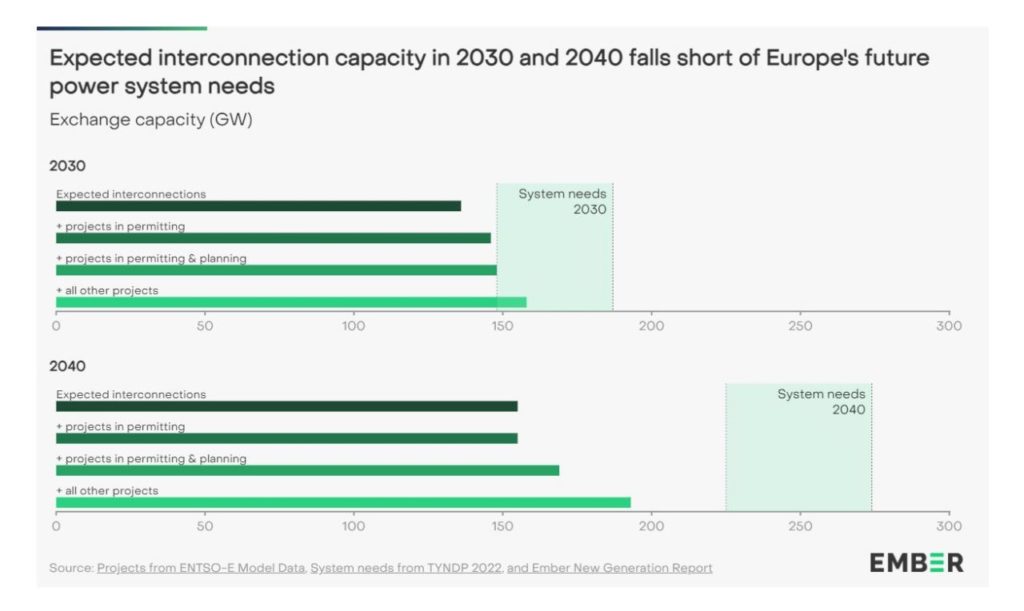
Ember’s latest report notes that, by 2040, Europe will need between 225GW and 274GW of grid connection capacity, much higher than the current projected capacity of 155GW, which takes into account existing grid infrastructure and projects planned to be completed in the next few decades.
While the researchers note that the continent could reach its 2030 grid capacity target of between 148GW and 187GW, as the current forecast capacity of 136GW will be buoyed by an additional 22GW of interconnectors planned that were not included in the original figures, the rate of progress will need to improve to meet the more long-term goal.
“By allowing electricity to move across borders in a matter of minutes, interconnection creates a more flexible system that can balance geographic variations in wind and solar generation, minimising output fluctuations and curtailment” explained the report’s author, energy and climate data analyst Elisabeth Cremona, in the document, drawing attention to how better grid infrastructure could help balance some of the inherent instability in solar power generation.
Solar, in particular, could benefit from greater grid investment, as the power source looks set to feature prominently in many clean energy forecasts. In 2022, the European Network of Transmission System Operators for Electricity (ENTSO-E) published its ten-year network development plan, which looked at how specific renewable power sources could contribute to a new European energy grid.
The group’s conclusions broadly align with those of Ember, estimating that 95% Europe’s power will come from renewable sources by 2040, but noted that the solar sector has a much broader range of outcomes than energy sources such as wind. The group’s “scenario differentiation” model, the range of outcomes for a number of power sources in Europe’s energy mix, suggests that the capacity of solar production in Europe could vary by up to as much as 50%, compared to 20% for onshore wind and 10% for offshore wind.
As a result, investing in solar power generation specifically could yield the most dramatic changes for Europe’s energy infrastructure, provided its grid can be expanded to meet the growing demand for power.
“This will be essential to integrate the variable output of wind and solar in a cost-effective way,” added Cremona. “By offering more opportunities for this electricity to be used, cross-border exchange can halve the curtailment of cheap, clean power.
“A better-connected Europe also allows wind and solar to exploit optimal locations, unlocking greater renewable potentials and increasing their generation efficiency. This reduces the costs and capacities required for decarbonisation.”