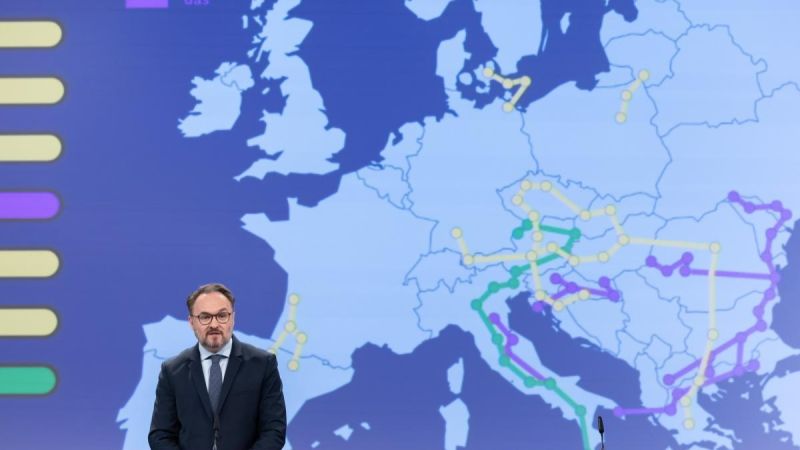
The European Commission has proposed a new two-pronged approach to improving Europe’s energy infrastructure, which will aim to accelerate and increase the transparency of the grid permitting process, and establish eight new ‘energy highways’ to deliver transmission capacity to areas of “strategic importance” to the EU.
The first part of this proposal—the ‘European Grids Package’—will see reforms made to the Trans-European Networks for Energy (TEN-E) initiative, introduced in 2013 to improve grid connections across Europe, and particularly between the grids of individual member states.
Try Premium for just $1
- Full premium access for the first month at only $1
- Converts to an annual rate after 30 days unless cancelled
- Cancel anytime during the trial period
Premium Benefits
- Expert industry analysis and interviews
- Digital access to PV Tech Power journal
- Exclusive event discounts
Or get the full Premium subscription right away
Or continue reading this article for free
The package includes what the Commission calls a “gap filling process” where the Commission can identify and address gaps in cross-border electricity transmission that have not yet been plugged by “suitable project proposals”. This is particularly important for the Commission as, according to the body, national regulators “do not have the power to deal with cross-border infrastructure planning”.
The Commission also noted a “substantial gap” between the current state of cross-border transmission infrastructure and the pace of future developments to ensure energy security across the bloc. The Commission notes that Europe is currently on pace to have 41GW of cross-border electricity transmission capacity in place by 2030, less than half of an 88GW target put in place; this target increases to 108GW by the end of 2040.
The Grids Package will also emphasise public participation in project planning, another area that the EU is uniquely positioned to oversee, as these grid projects will affect people across national borders. The Commission has proposed that new renewable energy projects larger than 10MW would “share benefits with the local population”, and it would work to ensure “fair cost-sharing” between groups involved in energy generation and transmission projects, but did not provide further details on these processes.
Similarly, the Commission announced plans to “provide more transparency and predictability in the way costs and benefits are assessed and shared” for these cross-border projects, but did not provide further details on how it would go about doing this beyond a general commitment to establish “EU-wide principles for a fair and predictable cross-border cost-allocation process”.
Tackling interconnection inefficiencies
The Commission acknowledged that developing a robust cross-border grid, and one that emphasises renewable energy and battery energy storage systems (BESS), is integral to ensuring Europe’s energy security following considerable criticism of its existing grid infrastructure.
The EU has already set a 15% interconnection target by 2030 for its member states, but noted this week that “several” countries are not on track to meet this target. The Commission described the potential cost of inaction, and thus reliance on imported fuels, particularly oil and gas, as “staggering”; in 2022, 98% of all oil and gas used by EU member states was imported from outside the bloc.
The Commission also noted that industrial electricity prices in Europe in 2024 were more than double that of China and the US – €0.199/kWh (US$0.23/kWh) compared to €0.082/kWh and €0.075/kWh, respectively -, while the average electricity price for EU consumers was as high as €0.3835/kWh in Germany. The theory is that improving transmission infrastructure within the bloc would help reduce reliance on electricity imports from farther afield, and minimise some of the power price discrepancy between individual member states.
However, the Commission noted that upgrading Europe’s cross-border energy infrastructure would require a mammoth €1.2 trillion investment until 2040, making clear the scale of the challenge. However, it argued that greater cross-border energy resilience would lead to long-term financial benefits for the bloc. It noted that grid investment of €5 billion would reduce system costs by €8 billion, while “enhanced market integration” could generate annual cost savings of as much as €40 billion.
Commission proposes eight ‘energy highways’
The Commission also estimates that boosting cross-border electricity trade by 50% could increase annual GDP growth in the EU by around €18 billion by the end of the decade, and facilitating more cross-border transmission and trade is a key component of the ‘energy highways’ component of the Commission’s proposal.
The second part of the Commission’s proposal, and one that aims to expand cross-border transmission capacity in particular, takes the form of eight ‘energy highways’, in the following areas:
- The Iberian Peninsula, connecting Spain and Portugal to central Europe via the Pyrenees mountains.
- The Great Sea Interconnector, connecting Cyprus and continental Europe.
- The Harmony Link, connecting the Baltic States to one another.
- The TransBalkan Pipeline (TBP), a reverse gas flow to improve energy resiliency in the Balkans.
- Bornhold Energy Island, a structure to turn the Baltic Sea into an “offshore interconnector hub”.
- South-East Europe, which will aim to improve price stability and energy security in southeastern Europe through grid investments and storage.
- The SouthH2 Corridor, which will deliver hydrogen between Tunisia, Italy, Austria and Germany.
- The Southwest hydrogen corridor, which will deliver hydrogen between Portugal and Germany.
These eight highways are all considered Projects of Common Interest (PCIs) and Projects of Mutual Interest (PMIs) under the TEN-E framework, and will help shore up energy supply, and the transmission of green hydrogen, in parts of the bloc where such investments have been lacking or, in the case of the Baltic States, require additional urgency considering the recent actions of Russia and the decoupling of the Baltic grid from Russia’s in February.
Both the grids package and the eight highways were introduced by President Ursula von der Leyen yesterday, in her 2025 State of the Union address, and the proposal will now pass to the European Parliament and Council to consider the terms, but the Commission has not yet published a timeline for the next steps.
SolarPower Europe says the proposal ‘hits the nail on the head’
“The European Grids Package is more than just a policy,” said Teresa Ribera, EU executive vice president for clean, just and competitive transition. “It’s our commitment for an inclusive future, where every part of Europe reaps the benefits of the energy revolution: cheaper clean energy, reduced dependence on imported fossil fuels, secure supply and protection against price shocks.”
“A truly interconnected and integrated energy system is the foundation of a strong and independent Europe,” added Dan Jørgensen, EU commissioner for energy and housing. “This is exactly what we are proposing today: a common European energy project that supports affordable living, economic competitiveness, security and decarbonisation.”
The proposal also drew support from outside of the Commission itself; leading trade body SolarPower Europe said that the proposed “grid connection guidance” would help solar and storage project developers, in particular, connect projects to Europe’s growing grids.
“The Grid Connection Guidance is the highlight of the package, it hits the nail on the head,” said SolarPower Europe CEO Walburga Hemetsberger. “This publication will help Europe to make better use of the grid hardware that we have.”
However, Hemetsberger noted that the proposals lack a “vital spotlight on distribution system operators”, and that these stakeholders will need to be better compensated for integrating flexible generation technologies, such as solar, into their operations, rather than having to rely on expensive and time-consuming grid expansion work.
Other criticism includes the suggestion that the proposals look to ensure the position of “industry incumbents” rather than deliver benefits for European citizens.
“The Grids Package takes some welcome steps to address lengthy connection queues; but does not address deeper governance challenges over the planning and operation of electricity grids in the EU,” said Juliet Philipps, an energy campaigner at German non-profit Beyond Fossil Fuels. “Without tackling these issues, we risk investing in a system designed to favour industry incumbents—rather than serve the public interest.”
“Europe risks trapping itself in a self-fulfilling prophecy, where fossil gas appears ‘necessary’ simply because clean alternatives were never properly planned for,” Philipps continued. “We urge member states and MEPs to support stronger oversight measures to ensure national grid planning and investments are designed to secure homegrown renewable energy and storage projects that can rapidly displace risky and expensive fossil gas imports.”
PV Tech publisher Solar Media will host the 13th edition of the Solar Finance & Investment Europe event in London on 3 – 4 February 2026. This event annually attracts infrastructure funds, institutional investors, asset managers, banks and development platforms at the forefront of European renewables. For more details, visit the website.