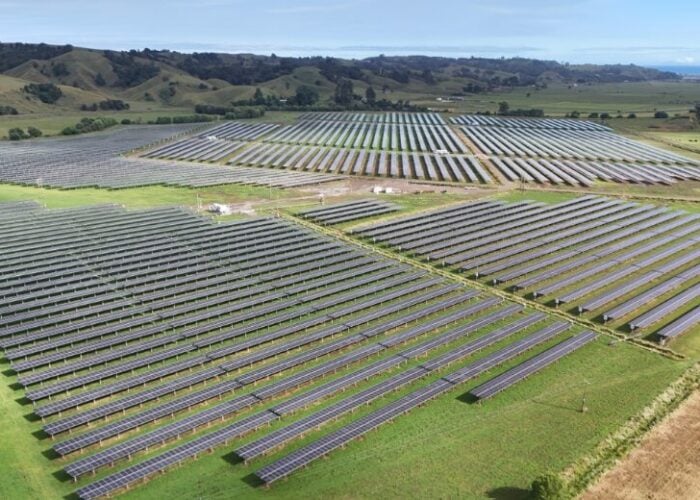
Italy’s renewable energy sector received a major boost earlier this month after the European Commission approved the country’s €23 billion ($26.5 billion) FER X support scheme, a measure expected to unlock more than 37.15GW of new renewable energy capacity by 2028.
The programme, which will support solar PV, onshore wind, hydropower and sewage gas projects through 20-year contracts for difference (CfDs), is central to Italy’s efforts to meet its 2030 renewable energy targets and reduce dependence on imported energy.
Try Premium for just $1
- Full premium access for the first month at only $1
- Converts to an annual rate after 30 days unless cancelled
- Cancel anytime during the trial period
Premium Benefits
- Expert industry analysis and interviews
- Digital access to PV Tech Power journal
- Exclusive event discounts
Or get the full Premium subscription right away
Or continue reading this article for free
The approval comes at a critical moment for the Italian market. While the country added a record 7.2GW of renewable capacity in 2025, it remains below the annual deployment rate of nearly 10GW required to reach its target of around 130GW of installed renewable capacity by the end of the decade.
Early 2026 figures also suggest momentum remains uneven, with solar installations slowing in both the residential and utility-scale segments.
Speaking to PV Tech Premium, Patrizio Donati, co-founder and director at Terrawat, discusses the significance of the scheme for developers, the opportunities it creates for Italy’s solar sector, and whether the country’s current deployment trajectory is sufficient to meet its ambitious energy transition goals.
“In essence, it’s a CfD mechanism,” Donati says. “That is significant in the sense that there aren’t really any other kind of long-term supports available in Italy. This gives a lot of security to energy producers. Power prices can be quite volatile, as we’ve seen.”
Under the scheme, developers receive payments when market prices fall below an agreed strike price and return revenues when prices exceed that level.
That volatility has become increasingly apparent in recent years, with European energy markets exposed to geopolitical events ranging from Russia’s invasion of Ukraine to ongoing tensions in the Middle East.
While policymakers ultimately want to bring wholesale electricity prices down, Donati argues that sudden price swings in either direction create challenges for investors and project developers alike.
A support scheme cannot solve ‘systemic problems’
Despite the scale of the FER X programme, Donati is sceptical that Italy can achieve its current 2030 renewable energy targets.
The country aims to reach around 130GW of installed renewable energy capacity by 2030. By the end of 2025, Italy had approximately 83.5GW installed, leaving a substantial deployment gap.
Italy added around 7.2GW of renewable capacity during 2025, but industry estimates suggest annual additions closer to 10GW are required throughout the remainder of the decade.
“I think the 2030 targets as stated are fairly out of reach,” Donati says. According to him, Italy has consistently failed to achieve the annual installation rates required to remain on track.
“The reality is that we’ve never achieved the annual level of installations needed to hit the 2030 targets. At this point, the 2030 targets are quite firmly out of reach unless something systemic changes not on the support scheme side, but on the permitting side,” he emphasises.
The introduction of revenue support may improve investor confidence, but projects still need to navigate a highly fragmented permitting system before reaching construction.
However, Donati argues that the support scheme is a “boon for investors.”
“We might not hit the targets, but we’re going to have to get these projects online at some point and having revenue certainty is a great boon to investors who obviously are the main engine behind getting these projects developed and built on the ground.”
Italy’s permitting maze
For Donati, permitting remains the single most important issue affecting renewable deployment in Italy. The challenge stems partly from the interaction between national and regional authorities. Different regions operate under different rules, creating uncertainty for developers attempting to build projects across multiple jurisdictions.
“Permitting in Italy is incredibly complicated,” he says. “There are so many moving parts. There are so many different layers of regulation. We have national level rules and then we have regional rules and a lot of the times you’ll have regional rules that are in contrast with national rules.”
This results in prolonged development timelines, even for relatively straightforward projects. According to Donati, government intervention could have the greatest impact by simplifying and accelerating project approvals rather than introducing additional support mechanisms.
“The main way that the government can play [is] where and how quickly these projects can be permitted,” he says.
Grid connections remain a growing bottleneck
Alongside permitting, grid access continues to constrain deployment. Italy’s transmission and distribution operators have increased investment in network upgrades, but connection timelines have lengthened as project pipelines expand.
“The grid is a big physical bottleneck,” says Donati. “The only way out for a grid is lots of investment and development.”

While upgrades are underway, developers continue to face significant delays.
“Projects are being upgraded to high-voltage transmission lines which improved the distribution networks. But it also means delays in connection—a few years ago it could take around 100 days for a project to be connected, now it can take up to two years.”
The importance of strike prices
As with any CfD mechanism, the success of FER X will ultimately depend on strike prices.
“The strike price is everything,” Donati emphasises. As support will be awarded through competitive auctions, developers face pressure to bid aggressively in order to secure contracts. Recent experiences in Italy’s battery storage auctions illustrate the risks associated with highly competitive tender processes.
Donati points to the MACSE storage auction, where winning prices came in lower than many market participants had expected. “What ended up happening was that, yes, some operators accepted the really low price, but others ended up giving up their bids.”
A similar outcome could emerge in renewable energy auctions if strike prices fall too far.
“If the strike price ends up too low, then operators are just going to kind of go and do the same,” Donati says.
However, he does not expect projects to disappear entirely. The question, he says, is less whether projects will be built and more how quickly they can be delivered and under what economic conditions.
NZIA requirements and supply chain choices
One of the more novel elements of FER X is the inclusion of requirements linked to the Net-Zero Industry Act (NZIA) for larger solar and wind projects. These criteria are designed to encourage supply chain diversification and reduce dependence on Chinese manufacturing, and Donati does not expect the measures to significantly disrupt the wider market.
“I don’t really see it too much as a concern because no one’s forcing you to participate in the NZIA auction,” Donati notes. Instead, he expects developers to make economic decisions based on auction outcomes and procurement strategies.
“The majority are going to kind of stick to the traditional guns. And then some will choose to experiment with the NZIA criteria.”
However, he argues that Europe cannot simultaneously seek greater energy independence while remaining dependent on imported renewable energy equipment.
“We can’t be talking about how it’s bad to have that type of exposure in your energy supply chain while then also going and buying all of our components for our energy from China.”
Although Europe is unlikely to close the manufacturing gap with China in time to influence deployment targets this decade, Donati believes investment in domestic production remains necessary.
“We have to start from somewhere.”
Revenue certainty versus deployment reality
FER X addresses one of the renewable sector’s most persistent concerns: long-term revenue visibility. For investors and lenders, 20-year government-backed contracts provide a level of certainty that private power purchase agreements often struggle to match.
Yet Donati repeatedly returns to the same conclusion: financing is no longer the primary obstacle. The greatest risk to FER X, he argues, is not investor appetite but project availability.
“I think the single greatest risk is the availability of projects. Permitting remains notoriously slow. The other issue is that there are many projects in the pipeline that I don’t think will ever see the light of day because there has been a lot of speculation in the market,” he argues.
“Many developers have grid connections or even approved project designs, but some of these projects aren’t really market-ready or economically viable. They may have worked under the market conditions of a few years ago, but they no longer make sense today. I think that’s the real challenge.”
Without faster permitting and continued grid upgrades, Italy risks falling behind its renewable energy targets. As Donati notes, the country may eventually deliver the required capacity, but not within the current timeline.
The success of FER X will therefore depend not only on improving project economics, but also on removing the bottlenecks that continue to delay deployment.