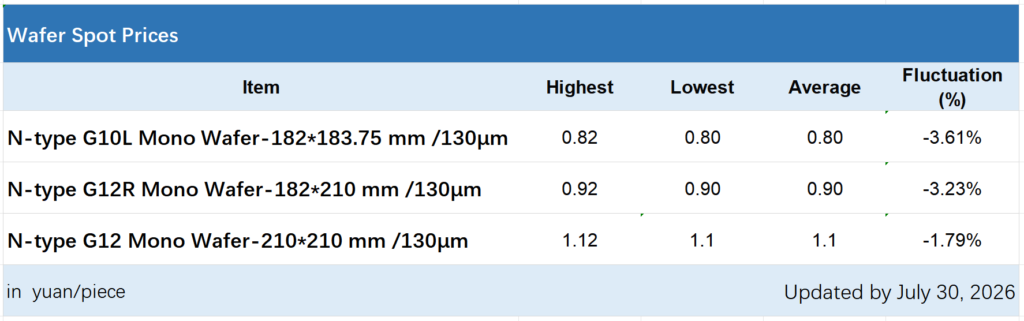
The Silicon Industry Branch, the Chinese upstream solar supply chain trade body, released its latest monocrystalline wafer pricing data on 30 July. Mainstream n-type wafer prices fell across the board this week, with the average price of n-type G10L monocrystalline wafers dropping 3.61% month-on-month, while cell and module prices declined in tandem.
Market data confirms the price of domestic mainstream n-type monocrystalline wafers extended its decline this week, dragging cell and module prices lower. The entire PV industrial chain is now caught in a synchronised price downturn. Persistent weak end-market demand, widening supply-demand imbalances and rising industry inventories remain the key factors weighing on wafer prices.
Try Premium for just $1
- Full premium access for the first month at only $1
- Converts to an annual rate after 30 days unless cancelled
- Cancel anytime during the trial period
Premium Benefits
- Expert industry analysis and interviews
- Digital access to PV Tech Power journal
- Exclusive event discounts
Or get the full Premium subscription right away
Or continue reading this article for free
By product segment, average transaction prices for all n-type wafer sizes declined month-on-month:
- N-type G10L monocrystalline wafers averaged RMB0.80/piece (US$0.12/piece), down 3.61% month-on-month—the sharpest drop among mainstream products.
- N-type G12R wafers averaged RMB0.90/piece, a 3.23% decline.
- N-type G12 wafers averaged RMB1.10/piece, edging down 1.79% month-on-month.
Downstream segments face parallel margin pressure, with cost pass-through risks rippling upstream. Mainstream cell transaction prices stand at RMB0.25–0.26/W, down 1.92% month-on-month, while standard module prices are at RMB0.67–0.68/W, a 1.46% monthly drop. The entire chain is gripped by soft demand and sliding prices.
Multiple bearish headwinds weigh on wafer market
The Silicon Industry Branch attributes the sustained wafer price slide to a fundamental supply-demand imbalance, with no visible signs of industry recovery.
Three core factors are driving the downturn: First, end-market demand has failed to rebound as projected, clogging price transmission along the value chain. Domestic PV installation rollouts and overseas project tender activity have both slowed. Downstream cell and module makers only restock minimally to fulfil existing contracts, with no large new procurement orders in sight. Sector-wide destocking lags behind output, and channel inventories keep building.
Second, ample supply persists, and production cuts have been too shallow to ease oversupply. While most producers trimmed operating rates in July, total output still outpaces downstream absorption. The top two tier-one wafer producers cut utilisation by 2% month-on-month, to 52% and 54% respectively. Vertically integrated manufacturers trimmed rates by 2% to 56–60%, while smaller peers cut by 4% to 50–78%. Industry-wide curtailments remain limited, leaving the supply glut unresolved.
Third, bearish sentiment has spread widely, prompting small and medium-sized manufacturers to offload inventory at discounts for cash flow relief. Market participants broadly expect wafer prices to keep falling, fuelling buyer wait-and-see sentiment. To ease capital and inventory strains, second- and third-tier suppliers slash spot offers voluntarily, dragging down average transaction prices and pulling prices across all categories lower in tandem.
Market outlook: prices near cost, short-term sentiment bearish
According to Silicon Industry Branch analysis, average transaction prices across all wafer formats have dipped below industry manufacturing costs, leaving limited room for further sharp declines. Still, a near-term rebound remains unlikely.
The sector’s supply-demand imbalance persists, weighed down by two key headwinds, which are high inventories and weak end-user demand. Without widespread, coordinated production cuts that meaningfully tighten supply, wafer prices will stay stuck in a prolonged soft patch. Profit recovery across the chain will have to wait for a pickup in terminal demand and full inventory digestion.