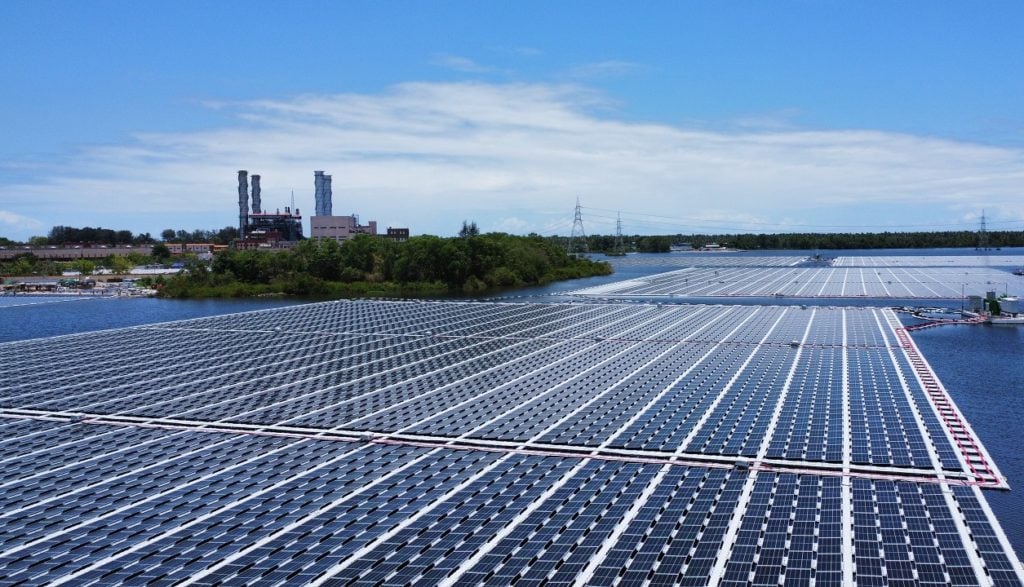
India’s Union Cabinet has approved a INR50.7 billion (US$531.7 million) scheme to deploy 5GW of floating solar PV with co-located battery energy storage systems (BESS) under the Pradhan Mantri Surya Sarovar Yojana (PM-SSY).
Chaired by Prime Minister Narendra Modi, the Cabinet approved the programme to deploy 5GW of floating solar PV with co-located energy storage systems providing a minimum of two hours’ storage, equivalent to 10GWh. Projects will be sanctioned between FY 2026-27 and FY 2030-31, with financial support continuing until FY 2032-33.
Try Premium for just $1
- Full premium access for the first month at only $1
- Converts to an annual rate after 30 days unless cancelled
- Cancel anytime during the trial period
Premium Benefits
- Expert industry analysis and interviews
- Digital access to PV Tech Power journal
- Exclusive event discounts
Or get the full Premium subscription right away
Or continue reading this article for free
Under the scheme, announced last Friday, developers of eligible projects will receive Central Financial Assistance (CFA) of INR10 million per MW following commissioning. An additional INR5 million per project will be available for feasibility studies covering bathymetry, hydrography, environmental assessments and other preparatory work aimed at de-risking projects.
The government said all States and Union Territories will be eligible under the programme.
The scheme is expected to increase India’s installed floating solar capacity from around 700MW to 5,700MW, while reducing annual carbon dioxide emissions by around 10 million tonnes. It also aims to support domestic manufacturing across the floating solar value chain, including floatation systems, PV cells, modules and energy storage systems.
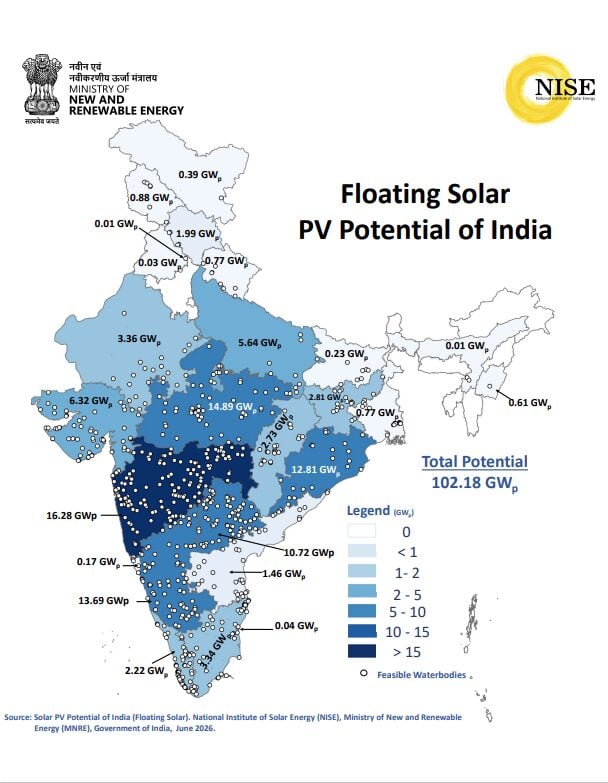
The approval follows a report by the National Institute of Solar Energy (NISE), which estimated India’s technical floating solar potential at 102.18GWp across reservoirs and other suitable inland water bodies.
Industry backs 5GW floating solar plan, calls for stronger grid infrastructure
Speaking exclusively to PV Tech Premium, Prabhakar Sharma, senior consultant at JMK Research, said the policy would position India among the world’s leading floating solar markets by increasing installed capacity more than eightfold over the next five years.
“This is undoubtedly a positive development and will position India among the leading floating solar markets globally, increasing installed capacity by more than eightfold. The policy’s clarity on the integration of BESS is also a commendable step.”
However, Sharma cautioned that grid infrastructure will need to keep pace with project deployment.
“Addressing transmission related constraints and facilitating transmission infrastructure development will be critical to the policy’s success, particularly for inland reservoirs located in remote areas, where inadequate grid connectivity could hinder project development through higher costs and longer implementation timelines.”
The inclusion of mandatory storage is also expected to create opportunities beyond floating PV, particularly for companies offering integrated renewable energy solutions.
Prashant Mathur, CEO of Saatvik Green Energy, said that the policy fundamentally changes the scale of India’s floating solar market.
“India has just opened up a market nearly seven times its current size. We have supplied modules across number of floating solar projects in India. The scheme’s architecture, with CFA materially de-risking project economics, is designed precisely to reward manufacturers who can bring modules, engineering, procurement and construction (EPC) execution, and storage capability to a single project. That is where we are positioned.”
The government’s emphasis on domestic manufacturing was also welcomed by industry.
Manmohan Sharma, CFO of Waaree Renewable Technologies, exclusively told us that the programme would help unlock the country’s vast floating solar resource while supporting local manufacturing and integrated clean energy solutions.
“The Pradhan Mantri Surya Sarovar Yojana marks an important step in expanding India’s renewable energy landscape by unlocking the potential of reservoirs and other water bodies for clean power generation. At Waaree, we have built meaningful experience in floating solar through successfully commissioned projects at Rubamin in Vadodara, NTPC Kawas in Gujarat, and NLC India in Neyveli. These projects have strengthened our understanding of floating solar applications and their role in maximising renewable energy generation without competing for land resources.”
The scheme is also expected to boost investment in floating solar projects as developers look to tap reservoirs and other inland water bodies.
Highlighting the policy’s benefits, Sandesh Naik, chief financial officer of AB Energia Solutions told PV Tech, that it provides the certainty needed to accelerate project deployment.
“The approval of the PMSSY is a landmark step for India’s renewable energy sector and provides the policy support needed to accelerate floating solar adoption at scale. At AB Energia, we have seen the potential of this technology firsthand through the successful execution of Odisha’s first floating solar project, a 7.324MW installation for Jindal Stainless. The project demonstrated how floating solar can unlock clean energy generation where land availability is a constraint while delivering strong operational performance.”
Naik added that the scheme should encourage greater collaboration across the sector.
Futhermore, Vineet Mittal, chairman of Avaada Group, told us that the scheme marks a shift from simply adding renewable energy capacity to building more reliable clean energy infrastructure.
“With an estimated floating solar potential of over 102GWp and only around 700MW installed so far, India has barely scratched the surface of this opportunity. What makes this scheme particularly significant is the integration of mandatory energy storage. Co-located storage transforms floating solar into firm, dispatchable clean energy, improving grid stability while supporting India’s growing electricity demand.”
Mittal added that the programme would also stimulate domestic manufacturing across the floating solar and battery storage value chain while helping developers avoid one of the sector’s biggest challenges—land acquisition—by making greater use of existing reservoirs.