US cadmium telluride (CdTe) thin-film module manufacturer First Solar has signed a patent licensing agreement with UK-based perovskite solar firm Oxford PV.
The non-exclusive patent license gives First Solar access to Oxford PV’s existing and currently pending technology patents in the US. The company said the license covers “the potential manufacturing and distribution” of perovskite products in the US and excludes crystalline silicon semiconductors.
Try Premium for just $1
- Full premium access for the first month at only $1
- Converts to an annual rate after 30 days unless cancelled
- Cancel anytime during the trial period
Premium Benefits
- Expert industry analysis and interviews
- Digital access to PV Tech Power journal
- Exclusive event discounts
Or get the full Premium subscription right away
Or continue reading this article for free
First Solar CEO Mark Widmar said the license would allow the firm to “continue pursuing viable pathways to manufacturing and commercialising thin film-perovskite products,” and that it “reflects the confidence we have in our R&D [research and development] team’s progress in developing an efficient, stable and manufacturable perovskite device.”
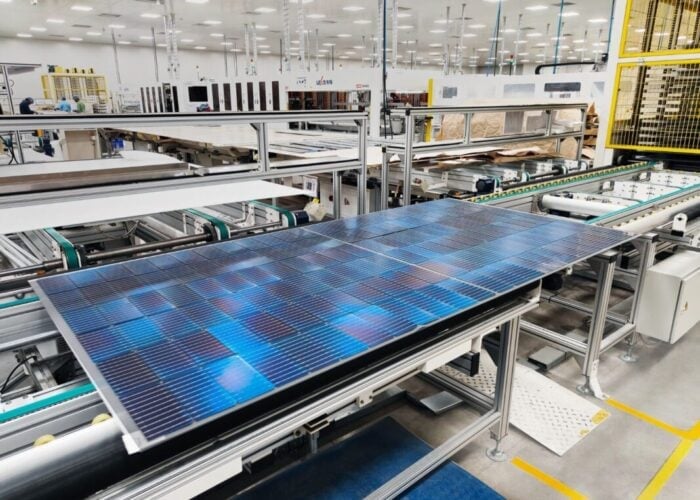
First Solar said it had invested US$2 billion in thin-film R&D, including a “focus” on perovskites. This includes a perovskite development line at its facility in Perrysburg, Ohio, which it said produces “small form-factor modules featuring a perovskite semiconductor” to support the company’s work on the efficiency and stability of perovskite solar products.
Oxford PV has emerged as one of the foremost companies in the silicon-perovskite tandem solar industry. The firm said it had shipped the first commercial perovskite tandem solar modules to an unnamed US client in September 2024, and has since signed another exclusive patent licensing agreement with Chinese solar manufacturing giant Trinasolar for the production of perovskite products in China.
“Strong intellectual property frameworks are essential to supporting innovation at scale across the solar industry,” said David Ward, CEO of Oxford PV. “Agreements like this, building on earlier industry validation, reflect growing confidence in perovskite-based photovoltaics—the next generation of solar technology we have been developing for over a decade—and support its advancement in the US market.”
Back in 2024, Ward told PV Tech Premium that Oxford PV was confident in its intellectual property (IP) portfolio, which would put it ahead in the “learning curve” of perovskite developments across the industry. He said that the company would plan to license its technology to other manufacturers to accelerate the development of the technology.
In particular, he said that the company had strong IP around a two-terminal perovskite-silicon tandem product with the perovskite laid directly on top of the silicon layer, which he predicted was “broadly going to be the majority of the application” of perovskites. We explored the different technologies and configurations of silicon-perovskite tandem products in the cover feature of the Q4 2024 edition of PV Tech Power.
Other companies in the US are also pursuing perovskite technology, trying to overcome the challenges of the material, which degrades rapidly when exposed to light, heat and moisture. This has prohibited meaningful industrial production of perovskite products to date.
Perovskite can absorb and convert a wider range of the light spectrum into electricity than silicon, which allows for a theoretical jump in the efficiency of solar modules. However, due to the nature of the material, perovskite products have mostly been restricted to laboratory conditions, with a few exceptional pilot projects around the world.
Swift Solar announced that Eni Plenitude, the renewables arm of Italian energy giant Eni, would deploy its perovskite modules at a pilot site in the US to field test the technology. Perovskite firm Caelux offers a more unique approach, producing “active glass” which incorporates perovskites and can be used with traditional silicon solar cells. The company said it shipped its first order of the product last summer.
The news follows First Solar’s publication of its 2025 financial results, which included year-on-year growth in net sales and gross profits.