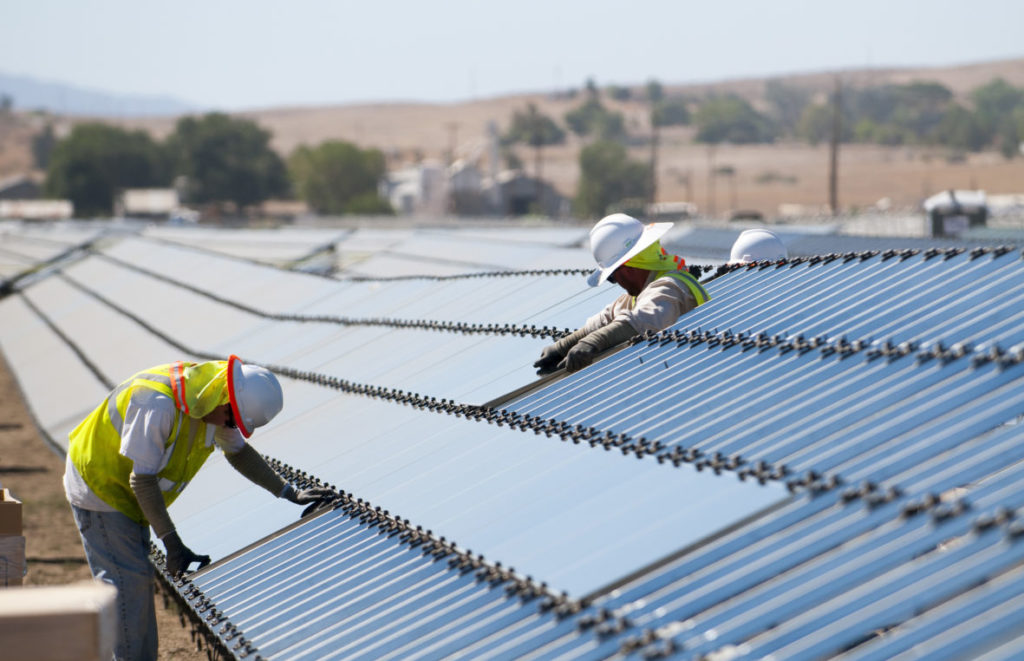
Global installed solar generation capacity has experienced exponential growth over the past few years, although meeting the target of trebling renewables by 2030 to 11TW set in COP28 could still be a challenge.
In SolarPower Europe’s recently launched Global Market Outlook for Solar Power 2024-2028 report, the Global Solar Council offers several policy recommendations to increase the global installed solar capacity and address the barriers that slow its deployment.
Try Premium for just $1
- Full premium access for the first month at only $1
- Converts to an annual rate after 30 days unless cancelled
- Cancel anytime during the trial period
Premium Benefits
- Expert industry analysis and interviews
- Digital access to PV Tech Power journal
- Exclusive event discounts
Or get the full Premium subscription right away
Or continue reading this article for free
Adequate financing to grow the global solar sector
In the report, SolarPower Europe states that US$12 trillion investment will be required to achieve the COP28 target of tripling renewables by 2030, with solar set to deliver half of this target. Global Solar Council recommends increasing public funding for solar PV projects and encouraging private investment to achieve low-cost solar finance.
Multilateral development banks and bilateral development finance institutions should be supported to increase project financing and de-risking instruments, especially to enable solar in regions where energy access remains a challenge.
Investment in energy system flexibility is also needed to accommodate newly installed solar and renewables capacity.
“As renewables grow at all voltage levels and electrification accelerates – offering new and high potential for flexibility – grid planning is more important than ever,” the Global Solar Council said.
Global Solar Council suggests that coordinating grid upgrades with capacity addition schedules is key to avoiding the curtailment of solar projects. Therefore, this can attract investors and offer them continued market certainty. System operators are also advised to develop tools to assess and plan for future flexibility needs, both on transmission and distribution levels. Measures include assessing how distributed solar PV and energy storage can reduce the need for high-voltage transmission lines by bringing generation closer to consumption.
In addition, the solar sector can establish a global storage target as it “provides a clear roadmap for investment and development.” For example, in May 2024, G7 nations agreed to a new global energy storage target of 1500GW by 2030, a six-fold increase from today’s levels.
Interconnections with other countries can also be considered since this can enable regional integration of electricity systems, demonstrating a viable way to increase solar penetration.
Setting up national targets
The Global Solar Council also recommends that countries can set up national targets that match their full potential.
“Whilst support schemes such as feed-in tariffs or green certificates can help boost solar deployment in the short term, they must be complemented with structural regulatory improvements in auction schemes and electricity market reform,” the council said.
It added that retroactive changes should be avoided as this will spoil investor appetite and stall market growth.
Additionally, governments should support different types of solar applications such as off-grid solar, agrivoltaics, floating PV and building integrated PV (BIPV) to maximise solar capacity in their countries.
Establishing low-cost and resilient supply chain
The Global Solar Council suggests that countries should increase investor confidence by combining energy transition strategies with policies that reward sustainable and resilient supply chains. At the same time, they can promote open trade, international cooperation, cost reductions, and sustainable growth in the global solar PV market.
Lastly, countries need to invest in research and development and foster innovation through government funding, private sector incentives and international collaboration. By doing so, technological breakthroughs that result in advanced manufacturing processes, resource efficiency improvements and increased environmental sustainability can be expected. These measures can also contribute to solar PV’s affordability and widespread adoption.