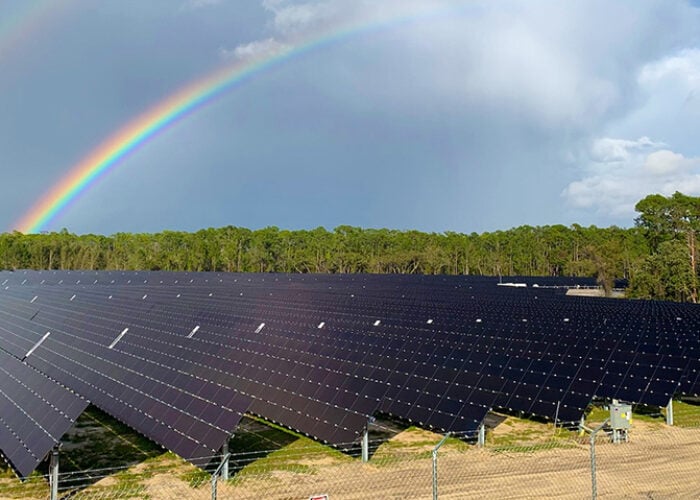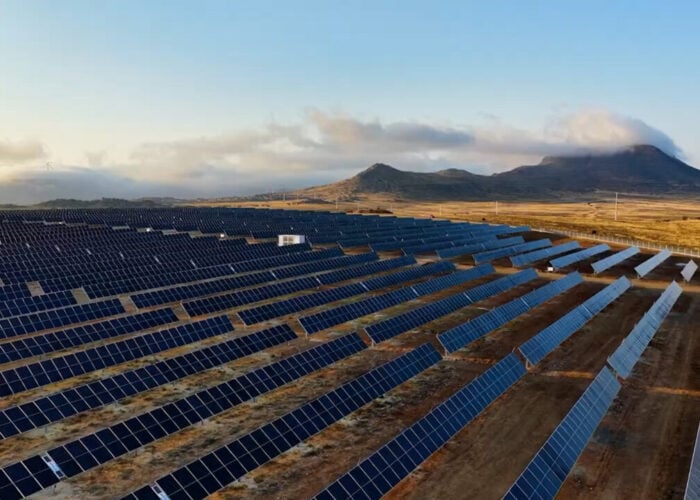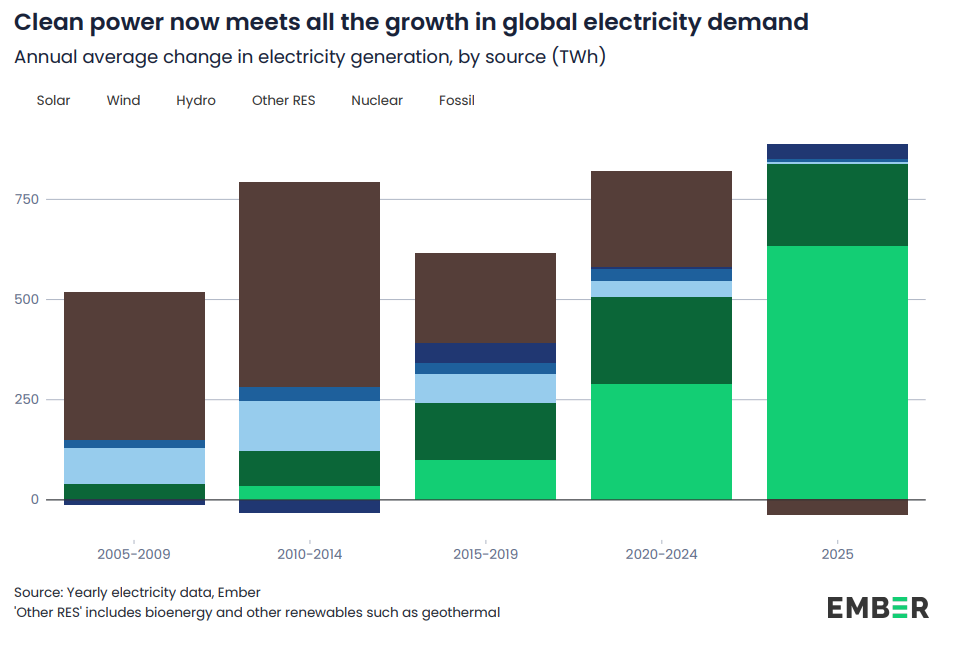
A record surge in solar generation met 75% of global electricity demand growth in 2025, according to the latest Global Electricity Review 2026 from energy think tank Ember.
According to the report, renewables accounted for 33.8% of global power generation in 2025, surpassing one-third for the first time and overtaking coal in a milestone moment for the energy transition. The structural shift in the global power energy mix contributed to a small decline in fossil fuel generation of 38TWh.
Try Premium for just $1
- Full premium access for the first month at only $1
- Converts to an annual rate after 30 days unless cancelled
- Cancel anytime during the trial period
Premium Benefits
- Expert industry analysis and interviews
- Digital access to PV Tech Power journal
- Exclusive event discounts
Or get the full Premium subscription right away
Or continue reading this article for free
Solar generation rose by 636TWh in 2025, marking the largest increase of any power source on record outside coal’s post-pandemic rebound in 2021. The scale of growth was equivalent to twice the annual electricity demand of the UK.
Solar’s upward trajectory has continued to accelerate, with generation increases rising from 331TWh in 2023 to 479TWh in 2024, before reaching a record level in 2025.
Global solar generation reached 2,778TWh in 2025, overtaking wind for the first time and cementing its position as the fastest-growing electricity source globally.
The expansion in generation was supported by another record year for installations, with 647GW of solar capacity added globally in 2025, an 11% year-on-year increase. According to Ember, this sustained pace of deployment reflects long-term cost reductions, with solar panel prices falling by 90% between 2015 and 2024.
Larger economies have also leaned heavily on solar-led clean power growth. China recorded the largest increase in electricity demand over the period, rising by an average of 513TWh annually, with 76% of this growth met by clean sources, led by solar. In the US, clean power supplied 88% of new demand, with solar forming a key component of that expansion.
In India, which saw the second-largest increase in demand at 101TWh per year, clean energy met 48% of additional demand, a significant rise from 24% in the previous decade.
China and India lead the way
A key driver of the global shift was the significant simultaneous decline in fossil generation in China and India. China’s fossil generation fell by 56TWh, while India recorded a decline of 52TWh. The two countries accounted for 42% of global fossil fuel generation in 2025.
In China, the fall came despite strong electricity demand growth of 503TWh, as clean generation expanded more rapidly, increasing by 15% to 561TWh. Solar was the primary contributor in the country, rising by 40% to 336TWh. Solar alone met two-thirds of the country’s demand growth.
China continued to dominate global capacity deployment, installing 378GWdc of solar in 2025, equivalent to 58% of global additions.
In India, a surge in renewable generation coincided with relatively modest demand growth of 49TWh, the third-lowest increase in the past decade. Renewable output rose by a record 24% to 98TWh, driven by strong gains in solar and wind.
However, milder weather conditions reduced electricity demand by an estimated 32TWh compared to 2024.
Emerging markets accelerate solar-led transition
Developing economies are increasingly shifting towards renewable energy deployment, with solar as a key driver of this transition. Countries such as Brazil and Pakistan have met 100% or more of their electricity demand growth with low-carbon sources, underscoring a structural change in how new demand is being supplied.
In Brazil, rapid solar expansion has strengthened an already dominant clean power mix anchored by hydro, helping to curb reliance on gas-fired generation. In Pakistan, the rise of distributed solar, increasingly paired with battery storage, has supported average demand growth of 4.5% annually between 2022 and 2025, while simultaneously reducing fossil generation.
While some markets, including Saudi Arabia, Indonesia, Thailand and Malaysia, continue to rely on fossil fuels to meet the majority of rising demand, their overall contribution remains limited. Countries meeting less than half of their demand growth with clean power accounted for just 26% of global electricity demand growth between 2022 and 2025, highlighting the growing dominance of solar-led clean energy expansion across emerging markets.
Untapped solar potential concentrated in fossil fuel-reliant regions
Despite solar’s rapid global expansion, deployment remains uneven, with the greatest untapped potential concentrated in regions still reliant on fossil generation growth.
Falling costs continue to strengthen the case for solar. In 2024, 90% of newly installed renewable projects globally were cheaper than the lowest-cost fossil fuel alternatives. Yet, countries experiencing continued growth in fossil generation between 2022 and 2025 are overwhelmingly located in high solar insolation regions.
Among markets with the fastest fossil generation growth of 3% or more per year, most have solar generation levels below the global average of 345kWh per capita, despite including high-resource countries such as Egypt and Saudi Arabia.
This contrasts sharply with countries that have deployed solar at scale despite less favourable conditions. The Netherlands reached 1,553kWh per capita, while Egypt, with more than double the solar resource, generates just 67kWh per capita, equivalent to around 4% of the Dutch level.
Elsewhere, high-deployment markets such as Australia, the UAE and Chile demonstrate the scale that can be achieved under strong solar conditions, with per capita generation reaching 2,080kWh, 1,379kWh and 1,117kWh, respectively.
Importantly, countries with lower electricity demand per capita do not need to match these levels to achieve significant impact. In Egypt, total electricity consumption stands at 2,050kWh per capita, meaning even moderate solar deployment could supply a substantial share of demand. Higher solar irradiation also enables greater output per unit of installed capacity compared with markets such as Germany or the Netherlands.
Solar momentum builds in emerging markets
The report noted early indications that solar deployment is beginning to accelerate across fossil-reliant regions. In Saudi Arabia, capacity is scaling rapidly, with estimates suggesting more than 10GW installed by 2025. The country has also secured financing for 15GW of new renewable capacity, including multiple solar projects in late 2025.
Across Africa, solar deployment is gaining momentum. Panel exports from China to the continent rose 48% year-on-year in 2025, increasing from 12.7GW to 18.8GW, signalling strong demand growth. Egypt more than doubled its imports to 2.3GW, up from 1GW in 2024, while Algeria recorded a sixfold increase to 2.1GW, compared with 0.35GW the previous year.