Despite softening demand momentum, premium solar module prices across Europe continued to rise in April, according to a module price report from solar trading platform sun.store.
The report showed the PV Purchasing Managers’ Index (PMI) fell to 66 in April, down from 68 in March, indicating a moderation in demand growth following what the sun.store described as an “exceptionally strong” first quarter.
Try Premium for just $1
- Full premium access for the first month at only $1
- Converts to an annual rate after 30 days unless cancelled
- Cancel anytime during the trial period
Premium Benefits
- Expert industry analysis and interviews
- Digital access to PV Tech Power journal
- Exclusive event discounts
Or get the full Premium subscription right away
Or continue reading this article for free
However, prices continued to increase across almost all monitored module categories, particularly among premium and high-efficiency technologies.
Tunnel oxide passivated contact (TOPCon) bifacial modules rose 9% month-on-month to €0.117/Wp in April, while TOPCon monofacial modules increased 6% to €0.121/Wp. The report said TOPCon remained the dominant technology in the European PV market, with prices now “significantly above late-2025 levels.”
Premium residential-oriented products also posted strong gains. Full Black modules increased 9% month-on-month to €0.124/Wp, while Back Contact modules climbed 9% to €0.129/Wp, remaining the highest-priced segment tracked in the index.
According to the report, the strongest pricing increases were concentrated in modules below 500Wp, reflecting sustained residential demand and continued buyer preference for premium and high-performance products.
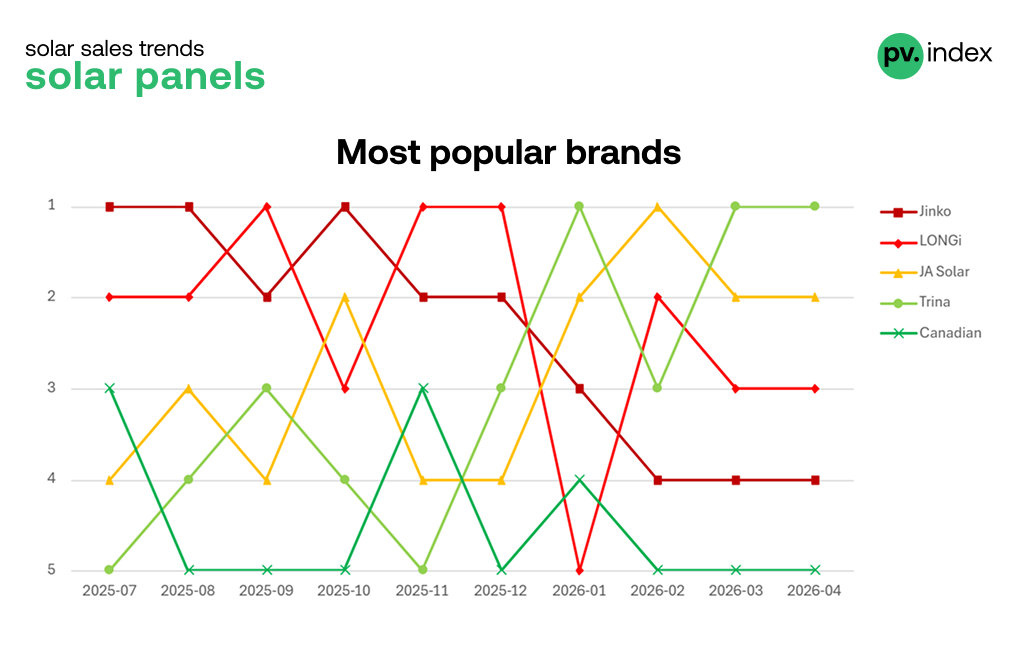
The report also highlighted a continued decline in the relevance of passivated emitter rear cell (PERC) technology within the European market. Among module suppliers, Trina Solar retained the leading position by power sold in April, followed by JA Solar, LONGi, Jinko Solar and Canadian Solar.
The inverter market remained largely stable during the month, with price changes across major segments limited to around 1-2%.
Hybrid inverter prices for systems between 1-15kW rose 2% month-on-month to €95.58/kW, while systems above 15kW fell 1% to €82.10/kW. In the string and on-grid inverter segment, prices for 1-15kW systems declined 1% to €44.05/kW, while systems above 15kW increased 1% to €27.04/kW.
The report said the inverter market had entered a period of “relative equilibrium,” contrasting with the stronger price volatility seen in modules. In hybrid inverter rankings, Deye retained the leading position ahead of Huawei, GoodWe, Sungrow and Fronius.
In the string inverter category, Sungrow moved into the top position ahead of Huawei, marking what the report described as one of the first major leadership changes after a prolonged period of Huawei dominance. Fronius, SMA and SolarEdge completed the top five rankings.
Survey data from 1,157 sun.store users showed 47% expected to increase purchases, while 39% anticipated no change and 14% expected reduced purchasing activity.
According to the report, the European PV market is entering a “more balanced phase,” with continued module price growth alongside moderating demand momentum.
This month’s Renewables Procurement & Revenue Summit, to be held from 20-21 May in London, will be hosted by PV Tech publisher Solar Media and cover PPA design, tackling high energy prices and more; for more information, including the full agenda and ticket options, visit the event website.