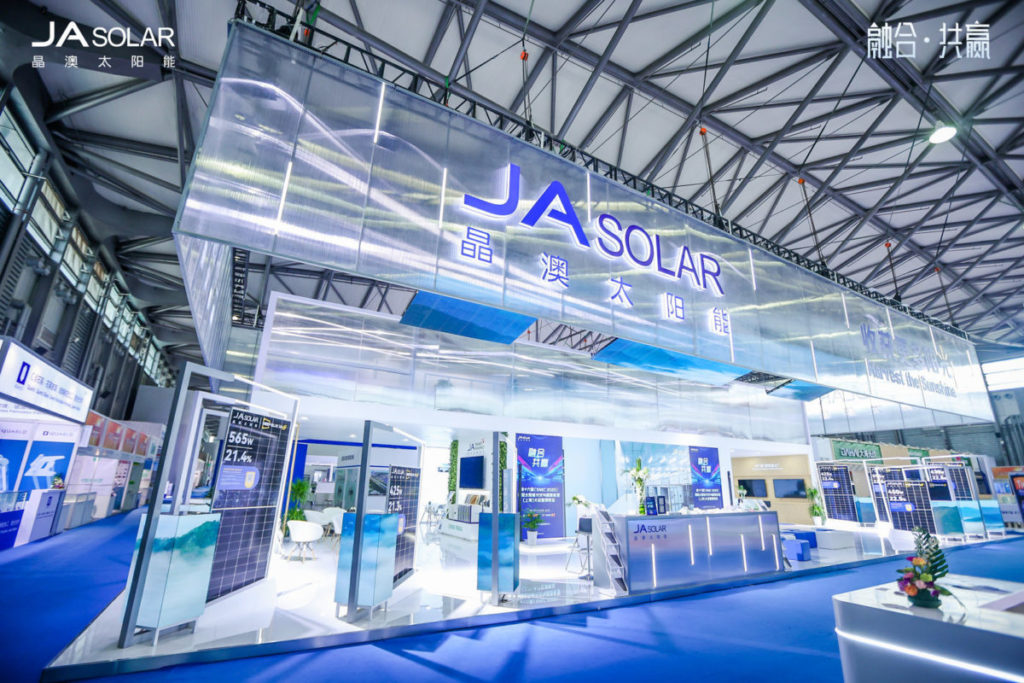
Amid the PV industry’s toughest downturn, Chinese solar manufacturer JA Solar held its 2025 annual results briefing on 6 May, offering the market a key glimpse of when the sector may turn the corner.
Senior management, including executive president Yang Aiqing, CFO Sun Peng, and operations centre president Guo Yafei, attended the investor Q&A session. As the entire industry is still mired in losses, the company reported a net loss of RMB4.608 billion (US$678 million) for 2025.
Try Premium for just $1
- Full premium access for the first month at only $1
- Converts to an annual rate after 30 days unless cancelled
- Cancel anytime during the trial period
Premium Benefits
- Expert industry analysis and interviews
- Digital access to PV Tech Power journal
- Exclusive event discounts
Or get the full Premium subscription right away
Or continue reading this article for free
During a lengthy Q&A session, top-tier institutions such as Morgan Stanley and CICC, along with tens of thousands of retail investors, all focused on one core question: as the industry undergoes sweeping capacity consolidation, when will JA Solar return to profitability?
Navigating losses while fortifying cash flow
An objective review of JA Solar’s financial performance is essential. In 2025, amid an industry supply-demand imbalance and brutal price wars, JA Solar posted revenue of RMB49.129 billion and a net loss of RMB4.608 billion. In Q1 2026, the company generated revenue of RMB9.216 billion while posting a net loss of RMB 1.067 billion.
Affected by the industry off-season in Q1 2026, the company saw a moderate decline in shipments of solar cells and modules, with total shipment volume hitting 11.87GW, including 11.7MW for internal use. Overseas module shipments accounted for roughly 77.16% of the total, almost at the same level as fellow Chinese manufacturer JinkoSolar. Solar exports from China have seen a big spike in March 2026, according to think tank Ember, with 68GW of solar PV products exported from China, doubling the figures from February.
On the surface, the quarterly results make for a disappointing reading.
JA Solar’s management frankly acknowledged at the briefing that despite broad headwinds across the PV sector, streamlined operations have kept the company’s losses relatively contained and manageable compared with industry peers.
Investors repeatedly raised concerns at the event over shrinking gross margins eroding net asset value. Faced with mounting pressure from short-term borrowings and current liabilities due within one year, JA Solar has upheld the principle of “cash is king”.
Management emphasised that safeguarding cash flow remains its top priority. By rigorously controlling capital expenditure and optimising supply chain operations, the firm has maintained solid cash reserves to weather the industry downturn. Its pragmatic strategy of prioritising survival over blind expansion has earned considerable confidence from the capital markets.
Discussions on technological routes stood out as one of the most substantive parts at the earnings briefing.
As a long-standing leading module manufacturer, JA Solar invested RMB2.958 billion in R&D in 2025, representing over 6% of its annual revenue. This sustained investment has built a solid technological advantage. The company’s mass-produced n-type Bycium+ solar cells have achieved a conversion efficiency of up to 27.5%, placing them among the highest levels for commercially available products.
The company’s high-power module product line is steadily ramping up production. These products command a price premium of RMB0.05-0.08 per watt over standard modules, with an even wider premium in overseas markets, delivering meaningful support to gross margins and profitability. The product series has already been commercially deployed across a wide range of application scenarios.
Facing industry-wide soaring silver prices, JA Solar has advanced its silver-plated copper technology. Management noted that the technology has passed lab verification and small-batch mass production trials. While the company maintains a quality-first approach and is taking a prudent stance on full-scale commercial rollout, this technological reserve opens up significant potential for future cost reduction. In a high silver-price environment, players that effectively curb silver consumption gain a crucial competitive edge in industry price competition.
JA Solar is building new growth drivers through integrated PV-storage solutions and global expansion. Energy storage was once seen merely as a supporting accessory to the PV business. Today, JA Solar has set up a dedicated storage division, moving beyond pure equipment supply. The company’s storage strategy centres on a “PV + Energy Storage + X” model. It is currently prioritising overseas markets, focusing its product portfolio on commercial, industrial, and residential storage systems, while adopting an asset-light, high-inventory-turnover operating model.
Looking ahead: will the industry inflection point arrive in H2 2026?
On investors’ top concern – when losses will reverse – JA Solar offered a relatively optimistic timeline.
Hampered by legacy order arrangements and rising silver prices, JA Solar remained in the red in Q1 2026. Even so, the company has set a full-year return to profitability as its official target. JA Solar noted that its gross margin already turned positive in Q1 2026, signalling an improving profit trend. While Q2 is still expected to face lingering pressure, the second half of the year stands a good chance of delivering quarterly profitability, as supportive policies take effect and market prices and shipment volumes stabilise.
JA Solar’s management projected that, backed by technological advances, supply chain optimisation, and the ramp-up of overseas production, the company could achieve quarterly profits in Q3 and Q4 if market conditions recover.
Global PV installed capacity is projected to decline year-on-year in 2026, yet surging power demand from AI data centres has introduced a new growth variable for the sector.
Management made it clear that the rapid expansion of the storage sector will bolster PV demand. Starting in 2027, when the global PV market resumes positive growth, solar PV and energy storage will emerge as the industry’s core growth driver.