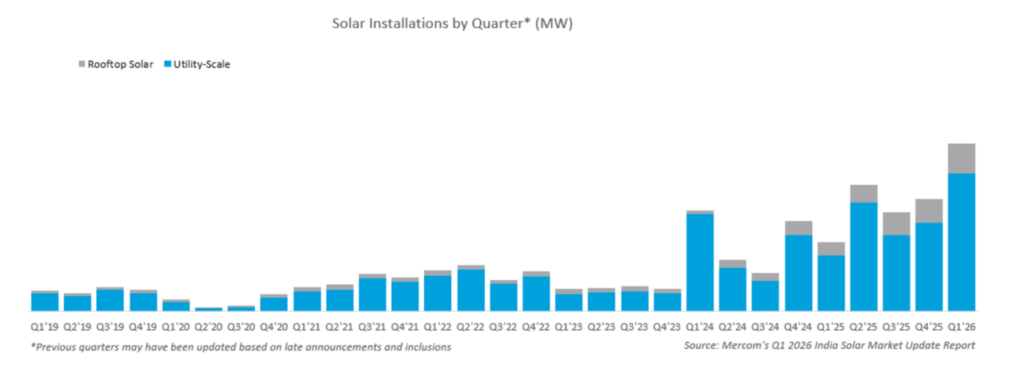
India installed a record 15.3GW of solar capacity in the first quarter of 2026, according to new data from market research firm Mercom.
The country’s quarterly solar additions rose 143% year-on-year from 6.3GW in Q1 2025 and were up 49% from the 10.3GW installed in Q4 2025, marking the highest quarterly solar capacity additions recorded in India to date. This was driven by developers rushing to commission projects ahead of looming policy changes and transmission waiver reductions, the report said.
Try Premium for just $1
- Full premium access for the first month at only $1
- Converts to an annual rate after 30 days unless cancelled
- Cancel anytime during the trial period
Premium Benefits
- Expert industry analysis and interviews
- Digital access to PV Tech Power journal
- Exclusive event discounts
Or get the full Premium subscription right away
Or continue reading this article for free
Large-scale solar projects accounted for 12.6GW of installations during the quarter, representing 82% of total capacity additions. Installations in the segment increased 55% quarter-on-quarter and 147% year-on-year, while open access projects contributed 21% of utility-scale additions.
According to Mercom, a combination of approaching policy deadlines and improved transmission readiness across key solar markets accelerated project commissioning activity during the quarter.
One of the primary drivers was the upcoming implementation of the Approved List of Models and Manufacturers (ALMM) List-II, scheduled for June 2026. Developers accelerated commissioning activity under the current procurement framework amid concerns over constrained domestic DCR cell availability and rising module procurement costs.
Execution activity was also supported by increased deployment under the Government of India’s Pradhan Mantri Kisan Urja Suraksha evam Utthaan Mahabhiyan (PM-KUSUM) scheme, alongside developers seeking to complete open access projects ahead of the next phase of Inter-State Transmission System (ISTS) waiver reductions.
India added 19.9GW of total power capacity during Q1 2026, with solar accounting for 77% of all new additions, according to the report.
As of March 2026, India’s cumulative installed solar capacity stood at 152GW, including utility-scale and rooftop systems. Large-scale projects represented 85% of installed solar capacity, while rooftop installations accounted for 15%. Solar energy now accounts for 28% of India’s total installed power capacity and 55% of installed renewable energy capacity.
Rajasthan remained the leading state for cumulative utility-scale solar installations, accounting for 32% of the national total. Gujarat and Karnataka followed with 21% and 11%, respectively.
During Q1 2026, Gujarat and Rajasthan led quarterly utility-scale installations, contributing around 40% and 39% of new additions, respectively, while Maharashtra ranked third with 6%.
Mercom said the average cost of utility-scale solar projects using TOPCon DCR modules declined nearly 1% quarter-on-quarter but increased 6% year-on-year.
Meanwhile, solar tender activity reached 3GW during the quarter, rising 100% quarter-on-quarter but falling 68% year-on-year. A total of 4GW of solar projects were auctioned in Q1 2026, down 47% from the previous quarter and 64% lower year-on-year.
In March 2026, Mercom reported that India had added 119GW of solar module manufacturing capacity and more than 9GW of solar cell manufacturing capacity during 2025.
According to the firm’s ‘State of Solar PV Manufacturing in India 2026’ report, the country’s cumulative solar module manufacturing capacity had reached approximately 210GW by December 2025, while cumulative solar cell manufacturing capacity stood at around 27GW.