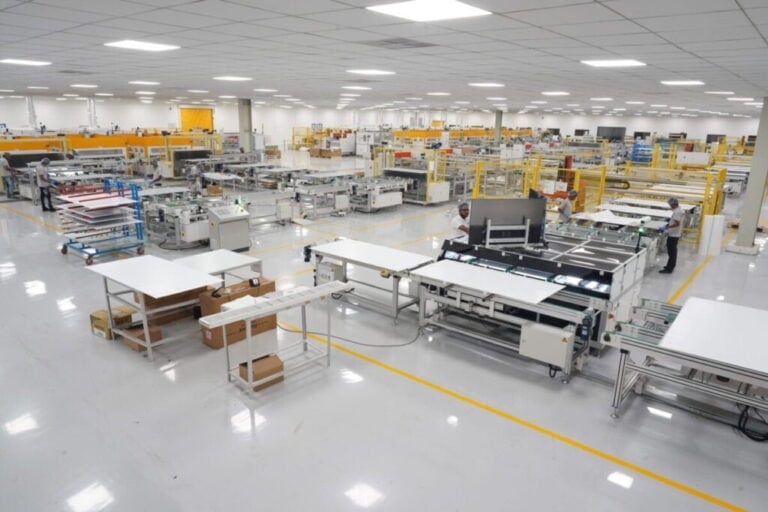
India added 119GW of solar module and over 9GW of solar cell manufacturing capacity in 2025, according to Mercom’s latest report.
According to the State of Solar PV Manufacturing in India 2026 report, India’s cumulative module manufacturing capacity stood at approximately 210GW, while cell manufacturing capacity reached around 27GW, in December 2025.
Try Premium for just $1
- Full premium access for the first month at only $1
- Converts to an annual rate after 30 days unless cancelled
- Cancel anytime during the trial period
Premium Benefits
- Expert industry analysis and interviews
- Digital access to PV Tech Power journal
- Exclusive event discounts
Or get the full Premium subscription right away
Or continue reading this article for free
Under the government’s Approved List of Models and Manufacturers (ALMM) List-I, module capacity was 173.1GW, with cell capacity under ALMM List-II nearly 26.5GW. The top ten Indian manufacturers accounted for 44% of module and 99.5% of cell production capacity.
This surge was driven by the Government of India’s solar initiatives, including the PM Surya Ghar program and the ALMM List-II domestic cell mandate introduced last year. These policies boosted demand for both utility-scale solar projects in the pipeline and rooftop solar installations.
Technology mix
Mercom said that approximately 70% of installed module manufacturing capacity was based on tunnel oxide passivated contact (TOPCon) technology, followed by monocrystalline at over 25%. Polycrystalline and thin-film technologies accounted for around 2% each, while heterojunction (HJT) module capacity, at about 1%, was included for the first time. The remainder comprised a combination of HJT and TOPCon.
For cells, monocrystalline technology accounted for more than 57% of production capacity, followed by TOPCon (over 39%) and polycrystalline (3.5%).
State-wise distribution, imports and exports
Furthermore, the Mercom report highlighted that Gujarat led module manufacturing with a 45% share, followed by Rajasthan (10%) and Tamil Nadu (7%). Gujarat also dominated cell production with approximately 45%, with Tamil Nadu (16%) and Karnataka (13%) trailing.
Domestic manufacturers exported around 5GW of modules and 192MW of cells in 2025. The US accounted for 96.8% of module exports, while 57% of cell exports went to the UAE.
Solar PV module exports in Q4 2025 reached US$98.96 million, while imports of modules totalling US$216.25 million, with Vietnam (33%), China (32%), and Malaysia (31%) as leading suppliers. Solar cell imports rose 31% quarter-on-quarter to US$892.15 million, dominated by China at 67% of total imports.
Earlier this month, JMK Research’s Q4 2025 India RE Update report noted that India’s solar module capacity grew nearly 14-fold between 2020 and 2025, reaching 200GW, of which 145GW was enlisted under ALMM.
India is projected to add 42.5GW of new solar capacity in 2026, including 32.5GW from utility-scale projects, 8.5GW from rooftop solar, and 1.5GW from off-grid installations. During Q4 2025, the country added 6.2GW of utility-scale solar, a 23% decline from the previous quarter, while rooftop installations reached 2.1GW, down 22% quarter-on-quarter.