India’s solar power generation increased 39% year-on-year to a record daily output of 705 million units (MU) on 30 September, as the country’s electricity generation rose 11% to 536 billion units (BU) in Q2 FY2026-27, according to the latest India Energy Snapshot, published by Finland-based Centre for Research on Energy and Clean Air (CREA).
Solar was the fastest-growing major source of electricity generation during the quarter, ahead of wind, which grew 29% year-on-year, and nuclear, up 26%. Solar accounted for 58% of the increase in renewable electricity generation, underlining its contribution to the expansion of India’s clean power output.
Try Premium for just $1
- Full premium access for the first month at only $1
- Converts to an annual rate after 30 days unless cancelled
- Cancel anytime during the trial period
Premium Benefits
- Expert industry analysis and interviews
- Digital access to PV Tech Power journal
- Exclusive event discounts
Or get the full Premium subscription right away
Or continue reading this article for free
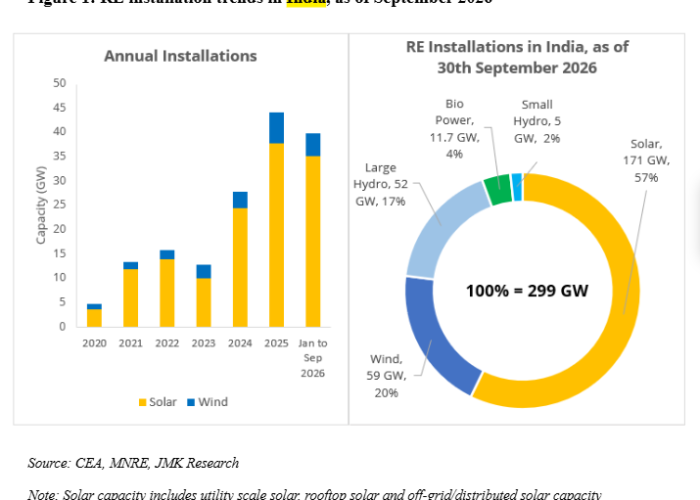
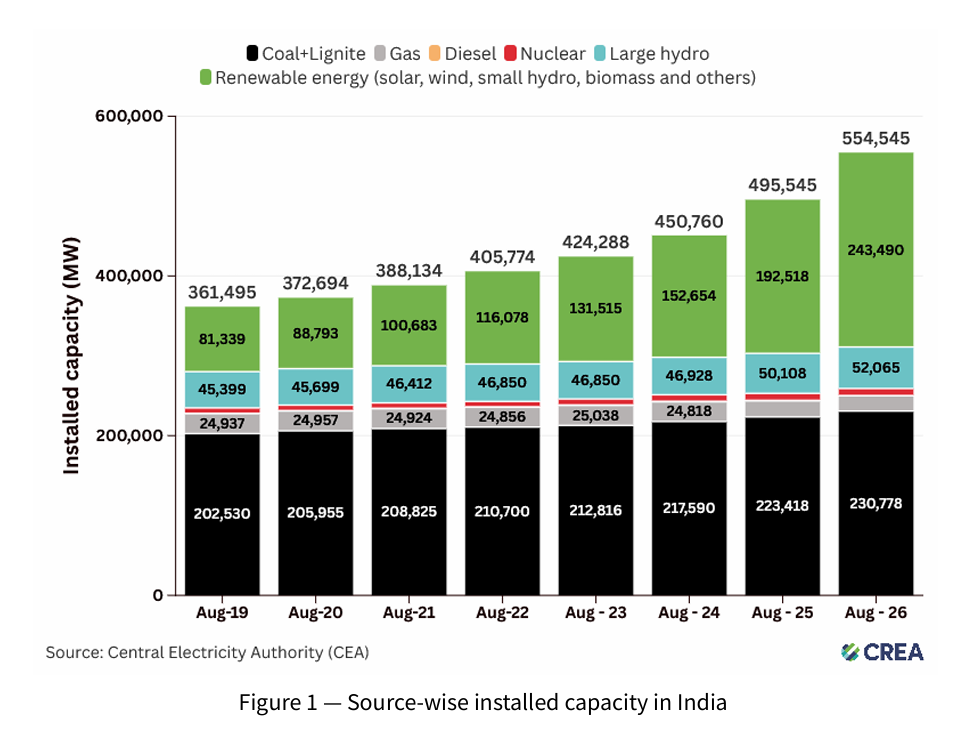
India’s installed solar capacity reached 168GW by the end of August 2026, representing around 30% of the country’s total installed power capacity of 555GW. Renewable energy capacity excluding large hydropower stood at 243GW, or 44% of the total, compared with 193GW a year earlier.
Renewable energy sources accounted for 19% of total electricity generation during Q2, while combined non-fossil sources, including hydropower and nuclear, generated a record 177BU, up from 163BU in the same quarter last year.
However, grid and operational constraints continued to limit renewable power output. Approximately 1,835MU of renewable electricity was curtailed during July and August, including 1,462MU of solar generation and 373MU of wind generation, highlighting the challenge of integrating rising renewable capacity into the power system.
Solar capacity utilisation averaged 18.3% during the quarter, down 0.3 percentage points year-on-year. Meanwhile, national peak electricity demand reached 270GW on 16 July, up 18% from 230GW in Q2 FY2025-26. Daily peak demand occurred during solar generation hours on 62 of the quarter’s 92 days.
Renewables added 7GW of capacity during Q2 FY2026-27, compared with 0.8GW of thermal capacity, according to the snapshot. The figures point to continued growth in India’s solar generation and installed capacity, alongside the need to address grid constraints and curtailment as renewable deployment expands.
According to JMK Research & Analytics’ Q2 2026 India RE Update, published in August 2026, renewables accounted for 26.35% of India’s 523.06BU power generation, up from 22% in Q1 2026.
However, variable renewable energy (VRE) curtailment surged 558.5% quarter-on-quarter to 1,874.09MU, with solar accounting for 1,601.51MU. The share of renewable generation curtailed rose from 0.28% to 1.36%, marking the highest quarterly curtailment in the period covered by the report.