A report from think tank Ember has highlighted six policy reforms in Indonesia that would accelerate the country’s 100GW solar PV target.
The country launched the 100GWp solar programme over the summer, with a target date of 2029. This comes as the Southeast Asian country had only 1.5GW of installed solar PV at the end of 2025, according to Ember. A third of this came from state-owned utility PLN, while industrial demand has been the key driver for Indonesia’s solar capacity so far.
Try Premium for just $1
- Full premium access for the first month at only $1
- Converts to an annual rate after 30 days unless cancelled
- Cancel anytime during the trial period
Premium Benefits
- Expert industry analysis and interviews
- Digital access to PV Tech Power journal
- Exclusive event discounts
Or get the full Premium subscription right away
Or continue reading this article for free
All the policy fixes from Ember are built on existing institutions, with PLN remaining at the centre of the system. It also draws from India, since both countries share similar fragmented land ownership and a financially stretched state utility. Since India redesigned how solar is priced, procured and sited, cumulative solar PV installations have risen to 171GW by September 2026.
Shortening pre-construction timelines for utility-scale solar
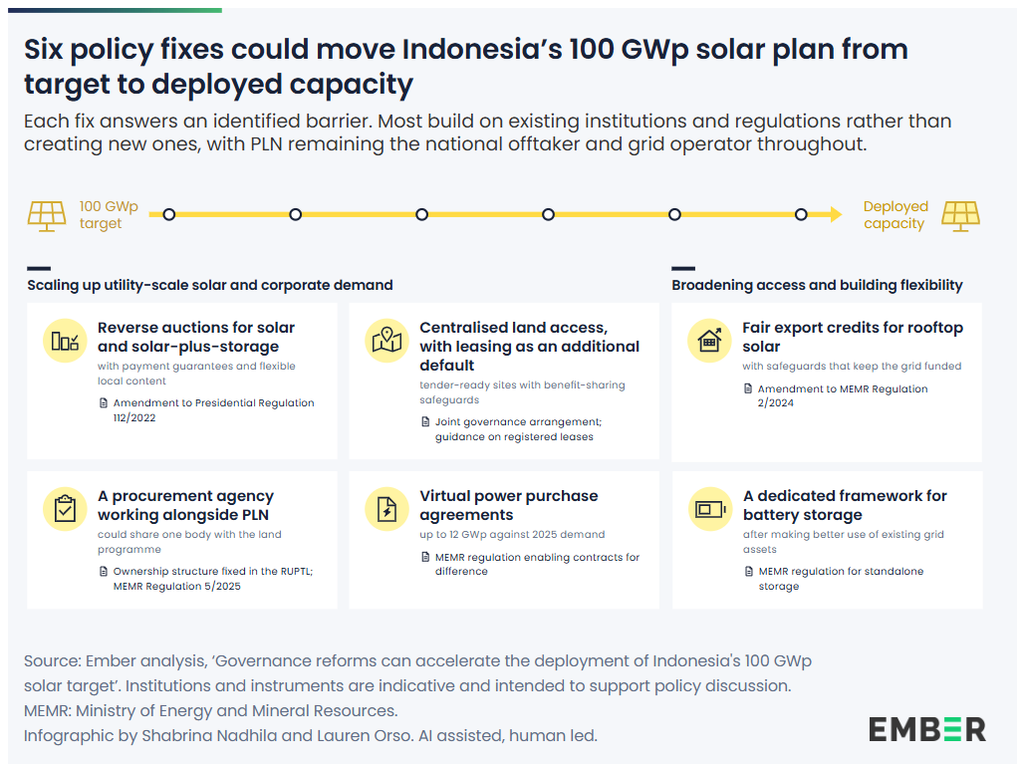
For the utility-scale solar market, Ember proposed centralising land access and procurement, as these can add high costs and uncertainty to project development. The current framework requires a long lead time before construction begins, with up to 40 months based on reported project timelines, and four to six years to reach commercial operations.
“Designating a government-backed entity to centralise these steps could ease the burden on PLN. Pairing it with land leasing as an additional default arrangement could speed up the early stages of getting projects started,” explained Ember. The think tank added that with these changes in place it would remove the need for developers to secure land on a project by project basis, instead it will be passed on projects with tender-ready land once awarded.
Another proposal from Ember is to replace PLN’s solar ceiling prices with reverse auctions, which could unlock greater potential for utility-scale solar. By doing so, Ember said this could help reduce solar costs, as seen in other countries; awarded prices dropped by 44% to 87% in India, Chile, Germany and South Africa, according to Ember.
Creating a VPPA mechanism for C&I market
Last year, only 8% of renewables met the demand of large commercial and industrial (C&I) consumers. Enabling a virtual power purchase agreement (VPPA) mechanism could add an extra 12% of renewables share to supply that demand. This would unlock 12GW of new solar PV capacity.
Ember stated that the VPPA mechanism would serve PLN’s economic potential, as it helps it achieve its solar target without losing its customers and revenue.
“Reaching the 100GWp target within three years requires governance reform, including a new route for businesses to fund additional solar through virtual power purchase agreements (VPPAs), while keeping PLN at the centre of the system,” said Shabrina Nadhila, Asia energy analyst at Ember.
Net billing tariff to accelerate rooftop solar’s growth
To help revive the rooftop solar market, Ember highlighted the introduction of a fair net billing regime. Since the end of bill credits in 2024, rooftop solar adoption has stalled at below 1GW, while reintroducing a credit for surplus power could drive private investment, displace midday coal and cut state subsidies.
“To prevent cost-shifting to non-adopters – as seen in Pakistan – Indonesia could adopt short credit cycles, prosumer network fees, capacity-based limits and tailored surplus power rates (1:1 for industry, near avoided cost for households),” said Ember.
With these measures in place, Ember estimated that net billing could add a further 1.4GW rooftop solar by 2030.
Creating a framework for energy storage
The final framework idea from Ember is about energy storage. Even though Indonesia’s 100GW solar target includes batteries, the lack of regulation for standalone storage is a key barrier for bankability.
Ember highlighted solutions from India and China and how initial growth could be supported with time-limited assistance, such as India’s 30GWh viability gap funding. The revenue models could then be layered and move from contracted availability payments to ancillary reserve services and eventual spot arbitrage.
“Establishing clear remuneration rules and including BESS in reverse auctions will lower costs through competition and turn Indonesia’s pipeline into a viable market,” said Ember.
The full report and details on each policy outlined by Ember are available here.