Before AI, before the Inflation Reduction Act (IRA) and well before the regulatory changes of the past two years, diligence on a solar and storage project was already a serious undertaking. That baseline complexity is easy to forget in a conversation focused on what has changed, but it matters for understanding why the current moment is so consequential.
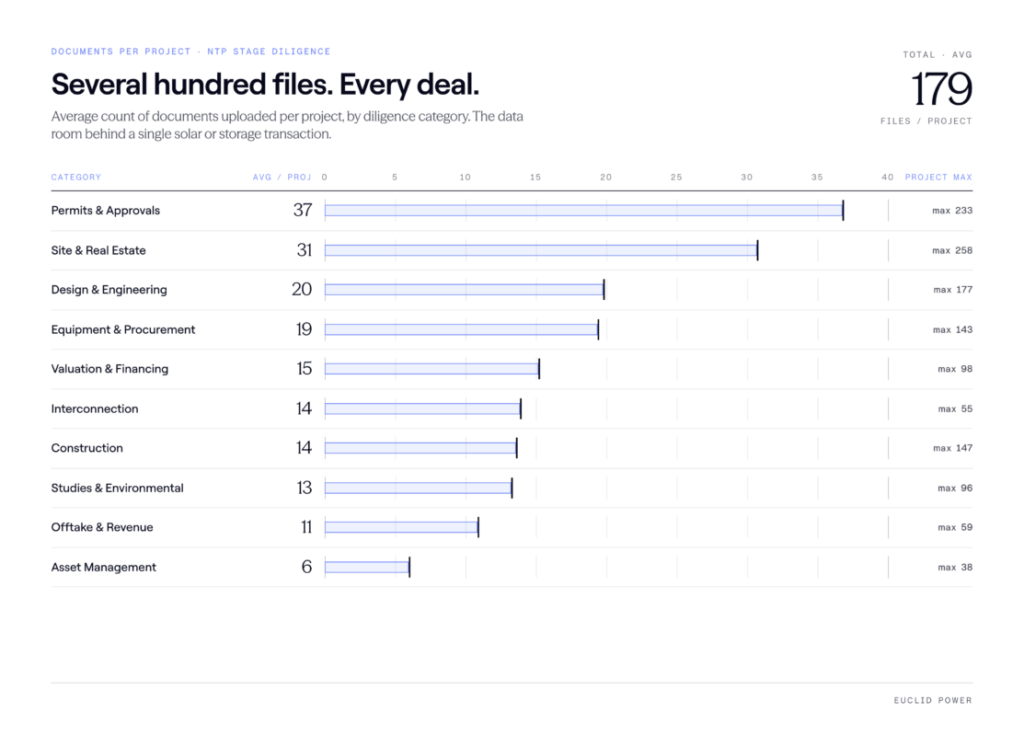
Every project is, at its core, a collection of several hundred contracts and documents. These documents govern site control and land rights, interconnection to the grid, local and state permitting, equipment procurement, offtake arrangements, tax structure and ongoing operations and maintenance obligations. Taken together, they define what a project is, what it is worth and what risks an investor is assuming.
Try Premium for just $1
- Full premium access for the first month at only $1
- Converts to an annual rate after 30 days unless cancelled
- Cancel anytime during the trial period
Premium Benefits
- Expert industry analysis and interviews
- Digital access to PV Tech Power journal
- Exclusive event discounts
Or get the full Premium subscription right away
Or continue reading this article for free
The problem is that this information has never been easy to access or use. It lives across multiple versions of unstructured PDFs, scattered data rooms and inboxes, in inconsistent formats and disconnected from the financial models, risk registers and workflow tools that deal teams actually rely on. Extracting, organising, and synthesising that information has historically required significant human time and messy coordination of multiple specialised advisors working in parallel.
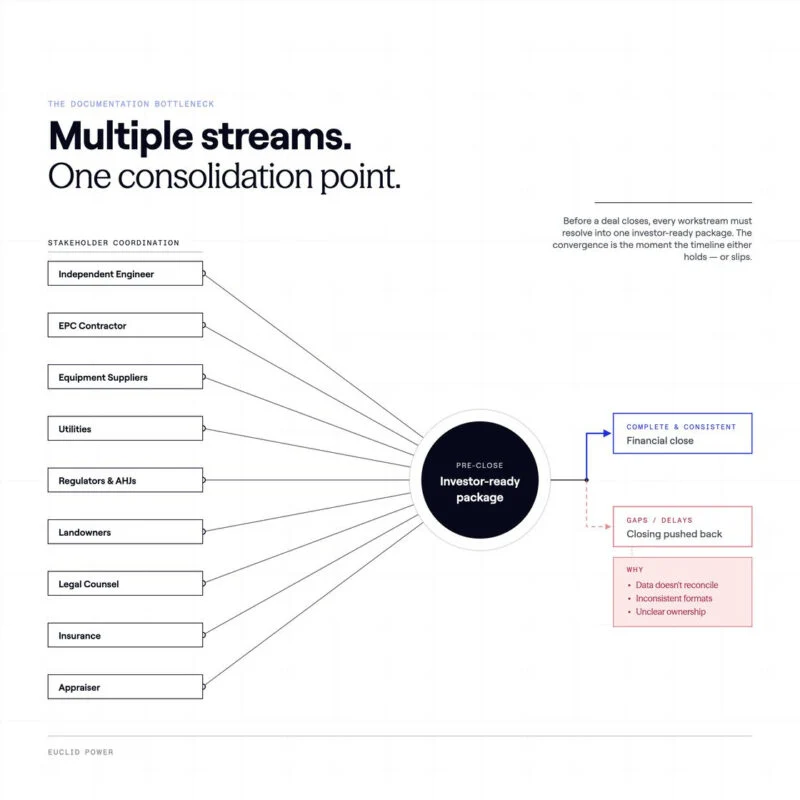
A typical investor coordinates across an independent engineer or technical advisor, tax counsel, real estate counsel, transaction counsel, an environmental consultant and a financial advisor. Each brings a distinct scope, a distinct working style, and a distinct set of information requests. Workstreams overlap. Handoffs are slow. Information sits in inboxes rather than shared systems. The result is a diligence process that routinely takes three months or more to complete—in a market where deal windows are often measured in weeks. That mismatch between the pace of deals and the pace of diligence was already a problem before the current wave of regulatory and market change. It has since become significantly more acute.
And then everything got more complicated
The passage of the IRA, the One Big Beautiful Bill Act (OBBBA) and the subsequent guidance introduced new layers of compliance obligations that have materially expanded the scope of what diligence must cover. These are not marginal additions. For many transactions, they have become the most consequential and time-consuming workstreams in the entire process.
Prevailing wage and apprenticeship requirements now attach to Investment Tax Credit (ITC) and Production Tax Credit (PTC) eligibility in ways that require detailed documentation of labour practices during construction. Prohibited Foreign Entity (PFE) restrictions require more granular diligence on the ownership, control and material assistance for equipment and components used by qualified facilities and energy storage technologies claiming the technology-neutral credits. Domestic content eligibility for the ITC adder requires careful tracking of where steel, iron and other products and components are manufactured—a task that can involve coordinating across multiple suppliers. Beginning-of-construction rules create schedule-sensitive compliance obligations tied to long-lead equipment procurement and physical work commencement, with significant tax credit value at stake if timelines slip.
Tariff exposure has added another layer of diligence for imported PV and BESS equipment. Investors need to understand not just the potential cost of tariffs, but who bears that risk under equipment supply and EPC contracts and whether project contingencies can absorb unexpected increases.
What used to be a checkbox has become a full workstream—in many cases, multiple workstreams
The investor universe has also shifted. Tax credit transfer investors, infrastructure funds and hyperscaler-adjacent investors have entered the market in significant numbers, some without deep solar and storage diligence experience. The assumptions and frameworks these investors bring do not always map cleanly onto the risk profile of the assets they are evaluating.
The consequence is a diligence environment in which the risks most likely to re-price or kill a deal are also the ones most likely to be missed. Solar yield assessments are systematically optimistic in ways that experienced technical reviewers have documented for years. Storage revenue underwriting requires offsetting merchant exposure with some contracted revenue in markets where merchant assumptions are difficult to validate. Domestic content compliance for the ITC adder eligibility remains incompletely documented in a large share of data rooms. Long-lead equipment procurement creates schedule dependencies that are rarely reflected accurately in seller-provided timelines. Interconnection costs and timing continue to surprise investors who underestimate network upgrade exposure.
To make this concrete: on a recent project we worked on for a client, the project developer was targeting a late 2030 commercial operation date. The project’s underwriting depended on revenue from a competitive state clean-energy solicitation that requires commercial operation by 1 January 2030, to be eligible. Nothing in the data room explicitly flagged the mismatch; the schedule and the offtake assumption were internally coherent. They were just inconsistent with each other. Without the right diligence framework, the project the buyer thought they were acquiring – one eligible for the offtake programme that anchored the financial model – did not exist. Catching that before exclusivity was a multi-million-dollar valuation event.
The real deal-killer in this environment is not risk itself; it is discovering risk late, deep into exclusivity, when a late-breaking finding does not just complicate the transaction but resets valuation, burns negotiating leverage and can kill the deal entirely.
A market moving faster than the existing process
Against this backdrop of structural complexity, the pace of market activity has accelerated sharply. AI and electrification are driving a surge in power demand unlike anything the industry has seen in a generation, particularly for firm, reliable power. As the industry races to advance six years’ worth of development pipeline within the four-year window ahead of the Investment Tax Credit cliff, development, financing and merger and acquisition (M&A) volumes are elevated and likely to remain so.
Hundreds of projects are actively changing hands at any given time, with thousands more in various stages of development and marketing. Each one is its own snowflake: a unique configuration of contracts, permits, interconnection agreements, equipment procurement timelines, and compliance obligations, all of which must undergo due diligence for every financing and M&A transaction.
The opportunity for investors in this environment is real. So is the challenge. Quality and risk vary enormously across the available universe of assets, and the ability to identify the best opportunities quickly is increasingly a source of competitive differentiation. The core tension is straightforward: the market is moving faster than traditional diligence processes were built to handle.
This is precisely where AI can change the equation.
The unlock: AI turns unstructured data into infrastructure
The core challenge of project diligence has always been the same: critical information is trapped in unstructured documents, and extracting it and connecting the dots accurately is slow, expensive and dependent on the availability of experienced reviewers. Across the most recent 225 transaction projects we have supported, a typical seller’s data room contains roughly 165 documents and generates roughly 71 distinct diligence findings—risks identified, RFIs to the seller, actions to be taken—before close. The most complex projects we see easily double those numbers. AI addresses this problem directly, and the implications for how diligence is done are significant.
In this context, the real superpower of large language models is that they can transform unstructured contract data into structured, actionable information at a scale and speed that was previously impossible. A data room that might take a team of analysts several weeks to process can now be ingested, organised and cross-referenced in a matter of hours. The result is an entirely new kind of output: a shared data infrastructure that supports faster decision-making, more accurate communication across the deal team and more effective stakeholder management throughout the transaction.
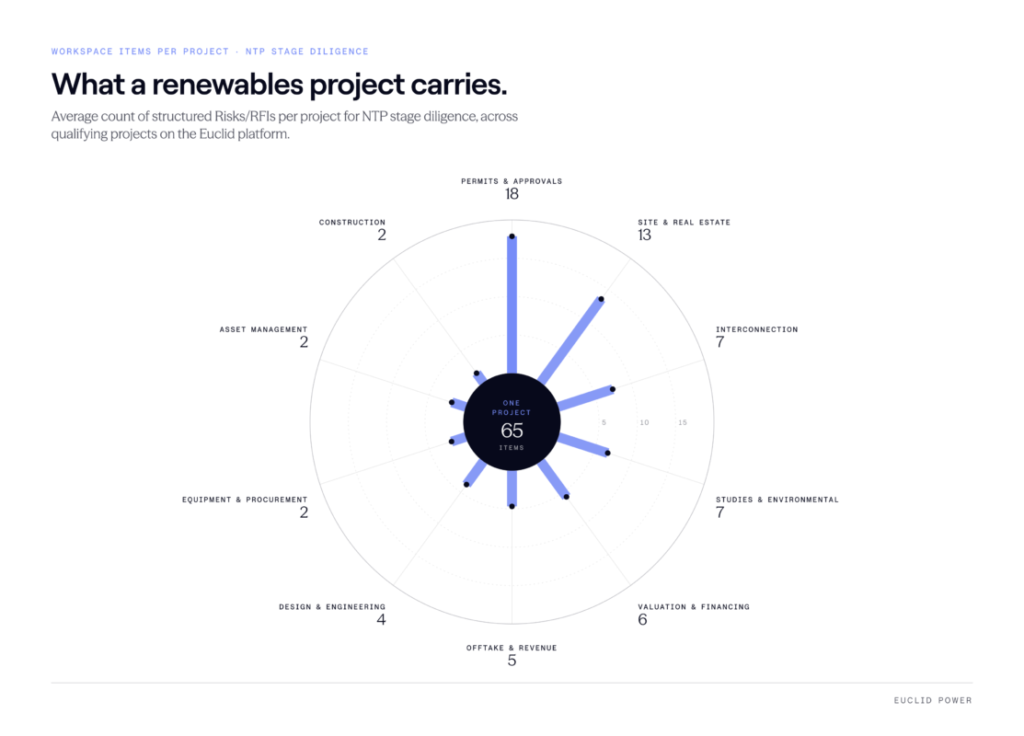
The practical implications for transaction timelines are substantial. A red flag report used to take a couple of weeks to produce. Euclid Power recently launched a 24-hour Red Flag Snapshot product. A full diligence package that once took several months can now be delivered in under a week. These improvements represent a fundamental change in what is possible within a given deal window—and in how many deals an investor can realistically pursue and close.
Though AI makes the initial pass much faster, its real value is in the quality of the foundation it
creates for the human judgment that follows.
That distinction is important. AI is probabilistic. The best models in deployment today are estimated to be 70 to 80% accurate on domain-specific tasks—and they present their outputs with a confidence that does not reflect that uncertainty. In a diligence context, the gap between 80% and 100% accuracy can represent a multi-million-dollar miss. Well-architected AI systems, built with domain-specific knowledge and designed for the specific risk taxonomy of solar and storage transactions, can bring that accuracy to, say, 95%. The residual 5% gap is precisely where expert validation becomes not just valuable but essential.
The model that works: AI and expertise in tight loops
The diligence model that is producing the best outcomes is not AI replacing expert review, but AI and expert review operating in tight loops, each doing what it does best.
AI workflows are most valuable when they are built around where risks actually live—organised by project type, development stage, geography, and deal structure. A well-designed system applies a risk-aware framework that reflects the specific compliance environment, asset class, and stage of development of the projects being evaluated. That specificity is what separates a useful AI-assisted process from a fast but unreliable one.
Instead of spending the majority of their time extracting and organising information from documents, expert reviewers are now focused on connecting the dots: making judgments that only experience can support, evaluating whether a yield assessment methodology is credible, assessing the enforceability of a key contract provision, determining whether a schedule assumption is realistic given the specific interconnection queue dynamics in a given market, or interpreting the significance of a risk that an AI system has correctly flagged but cannot place in context.
Consider a solar project in New York State at an advanced stage of development with no secured offtake. Utility-scale solar in the state is almost entirely dependent on a NYSERDA Tier 1 REC agreement as the only viable offtake path, making the absence of one a critical risk, not merely a risk. Reaching that conclusion requires knowing how NYSERDA solicitation cycles work, what curtailment levels do to strike price competitiveness and what the interconnection security deposits, lease payments and long-lead procurement commitments required before the next award date mean for the investment thesis. That is not a document extraction problem. It is a market judgment.
Or, consider a notice-to-proceed-stage (NTP) BESS project without secured offtake. An AI system will correctly flag this as a critical risk, and it is. But the severity of that gap is not uniform across markets. In Nevada, where a single investor-owned utility dominates the offtake landscape, a missing PPA at NTP is a critical risk: without it, the project may not have a viable path to revenue. In CAISO, the same gap is materially different. The market supports a range of offtake structures—RA contracts, utility tolling agreements, community choice aggregator agreements, merchant participation—that give a well-positioned project genuine optionality. Treating both situations identically in underwriting is a mistake that only market experience can prevent.
The initial project diligence review that previously required three people working for a week now routinely takes one person less than a day. That acceleration is more than a marginal efficiency gain; it is a structural change in the economics of diligence and in the number of opportunities an investor can evaluate with a given team.
This model is in practice today among the investors and advisors who have invested in building the right systems and pairing them with the right expertise. The early adopters are making better-informed decisions on more opportunities, with less duplicated effort across their advisor ecosystem.
The competitive advantage payoff
The strategic implications of this shift are straightforward, but worth stating explicitly. In a buyer’s market with hundreds to thousands of available projects, the ability to screen more opportunities—faster, more consistently and at lower cost per transaction—is a structural competitive advantage.
Most institutional investors and lenders active in the solar and storage market today are not constrained primarily by capital or by access to deal flow. They are constrained by their capacity to undertake the necessary diligence and close transactions. The bottleneck is operational, not financial. An investor who can evaluate two deals per month is categorically different from one who can evaluate ten. The latter will see more of the market, identify the best value opportunities more reliably, pass on weaker deals faster and deploy capital more efficiently with the same underlying resources.
AI-driven diligence will become table stakes in this market within a relatively short period. The question for investors and their advisors is not whether to adopt it, but how to build the domain expertise and IP required to use it effectively. The differentiators are risk knowledge, transaction experience and judgment that determine whether the technology produces accurate, actionable output or fast, confident mistakes.
Raising the bar
The complexity of solar and storage M&A diligence has never been higher. New compliance regimes, an evolving investor universe and the compressed timelines created by the federal tax-credit changes have all raised the stakes for getting diligence right. At the same time, the tools available to do it well have never been more powerful.
The investors and advisors finding the best deals in today’s market are the ones who have figured out how to leverage AI alongside human expertise, in the right combination, with the right workflows and with a clear-eyed understanding of where human judgment remains irreplaceable.
The bar has moved. Investors will modernise on their own terms, or they will be forced to when they lose deals they should have won. Diligence, done right, is no longer just about avoiding bad transactions. It is about finding good ones, faster, and at scale.
Jacob Sandry is CEO and co-founder of Euclid Power, a platform that delivers precision, quality and speed for renewable energy teams by uniting technical, commercial and financial expertise with purpose-built software. Rubin Sidhu is director of transactions & development, Euclid Power