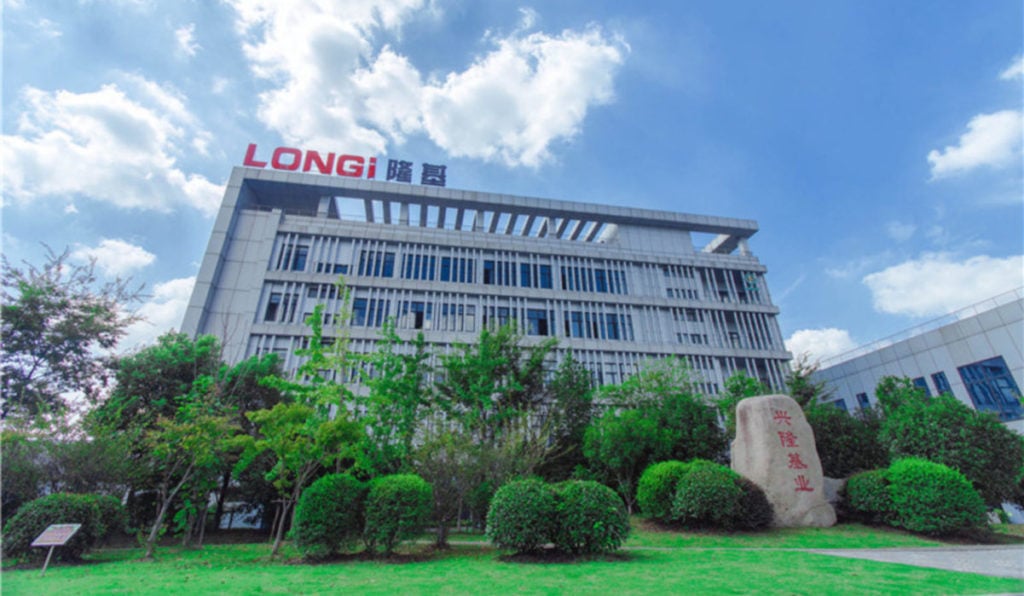
Chinese module manufacturer LONGi has announced a commercial M6 size wafer-level silicon-perovskite tandem solar cell with 30.1% efficiency at Intersolar Europe 2024.
LONGi said the record conversion efficiency was certified by German research organisation Fraunhofer Institute for Solar Energy Systems (Fraunhofer ISE).
Try Premium for just $1
- Full premium access for the first month at only $1
- Converts to an annual rate after 30 days unless cancelled
- Cancel anytime during the trial period
Premium Benefits
- Expert industry analysis and interviews
- Digital access to PV Tech Power journal
- Exclusive event discounts
Or get the full Premium subscription right away
Or continue reading this article for free
He Bo, R&D director of LONGi Central R&D Institute, said that LONGi’s R&D team had overcome two key challenges when developing the cell, including the preparation of large-area perovskite films in air and ultra-low-temperature metallisation.
He added that the new record represented a “milestone in the commercial viability” of the technology.
LONGi established the Central R&D Institute in 2012, which the company described as “the backbone of the company.” Over the past year, the company has invested more than RMB30 billion (US$4.13 billion) in the institute.
Prior to this announcement, LONGi also recently launched a new black dual-glass back contact module with a 22.3% conversion efficiency. Presented at Intersolar 2024 in Munich, Germany, the Hi-MO X6 Artist Ultra Black module generates up to 435W and has a 25-year product warranty and a 30-year power warranty. The modules are designed for the residential, commercial and industrial solar markets and are already available for the European market.
Moreover, it features the company’s proprietary hybrid passivated back contact (HPBC) cells which allow for a gridless and zero busbar (0BB) front for lossless light absorption. The low reflective texture of the HPBC black cell provides deeper light trapping, reducing reflection and a 1.2% light absorption increase.