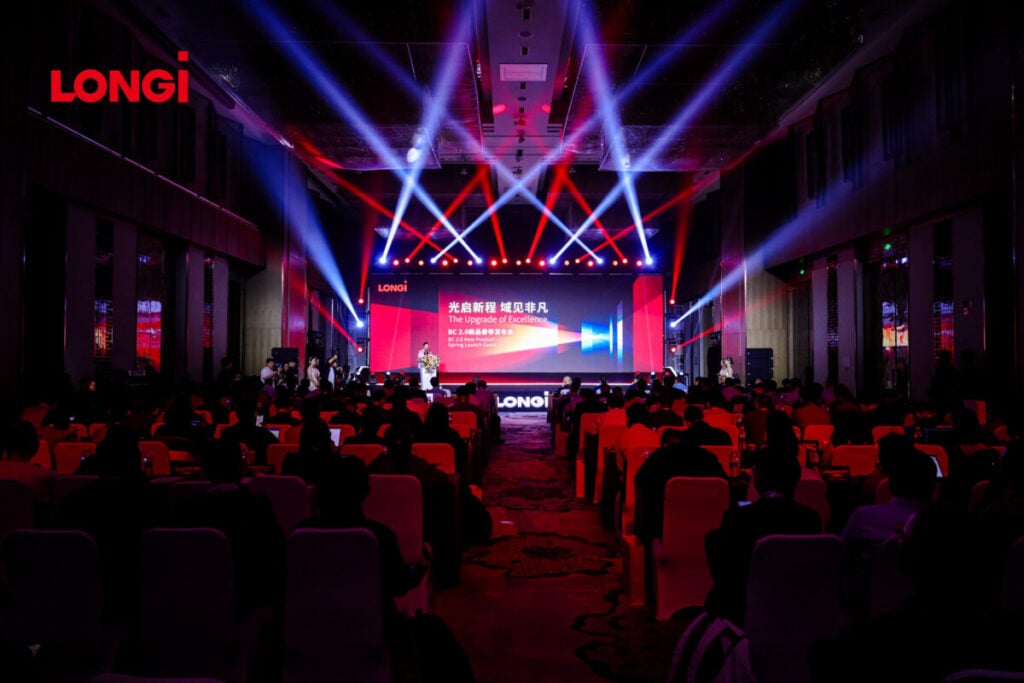
Leading Chinese solar manufacturer LONGi has launched the latest version of its Hi-MO 9 module, which now boasts a conversion efficiency of 24.8% and an output of 670W.
Both metrics are improvements on the previous generation of the Hi-MO 9, which has an efficiency of 24.43% and an output of 660W. The new module also uses the company’s hybrid passivated back contact (HPBC) 2.0 cells, a zero busbar cell that locates its metal contacts on the rear of the cell, in order to maximise the cell’s electricity generation.
Try Premium for just $1
- Full premium access for the first month at only $1
- Converts to an annual rate after 30 days unless cancelled
- Cancel anytime during the trial period
Premium Benefits
- Expert industry analysis and interviews
- Digital access to PV Tech Power journal
- Exclusive event discounts
Or get the full Premium subscription right away
Or continue reading this article for free
LONGi claims that its latest module has a 1.5% higher conversion efficiency and up to 40W higher power output than tunnel oxide passivated contact (TOPCon) modules currently in commercial production. This translates to an increase in installed capacity of approximately 6.4% over “equivalent land area”, according to LONGi’s testing.
“BC technology represents the ultimate advancement in crystalline silicon solar cells,” said LONGi vice president Dennis She. “With a mature global ecosystem, high-efficiency BC modules are rapidly being deployed across diverse applications.”
She’s comments reflect the fact that LONGi has tested the products in both China and Saudia Arabia, to measure the impacts of high-humidity and high-temperature environments on the modules.
Legal and financial challenges
LONGi also announced that its heterojunction interdigitated back contact (HIBC) cells, another form of back contact cells, have reached a conversion efficiency of 27.81%.
Last year, the company developed HJT back contact cells with a conversion efficiency of 27.09%, and earlier this year chairman Zhong Baoshen told PV Tech Premium that “from a technical point of view, BC is now the product with the most customer value in the PV field”.
The new cell and module developments follow months in which LONGi has been embroiled in a wave of patent disputes. In February, rival Chinese manufacturer JinkoSolar launched a patent case against LONGi in Australia, and LONGi responded by filing a lawsuit of its own against JinkoSolar in the US, following a swathe of lawsuits filed in China and Japan.
LONGi’s leadership has also expressed concern over the extreme price competition within the solar manufacturing sector. Last month, LONGi founder and CEO Li Zhengou held a joint press conference with Canadian Solar chairman Shawn Qu to discuss the challenges facing Chinese manufacturers as a whole.
“The long-term prospects for PV remain bright, but in the short term, I’m not overly optimistic,” he said. “Companies have shifted from merely losing cash to a state of severe bleeding.”