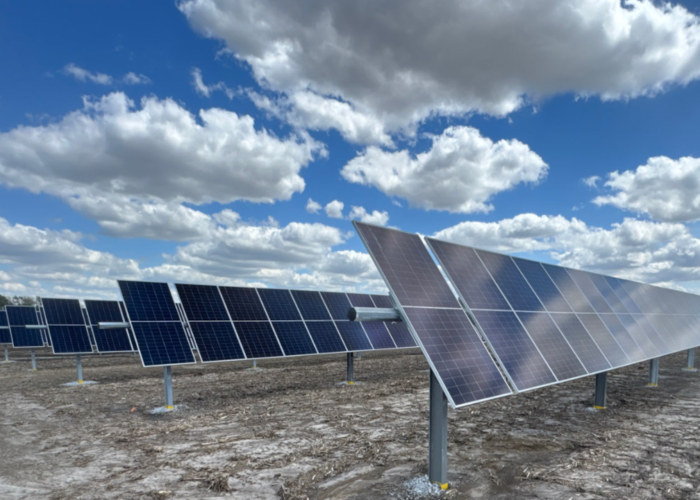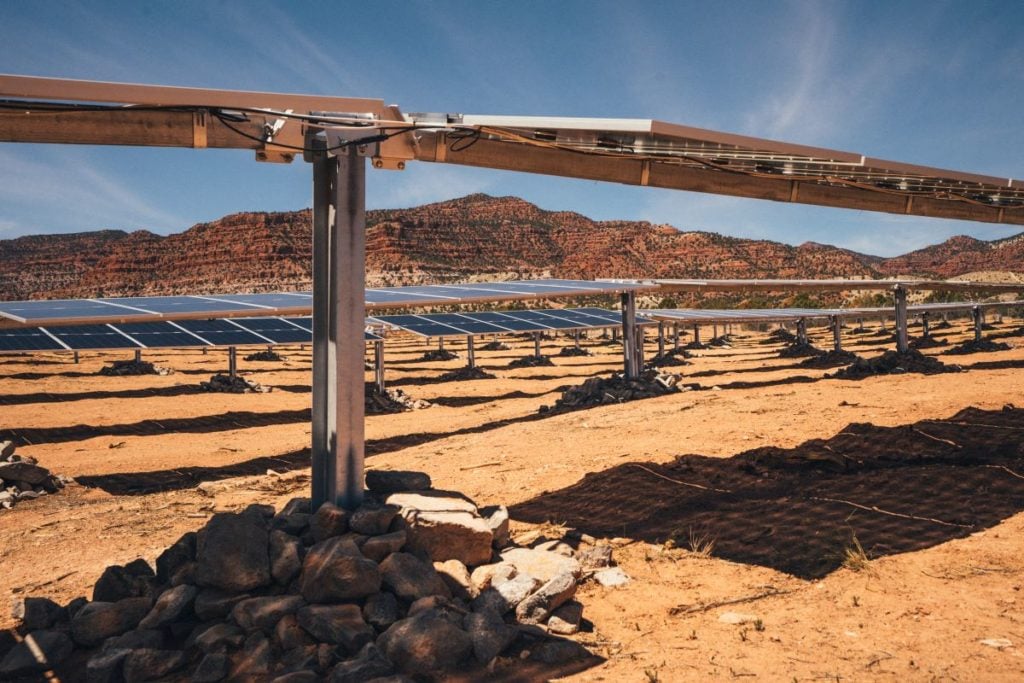
US solar tracker producer Nevados has launched a new all-terrain tracker which it said opens up land that was previously unsuitable for solar PV developments.
Nevados said the TRACE All-Terrain Tracker can be deployed on slopes of up to 37% and includes 75% hail stowing—which protects modules from hail and snow damage—and anti-shading technology to increase energy yield.
Try Premium for just $1
- Full premium access for the first month at only $1
- Converts to an annual rate after 30 days unless cancelled
- Cancel anytime during the trial period
Premium Benefits
- Expert industry analysis and interviews
- Digital access to PV Tech Power journal
- Exclusive event discounts
Or get the full Premium subscription right away
Or continue reading this article for free
The company said the tracker “features bidirectional, automatic stow, resulting in up to 50% faster wind and hail stow.” Stowing is the practice of changing the angle of solar modules to protect them from adverse weather, conducted by digital management software within trackers. PV Tech Premium published a feature on stowing and hail damage earlier this year.
Yezin Taha, CEO and founder of Nevados, said: “As flat or gently sloping land becomes scarcer and more expensive, the solar industry needs solutions that can adapt to the world’s diverse terrains more than ever.”
As global solar installations accelerate year by year, the land they require will grow too. The latest Bloomberg New Energy Finance (BNEF) Global PV Market Outlook predicts that the world will install 592GW of solar PV in 2024, which could even prove to be a conservative estimate.
Simultaneously, various governments are implementing restrictions on land used for solar PV generation. Italy recently announced restrictions around the use of agricultural land for solar, France’s solar market is facing challenges over the country’s extensive planning and permitting regulations and the Ontario government in Canada recently imposed a ban on “prime” agricultural land developments for solar.
In addition to opening up more usable land, Nevados said its products and those like them reduce the need for levelling land to make it suitable for solar deployments – a practice that has been commonplace in the industry and can have an impact on land quality and biodiversity. Taha wrote a technical paper on the subject for PV Tech Premium last year.
In a statement, the company also said that the trackers can be produced in a way that is fully compliant with the US Inflation Reduction Act (IRA) Domestic Content bonus, which awards an extra 10% tax credit to solar projects which use at least 40% US-made components (rising to 55% next year).
Action around the Domestic Content bonus has grown more frequent recently. For example, community solar developer Summit Ridge Energy signed a deal with Siemens to procure its US-made string inverters, which would enable the former to exceed the minimum content requirements.
Nevados said an overseas version can be supplied to companies which do not need to meet US requirements. It is currently taking orders for trackers to be shipped in Q2 2025.