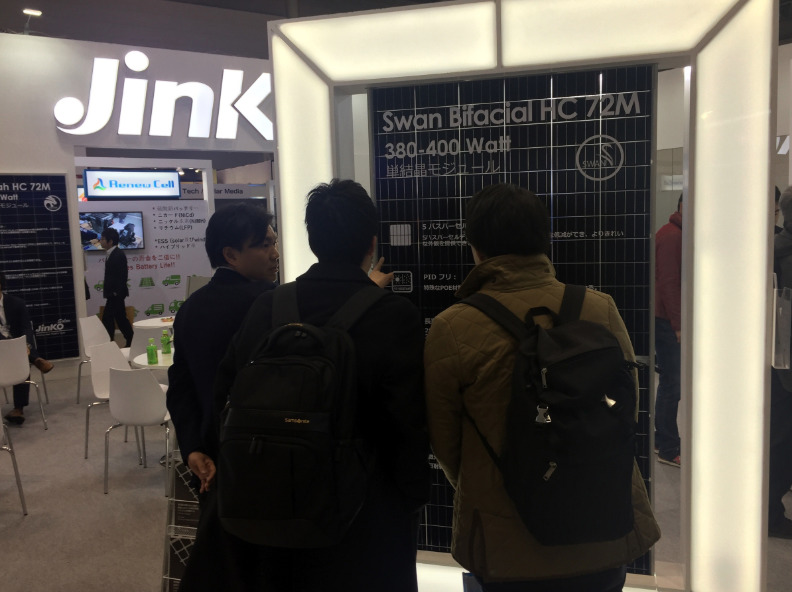
Single-glass modules with a transparent backsheet will eventually offer the lowest cost bifacial solar power, according to JinkoSolar.
The company has launched such a module this year ahead of putting it into the market in H2 2019.
Try Premium for just $1
- Full premium access for the first month at only $1
- Converts to an annual rate after 30 days unless cancelled
- Cancel anytime during the trial period
Premium Benefits
- Expert industry analysis and interviews
- Digital access to PV Tech Power journal
- Exclusive event discounts
Or get the full Premium subscription right away
Or continue reading this article for free
“We expect the cost of the product, once fully-commercialised at scale, will be better than dual glass,” said Gulnara Abdullina, GM for Jinko’s Middle East and Africa business. The module was given a soft-launch in Abu Dhabi in January. Abdullina points out that as well as benefits for EPC firms, a single-glass approach to bifacial solar will also mean lower impact from high-temperatures.
“A single-glass panel is going to heat up more slowly. That will also contribute to a better degradation pattern and that makes a huge difference to the financial model,” she said.
“The transparent backsheet has been developed by DuPont over the course of 20 years of R&D. The advantage is that it is lighter. One person can handle it because it is 23 kg, 9 kg lighter than a double glass product,” said Abdullina. “It is framed like a standard module too so you standardise the installation, minimise the labour costs and minimise the breakage rates. All this makes a great contribution to decreasing the capex.”
The new modules will use the company’s Cheetah cells with a 400W version available soon. A half-cut cell version has already tipped the 400W mark. Jinko will match the 30-year warranty offered on dual glass modules.
The footprint and frame of the module are the same as a “plain vanilla 72-cell” panel, according to Abdullina, which means the full ecosystem of conventional trackers, clamps etc are compatible.
Data on the precise impact on the levelized cost of energy (LCOE) has been modelled by Jinko with the firm keen to hold off on publishing numbers until more field data has been acquired.