Minnesota governor urged to veto anti-solar bill

March 20, 2017
Facebook
Twitter
LinkedIn
Reddit
Email
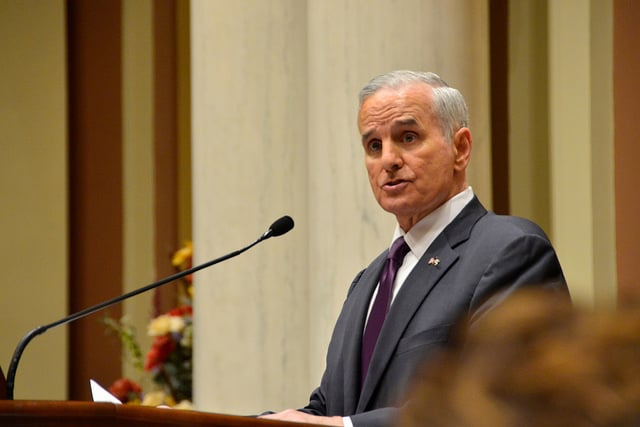
Minnesota governor Mark Dayton. Source: Flickr/Office of governor Mark Dayton

Minnesota is battling a new bill that would allow state electric utilities to be exempt from regulation by the Public Utilities Commission (PUC) with respect to net metering.

HF 234, as it is known, would allow such utilities to implement their own law and allow them to pay smaller fees to independent small renewable electricity generators, which could result in less compensation for solar users selling power back to the grid.

This article requires Premium SubscriptionBasic (FREE) Subscription

Try Premium for just $1

  • Full premium access for the first month at only $1
  • Converts to an annual rate after 30 days unless cancelled
  • Cancel anytime during the trial period

Premium Benefits

  • Expert industry analysis and interviews
  • Digital access to PV Tech Power journal
  • Exclusive event discounts

Or get the full Premium subscription right away

Or continue reading this article for free

The bill also exempts municipal utilities from PUC jurisdiction with respect to resolving net metering disputes.

Ultimately, the legislation could significantly harm Minnesota’s residential solar industry by enabling utilities to impose higher fees for solar users and limit their ability to fight back, according to Sean Gallagher, the Solar Energy Industries Association’s vice president of state affairs:

“Under governor Dayton’s leadership, Minnesota has transformed into a national leader in solar energy with nearly 3,000 solar jobs in the state. However, HF 234/SF 141 risks slowing that progress. This bill would enable cooperative utilities to target solar customers with unfair fees and limit their ability to fight back, making it more difficult for Minnesota residents to go solar.

“This is consistent with a larger nationwide trend by entrenched interests to discourage customers’ electricity choice with unreasonable fixed fees designed to reduce customers’ ability to control their electric bills and stifle competition from the burgeoning solar industry.  Existing law provides for a fair review of such proposals by utility regulators.  We urge governor Dayton to veto this legislation so solar’s economic contribution can continue to grow, not contract, in Minnesota.”

A lot is at stake for Minnesota. The state has one of the nation’s most successful community solar markets, alongside Massachusetts and Maryland. The Dayton administration also recently proposed a greater renewable portfolio standard (RPS) at 50% renewables by 2030, up from 25% by 2025.

The bill would evidently derail progress to reach that more aggressive RPS – a move that would help drive down the cost of clean energy while creating thousands of new jobs.
16 June 2026
Napa, USA
PV Tech has been running PV ModuleTech Conferences since 2017. PV ModuleTech USA, on 16-17 June 2026, will be our fifth PV ModulelTech conference dedicated to the U.S. utility scale solar sector. The event will gather the key stakeholders from solar developers, solar asset owners and investors, PV manufacturing, policy-making and and all interested downstream channels and third-party entities. The goal is simple: to map out the PV module supply channels to the U.S. out to 2028 and beyond.
13 October 2026
San Francisco Bay Area, USA
PV Tech has been running an annual PV CellTech Conference since 2016. PV CellTech USA, on 13-14 October 2026 is our third PV CellTech conference dedicated to the U.S. manufacturing sector. The events in 2023, 2024 and 2025 were a sell out success and 2026 will once again gather the key stakeholders from PV manufacturing, equipment/materials, policy-making and strategy, capital equipment investment and all interested downstream channels and third-party entities. The goal is simple: to map out PV manufacturing in the U.S. out to 2030 and beyond.

Read Next

January 22, 2026
Newly tightened federal permitting procedures for solar and wind projects are onerous, but can be navigated with proper planning, write Allison Chapin and Michael Downs.
January 21, 2026
Yield Energy has launched Yield Edge, a distributed energy resource management system (DERMS) for grid-ready flexibility from farms.
Premium
January 21, 2026
To say that it has been a busy time for the US solar industry lately would be an understatement, especially at the policy and tariff level.
January 21, 2026
Energy generation and storage developer Estuary Power has completed the final phase of construction at its Escape solar project in Lincoln County, Nevada. 
January 21, 2026
The USPTO has denied three challenges to patents held by US solar manufacturer First Solar pertaining to its production of TOPCon cells.
January 20, 2026
Radial Power has secured US$355 million from Goldman Sachs for 214MW of distributed solar across 106 projects nationwide.

Upcoming Events

Solar Media Events
February 3, 2026
London, UK
Solar Media Events
March 24, 2026
Dallas, Texas
Solar Media Events
April 15, 2026
Milan, Italy
Solar Media Events
June 16, 2026
Napa, USA
Solar Media Events
October 13, 2026
San Francisco Bay Area, USA