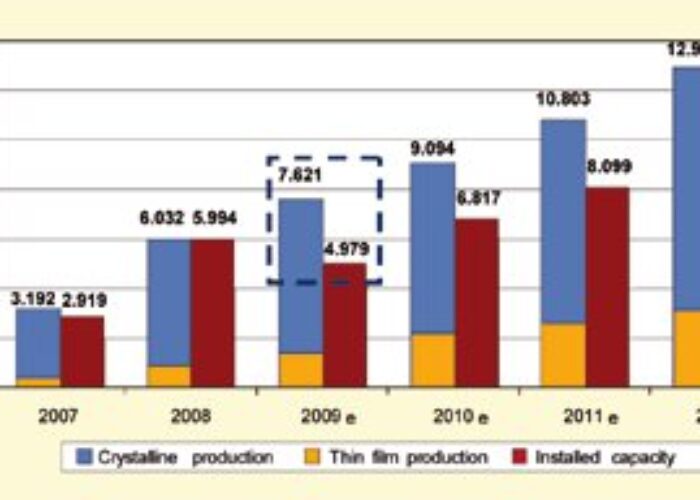
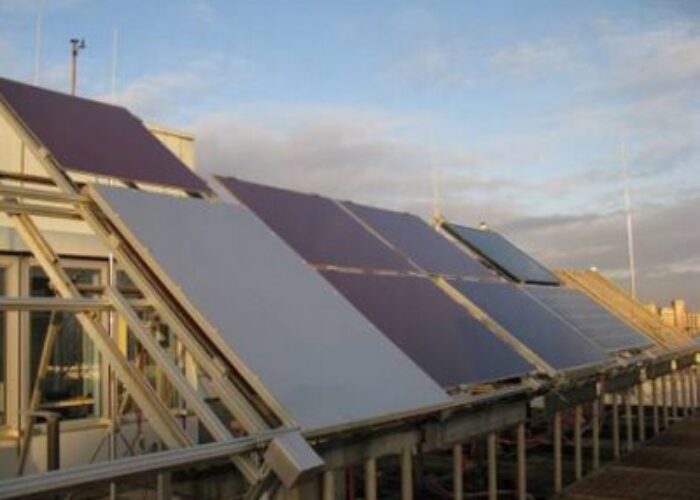
Until the year 2002, wafer-based crystalline silicon solar cells were almost exclusively the solar cell technology used for large-scale power plants. Since then, steady growth in the market share for thin-film technologies has been observed, although crystalline silicon technology still remains the most important solar cell technology used in large-scale PV power plants. The market share of thin-film modules, especially CdTe modules, has been continuously increasing in recent years, most notably in the German market. However, other countries like Spain, the USA, Italy and France have seen some large-scale CdTe-based modules being installed in power plants recently.
Wet processing can be a very high performing and cost-effective manufacturing process. It is therefore extensively used in Si solar cell fabrication for saw damage removal, surface texturing, cleaning, etching of parasitic junctions and doped oxide glass. PV manufacturers have succeeded in bringing down the cost of ownership of batch-type and in-line tools. The trend to back-side passivated solar cells requires cost-effective single-sided processing solutions. With the future pointing to ever-thinner silicon solar cells, handling these thin wafers in wet environments is a major challenge for any wet process. This paper reviews the major wet processing steps, emphasising some new developments and unknown issues, and provides a more general outlook on trends in wet processing.
Solar enterprises will each be faced with the occasional surplus or lack of solar modules in their lifetimes. In these instances, it is useful to adjust these stock levels at short notice, thus creating a spot market. Spot markets serve the short-term trade of different products, where the seller is able to permanently or temporarily offset surplus, while buyers are able to access attractive offers on surplus stocks and supplement existing supply arrangements as a last resort.
The photovoltaic market is currently experiencing a rapid decline in average selling price per module, resulting in a new era of challenges to reduce the investment and operational costs of manufacturing facilities. Subsequently, PV modules are rapidly gaining acceptance for industrial applications in the renewable energies sector. The PV industry will therefore need to progress toward high volume production of the established process technologies to meet future demand after the current inventory base has been installed. This paper addresses the potential impact of process technology, manufacturing and automation considerations, as well as the appropriate building concepts for large-scale crystalline silicon cell manufacturing. The other inherent advantages and considerations regarding fabs with a capacity approaching one gigawatt peak are also evaluated and discussed based on comparisons between two actual production facilities.
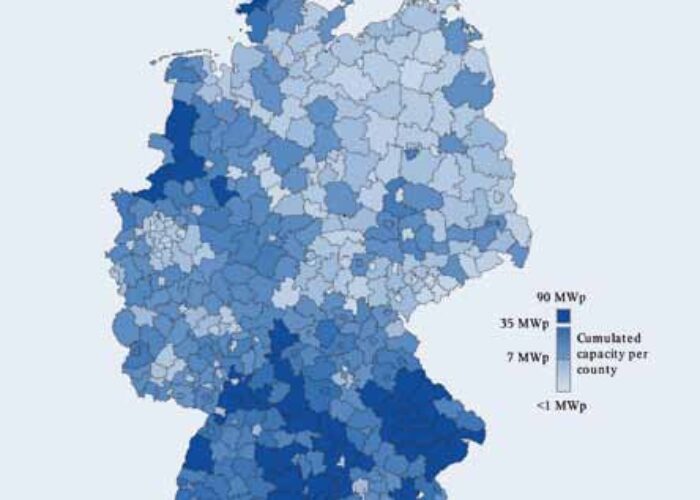
The global PV market is undergoing fundamental change. According to a new survey by EuPD Research, Germany is once again the most important PV sales market worldwide this year. Current market conditions are tightening, but within Germany there is still plenty of undiscovered potential. The transformation of the PV market from a supply-driven sellers’ market to a demand-driven buyers’ market is, however, an accelerated process rather than a slow development.
Solar photovoltaic power plants have emerged in recent years as a viable means of large-scale renewable energy power generation. A critical question facing these PV plants at the utility scale remains the competitiveness of their energy generation cost with that of other sources. The relative cost of electricity from a generating source can be compared through the commonly used levelized cost of electricity (LCOE) calculation. The LCOE equation evaluates the life-cycle energy cost and production of a power plant, allowing alternative technologies - with different scales of operation, investment, or operating time periods - to be compared. This article reviews the LCOE drivers for a PV power plant and the impact of a plant’s capacity factor on the system LCOE, as well as the effects of various factors such as capacity and geographical location. The economic tradeoffs between fixed and tracking systems are evaluated as well as a review of land use, plant operation and maintenance costs.
The fourth edition of Photovoltaics International was published in May 2009. It features an exclusive interview with First Solar’s Bruce Sohn on manufacturing and the future. SunPower also outlines the economic benefits of LCOE drivers in Power Generation and Fraunhofer IPA gives an overview of automation in the photovoltaic industry.
New interconnections requirements for utility-connected photovoltaic systems are coming into play in several European countries, armed with the task of supporting the grid operation and stability. This approach to better integration of photovoltaic systems into the electric power system enables a larger selection of renewable energies. This paper presents the new grid code in Germany as an example of this improved integration, complemented by a brief report regarding activities currently being undertaken to ensure European harmonisation of interconnection requirements.
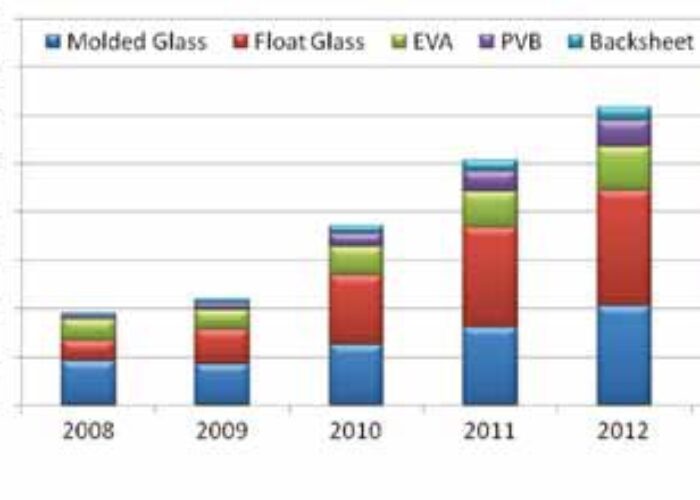
Although simple in concept, a photovoltaic solar cell is a difficult feat of technology in execution. The challenge of balancing cell structure design, material optimization and module technology to achieve efficient, low-cost modules that perform in aggressive environments for up to a generation is huge. The modules’ structure has to support and protect a thin, fragile slice of semiconductor, while ensuring a stable environment free from contamination and moisture with little or no change in the incident light on the cell. Key to the modules’ performance are the first-level polymeric materials that contact the cell and conductor structures, hold the module together, and in many cases form the second-level protection of the cells from the environment. In this article we explore the industry dynamics in the supply of advanced materials for module assembly, the new technology directions, and how the market will develop over the next five years.
The current industry situation of more competitive business approaches, increased PV project sizes and investments but declining profit margins renders an accurate knowledge of PV performance a vital factor in remaining competitive. Comprehension of expected lifetime and energy yield of PV generators is essential. Therefore, accurate characterization of PV modules is quickly becoming a more and more significant issue. This article gives an overview of the characterization topics of PV modules in terms of safety, failure susceptibility, overall reliability, system performance and energy rating.