The conflict in the Middle East could drive European solar power purchase agreement (PPA) prices up by as much as 35% as the conflict shifts towards attacks on energy infrastructure, which pose a risk to global gas supplies.
This is according to a blog post published yesterday by Swiss analyst Pexapark, which considers the impacts of the conflict on European renewable energy offtake deals. Using two European examples, the analyst points out the strong impact that gas prices have on overall power prices—driving marginal prices 45-55% of the time in Germany and 35-50% of the time in Great Britain—and how increases in gas price forecasts could drive increases in PPA prices.
Try Premium for just $1
- Full premium access for the first month at only $1
- Converts to an annual rate after 30 days unless cancelled
- Cancel anytime during the trial period
Premium Benefits
- Expert industry analysis and interviews
- Digital access to PV Tech Power journal
- Exclusive event discounts
Or get the full Premium subscription right away
Or continue reading this article for free
For instance, Pexapark expects gas prices in Germany to increase by 23% in the coming months and by 44% in Great Britain, as shown in the graph below. Over the same period, the analyst expects one-year solar PPA prices to increase by 24% and 35%, respectively, while ten-year solar PPA prices will increase by 5% and 19%, respectively.
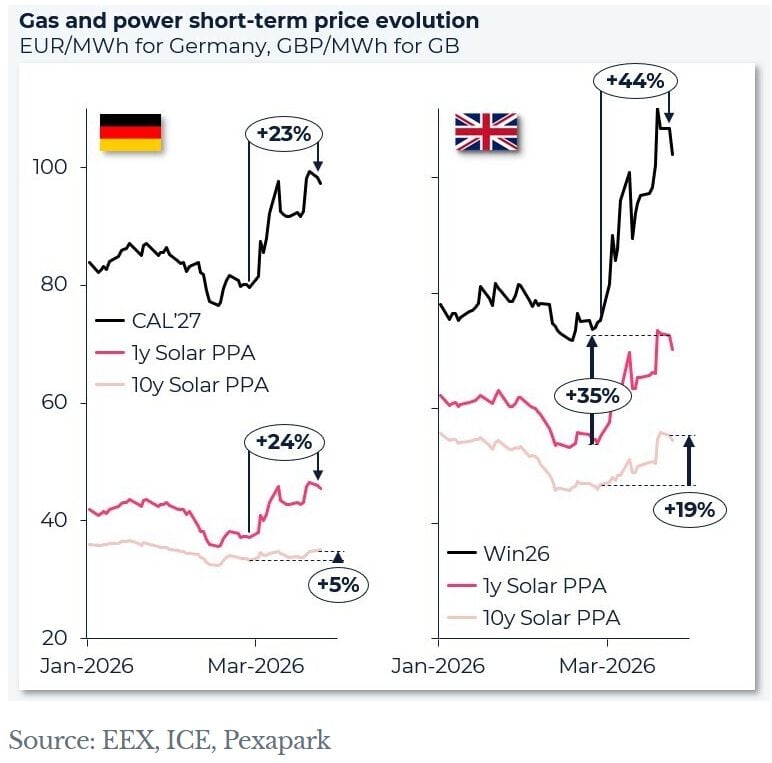
There has already been an uptick in PPA prices in the UK, with the value of a ten-year solar pay-as-produced PPA increased by 19%, compared to Pexapark. However, these improved “headline PPA economics”, as Pexapark puts it, in addition to a potential increase in demand for solar installations amid the conflict, would not necessarily be to the long-term benefit of the European renewable energy sector.
Pexapark notes that the disparity between buyers’ and sellers’ expectations of prices remains “wide”, and the impacts of the crisis on power prices will be particularly impactful in markets like the UK, where long-term PPA valuations rely on extrapolating short- and medium-term price signals, which are affected by disruptions such as the war.
ACER launches 2026 European market survey
The Pexapark report has coincided with the launch of a new survey from the EU Agency for the Cooperation of Energy Regulators (ACER). The agency publishes a survey each year to assess sentiment towards the European PPA space from stakeholders in the industry, and this year asks questions on four key topics: the availability of state-backed guarantees, the existence of PPA platforms, tax incentives to support PPAs and the role of carbon accounting standards.
The role of state-backed guarantees is particularly interesting, following the publication of a report from SolarPower Europe last month that showed that government auctions, rather than corporate PPAs, were becoming more popular in Europe. The report’s authors told PV Tech Premium that a “complimentary” relationship between these routes to market would be to the industry’s benefit, but the general trend seems to be that developers are more able and willing to secure finance from governments, such as through tenders and auctions, than through strictly private investment.
Last year’s ACER survey reflected many of the frustrations that have been expressed elsewhere in European solar, including a “lack of system flexibility” and an understanding that “further EU market integration”, that is to say improved cross-border power connections, would help protect consumers from price volatility.
Some of these conclusions were echoed by ACER in its 2026 Recommendations to the European Commission, which were published on Monday and include several recommendations to improve Europe’s grid infrastructure, including improving monitoring of grid activities and “strengthening the enforcement framework”.
The 2026 survey will remain open to responses until 8 May.
Leaders in the European solar sector are turning their attention to this year’s SolarPlus Europe event, to be held in Italy on 15-16 April by PV Tech publisher Solar Media. Information about the event, including the full agenda and options to purchase tickets are available on the official website.