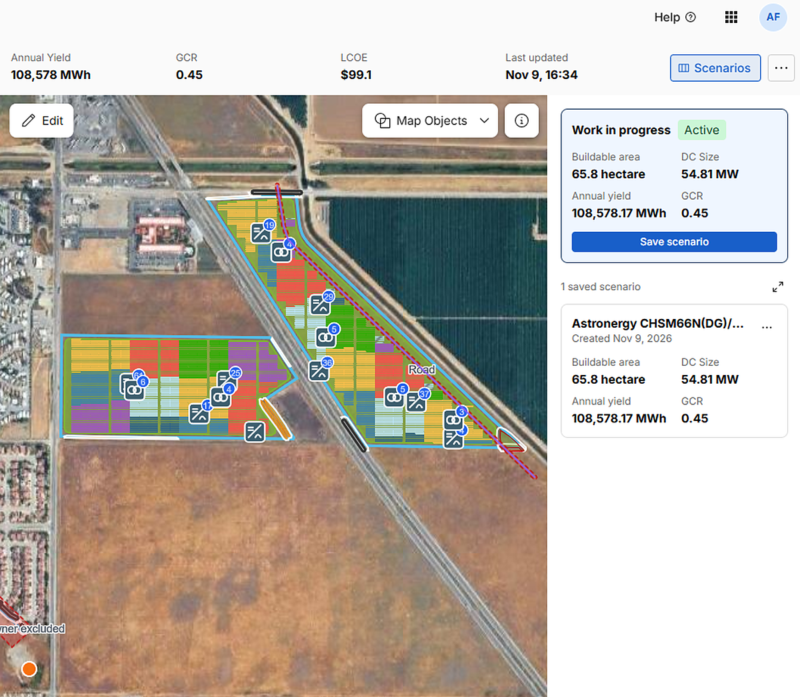
Lithuanian solar software developer PVcase has launched Concept, a cloud-based platform to assist developers in the site feasibility assessment phase of utility-scale solar project development.
The new platform, launched today at the RE+ event in Las Vegas, Nevada, allows developers to select an area of land and test a number of scenarios for deploying a solar project in that area, including choice of modules and components, avenues for grid connection and sentiments of local residents. The platform can then compare financial factors such as the expected cost of various components to give a clear overview of the potential financial investment required for each iteration of a project.
Try Premium for just $1
- Full premium access for the first month at only $1
- Converts to an annual rate after 30 days unless cancelled
- Cancel anytime during the trial period
Premium Benefits
- Expert industry analysis and interviews
- Digital access to PV Tech Power journal
- Exclusive event discounts
Or get the full Premium subscription right away
Or continue reading this article for free
These components, such as modules, inverters and racking systems, are collected in a product library, to which developers can add their own products and make amendments to components as specifications are updated. Douglas Geist, chief sales officer at PVcase, confirmed to PV Tech exclusively that the company has partnered with accreditation company DNV to access DNV-verified component files through the Concept platform.
“We’ve also partnered with DNV on this as well, to be able to provide users with access to and the ability to get actual DNV-verified component files through our platform,” said Geist. “That’s part of what we’ve done to try and make sure we’re as up-to-date and current on these types of things as possible.”
PVcase already offers two software platforms for project development, dubbed Prospect and Ground Mount, which are intended for use in the early site selection and later engineering work of the project development lifecycle. Geist told PV Tech that the new software aims to tackle what PVcase calls the “missing middle” of project decision-making that falls between the remits of these two existing platforms.
“Teams have used PVcase Prospect in order to identify a particular parcel of land or a series of parcels of land in order to be able to build a solar asset, [but] there’s this next step that they have to go through in order to funnel or filter through those parcels of land in order to really see what is going to be able to be built on it and hit the targets that they have for that particular project,” Geist explained.
“That’s a step that currently happens before they go into the more detailed engineering product, that being our PVcase Ground Mount product.”
The need for a more robust site selection and design process is clear, as an increasing number of solar project developers have reported challenges with realising a project from initial concept to functional project. Earlier this year, PVcase published a report on sentiment among solar industry professionals, which found that project attrition—a measure of projects at which work begins but never reach commercial operations—increased notably between 2025 and 2026, and 46% of those surveyed said at least half of their projects never reach construction.
You can read the interview with Douglas Geist in full on PV Tech’s Premium channel (subscription required).