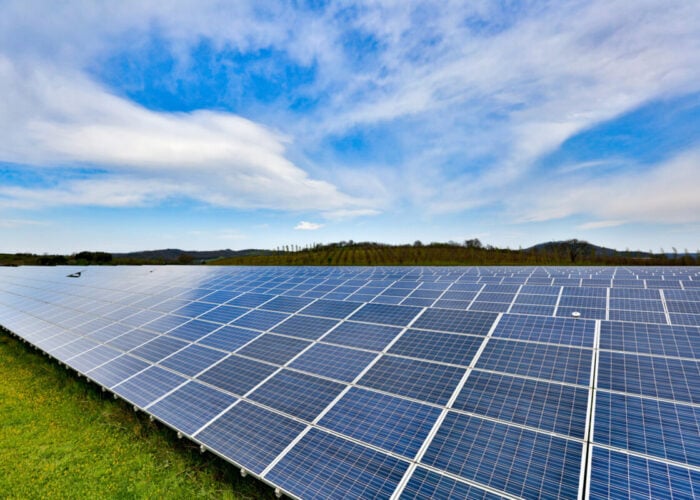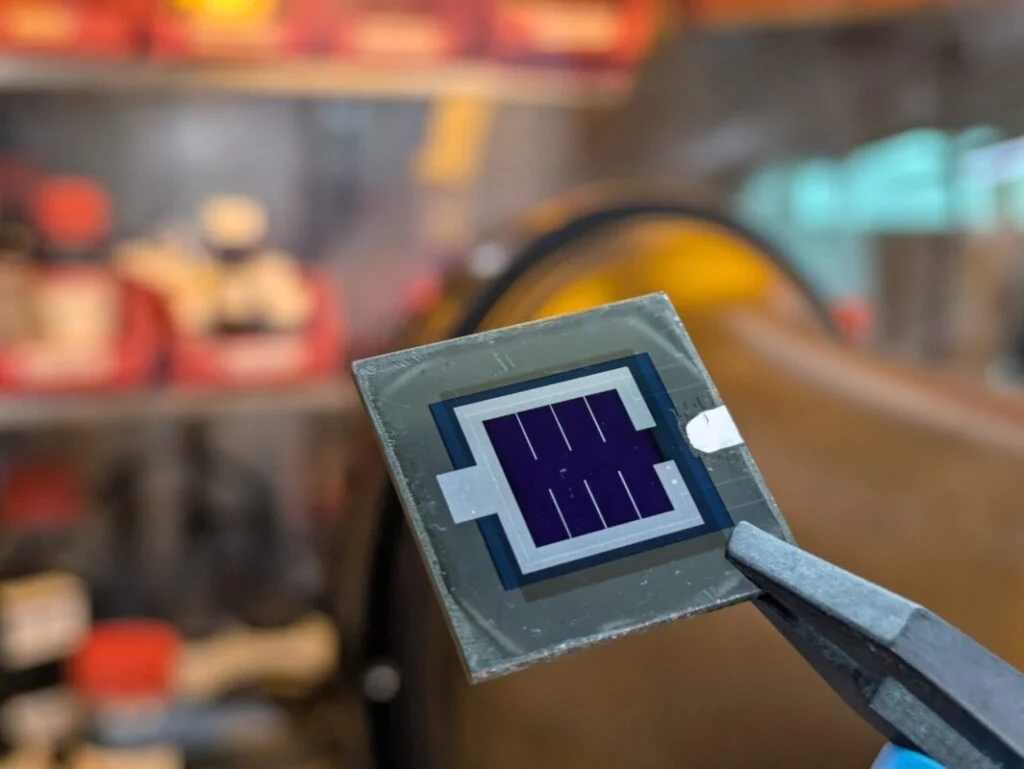
German researchers have achieved a record power conversion efficiency for a tandem solar cell combining a perovskite top layer and copper indium gallium selenide (CIGS) thin-film bottom layer.
Scientists from the Helmholtz-Zentrum Berlin (HZB) and Humboldt-Universität said the 25.5% milestone had been certified by the European Solar Test Installation (ESTI) and logged in the latest edition of the ‘Solar cell efficiency tables’, the definitive ledger published by the University of New South Wales.
Try Premium for just $1
- Full premium access for the first month at only $1
- Converts to an annual rate after 30 days unless cancelled
- Cancel anytime during the trial period
Premium Benefits
- Expert industry analysis and interviews
- Digital access to PV Tech Power journal
- Exclusive event discounts
Or get the full Premium subscription right away
Or continue reading this article for free
The research was part of the ‘SOLMATES’ project, an EU-funded venture led by HZB to explore the integration of CIGS and perovskite technologies. HZB said its previous record under this initiative stood at 24.6%.
HZB researcher Guillermo Farias Basulto said that to push past this earlier milestone, the researchers employed CIGSe-bottom cells with different band gaps of 1.05eV and 1.1 eV and two different thicknesses of aluminium-doped zinc oxides with similar characteristics.
“We also tested different cell architectures, added to the continuous improvements we had achieved with our previous record,” Farias-Basulto explained.
To reduce interfacial recombination losses and improve device stability, the researchers screened multiple combinations of nickel oxide (NiOx) and self-assembled monolayers (SAMs) as hole transport layers. They also refined the electron-selective contact processing by regulating the initial thermal evaporation rate of Buckminsterfullerene (C60) onto an ultra-thin, 1nm lithium fluoride passivation layer.
The record cell had only a small area of 1.081cm2, but the SOLMATES researchers were able to fabricate a mini-module with a similar stack of materials, achieving about 19.7% efficiency and an area of 2.25cm2.
Farias-Basulto highlighted the potential of the methods in the trial to yield even higher efficiencies. “The physics embedded in our current cell architecture suggests that 25.5% is merely a stepping stone, given that our in-house testing of similar architectures have already reached efficiencies of 27.5%’, he said.