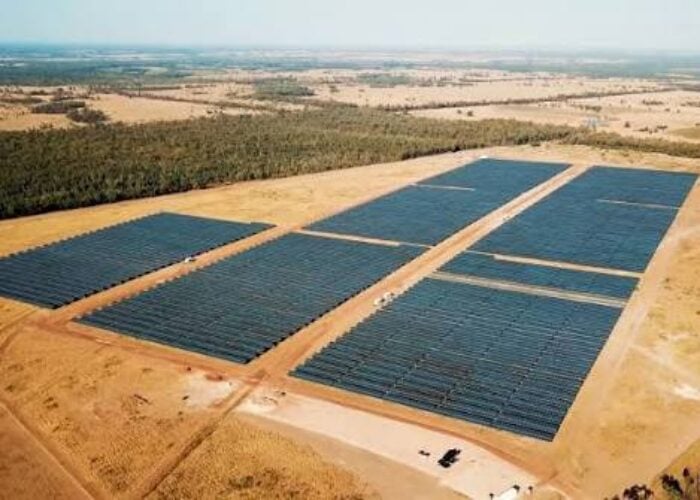
Samsung C&T Renewable Energy Australia, a regional energy division of South Korea’s Samsung Group, has submitted a 250MW solar-plus-storage site in New South Wales to the Australian government’s Environment Protection and Biodiversity Conservation (EPBC) Act.
Named the Romani Solar Farm, the project includes a 250MW solar PV power plant with a co-located 150MW/600MWh battery energy storage system (BESS) on site. Alongside this, a separate standalone 200MW/800MWh BESS is also being proposed as part of the project.
Try Premium for just $1
- Full premium access for the first month at only $1
- Converts to an annual rate after 30 days unless cancelled
- Cancel anytime during the trial period
Premium Benefits
- Expert industry analysis and interviews
- Digital access to PV Tech Power journal
- Exclusive event discounts
Or get the full Premium subscription right away
Or continue reading this article for free
According to documents submitted as part of the EPBC Act application, the solar-plus-storage site would connect to the National Electricity Market (NEM) via a connection with the Project EnergyConnect, an interconnector between the power grids of New South Wales and South Australia that is currently under construction.
Project EnergyConnect is being pursued via a partnership between transmission operators ElectraNet and Transgrid, and aims to deliver an 800MW interconnector between the power grids of South Australia and New South Wales, with an added connection to Victoria. Construction started in 2022, and it is anticipated to be completed in July 2027, having been delayed.
Samsung C&T Renewable Energy Australia has proposed to build a new 330kV transmission line, or use an existing 220kV transmission line, for the Romani project.
The plant will be located in Booroorban, in the Riverina Murray region, around 618km south of Sydney, the state capital. The project will sit across around 1,810 hectares, with the solar plant to cover an area of 430 hectares.
Samsung C&T, oriented towards the construction of large-scale projects, has a global presence in the renewable energy and storage market through various partnerships.
One such partnership is with Australian power and communications infrastructure provider Genus. The company, in a joint venture with Samsung C&T, was awarded three contracts for the engineering, procurement, construction (EPC) and commissioning for the balance of plant scope and BESS installation for a 600MW/1,600MWh BESS as part of the Melbourne Renewable Energy Hub (MREH) in Victoria.
Solar PV in the EPBC Act
The EPBC queue, administered by the federal government, aims to protect nationally threatened species and ecological communities. Approval must be received before a project can be developed.
Several solar-plus-storage projects have been submitted to the EPBC queue in recent months, including French energy major TotalEnergies’ 320MW Middlebrook solar-plus-storage project in Tamworth, northeast New South Wales and Acen Australia’s 320MW Deeargee solar PV power plant.
One of the latest solar PV projects to have been submitted to the act is Spanish solar developer X-Elio’s 720MW North Burnett Renewable Energy Hub in Queensland. The project features a 4-hour duration 720MW/2,880MWh BESS co-located with the solar PV power plant.
Should X-Elio secure the necessary approvals for the project, the developer expects construction to last around 36 months. The project is expected to have an operational life of 30 years. At the end of its life, the power plant will either be decommissioned or repowered with new solar equipment.
In December 2024, the Australian trade association Clean Energy Investor Group scrutinised the EPBC Act, arguing that the length of time required to make a decision had doubled from 2021 to 2023.
According to the group representing Australian and global renewable energy investors, the average decision-making period for controlled actions requiring comprehensive environmental assessments increased from 62 days in 2021 to 136 days in 2023.