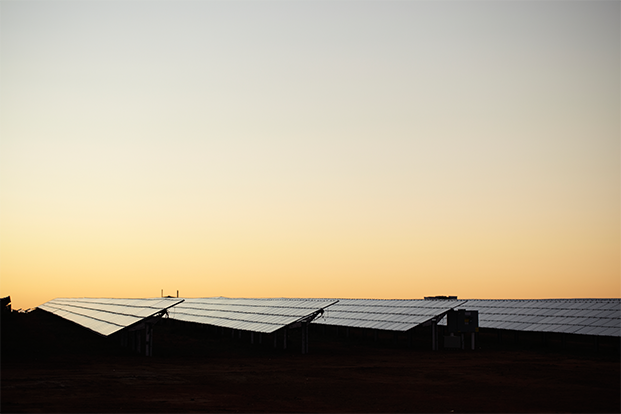
Australia has confirmed it will return AU$1.3 billion (US$940 million) in uncommitted funding from several clean energy manufacturing programmes as part of broader budget savings measures announced in the 2026-27 Federal Budget, with the Solar Sunshot Program among those affected by the reallocation.
The decision forms part of AU$63.8 billion in savings and reprioritisations outlined in the budget, which the government said was necessary to strengthen fiscal sustainability amid global economic disruption caused by conflict in the Middle East.
Try Premium for just $1
- Full premium access for the first month at only $1
- Converts to an annual rate after 30 days unless cancelled
- Cancel anytime during the trial period
Premium Benefits
- Expert industry analysis and interviews
- Digital access to PV Tech Power journal
- Exclusive event discounts
Or get the full Premium subscription right away
Or continue reading this article for free
The returned funds come from uncommitted allocations across the Battery Breakthrough Initiative, Hydrogen Headstart, Solar Sunshot and Australia’s Economic Accelerator programmes.
Specifically, the Hydrogen Headstart programme has seen AU$1 billion clawed back, whilst a combined AU$300 million has been reduced from the Solar Sunshot Program and the Battery Breakthrough Initiative.
The budget papers describe the move as part of “sensible and responsible savings” aimed at containing cost pressures while safeguarding long-term service continuity. The government emphasised that the reallocation does not affect committed funding or projects already underway, with the clawback targeting only funds not yet allocated to specific recipients.
Gross debt is now AU$18 billion lower in 2026-27 than forecast in the mid-year update and AU$173 billion better than the government inherited, according to budget documents.
Solar Sunshot Program faces funding adjustment
The Solar Sunshot Program, launched in March 2024 with an initial AU$1 billion commitment by Prime Minister Anthony Albanese, was designed to accelerate domestic solar photovoltaic manufacturing across the supply chain.
Managed by the Australian Renewable Energy Agency (ARENA), the initiative aimed to support Australia’s ambition to capture a larger share of global solar manufacturing while reducing reliance on imports.
The programme’s core objective centred on ARENA’s “30-30-30” vision: achieving 30% solar module efficiency at an installed cost of 30 cents per watt by 2030, which would drive the levelised cost of electricity below AU$20 per megawatt hour.
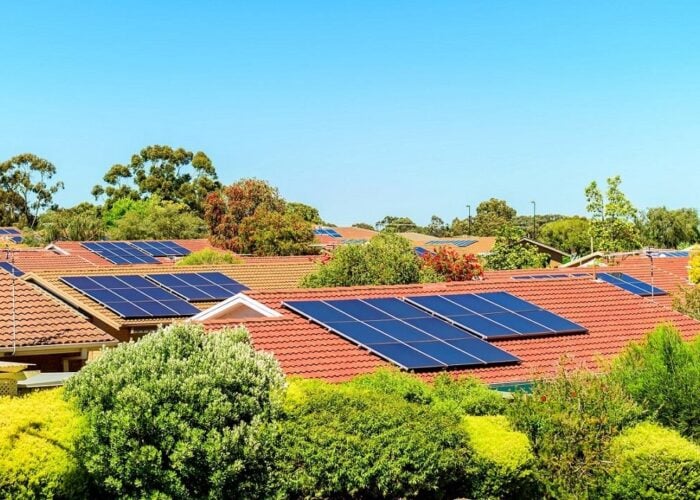
Currently, only 1% of solar modules installed on Australian rooftops are manufactured domestically, despite one in three households using solar power. The government had set a target to increase domestic production to 20% of installed capacity, aiming to reshape Australia from a solar consumer to a manufacturing hub.
Solar Sunshot was structured across multiple funding rounds, with Round 1A allocating AU$500 million toward solar PV manufacturing innovation focused on modules, inputs such as solar glass and frames, and deployment systems.
Round 1B, which allocated AU$50 million for feasibility studies and front-end engineering design, remains open until November 2026.
Round 2, launched in September 2025 with AU$150 million allocated, targets inputs to modules and deployment technologies, including balance-of-plant components.
Dan Sturrock, general manager solar at ARENA, recently discussed the initiative and its various rounds at the Smart Energy Conference 2026 in Sydney last week.
Among the programme’s early recipients, Adelaide-based manufacturer Tindo Solar secured AU$34.5 million to expand its production capacity, marking one of the initiative’s first major commitments.
The funding was intended to help Tindo increase module production from 20MW to 180MW per year and to renovate its Mawson Lakes factory in South Australia to produce at a larger scale and at lower cost.
Tindo confirmed it would introduce advanced automation and expand its product range to include premium N-type solar modules, with the support including both a Manufacturing Production Credit and a capital grant for a feasibility study into developing a future gigafactory capable of producing up to 1GW of solar modules annually.
Other early recipients included 5B, which secured up to AU$46 million to expand manufacturing capacity for its “Maverick” solar deployment system, and AU$11 million allocated across three feasibility studies exploring upstream solar PV component manufacturing.
These studies examined the technical and commercial viability of establishing domestic supply chains for polysilicon, ingots and wafers.
ARENA had positioned Solar Sunshot as complementary to its broader Ultra Low-Cost Solar research and development programme, which allocated AU$60 million to advance breakthrough technologies in solar efficiency and cost reduction.
Battery Breakthrough Initiative also affected
The Battery Breakthrough Initiative, launched in August 2025 with AU$500 million in total funding, has similarly been subject to the uncommitted funds clawback.
The programme, also delivered by ARENA in collaboration with the Department of Industry, Science and Resources, was designed to position Australia as a competitive player in global battery manufacturing by addressing critical gaps in domestic capability.
The initiative targeted three strategic segments of the battery value chain: advanced materials processing leveraging Australia’s lithium, nickel, cobalt and graphite reserves, battery cell production to transform Australia from a raw materials supplier into a finished cell producer, and battery pack assembly serving both domestic storage needs and export markets.
Funding mechanisms under the Battery Breakthrough Initiative included capital grants for infrastructure development, production incentives for operational support, and streamlined approvals for projects seeking AU$50 million or less in funding.
The programme was structured as an open, merit-based initiative intended to remain active until funds were exhausted or the government determined a closure date.
Early recipients included Victorian manufacturer PowerPlus Energy, which secured AU$2.3 million to triple its battery module production capacity to 150MWh by semi-automating local manufacturing.
The AU$6.7 million project aims to support growth in sectors such as agriculture, utilities, and eco-resorts.
Firebird Metals received AU$2 million to develop Australia’s first demonstration-scale facility processing manganese concentrate into cathode materials for batteries at a Perth site, leveraging Australia’s mineral resources to meet growing global demand for manganese-rich batteries.
The Hydrogen Headstart programme, which had AU$4 billion in total funding across two rounds, was also affected by the return of uncommitted funds.
Round 1 had already allocated AU$814 million to Copenhagen Infrastructure Partners for a 1.5GW development in Western Australia, while Round 2 maintained AU$2 billion in available funding for large-scale green hydrogen production projects.
Budget forecasts for the hydrogen production tax incentive, which comes into effect in 2027, have been scaled back by AU$1.9 billion over five years to June 2030, largely reflecting lower-than-expected production forecasts from the green hydrogen industry.
While the clawback targets only uncommitted allocations, it signals a more cautious approach to discretionary programme spending as Australia navigates inflationary pressures forecast at 5% through the year to June 2026 and slower economic growth forecast at 1.75% for 2026-27.