Sharp hits 25.09% conversion efficiency for 6-inch HBC solar cell

Facebook
Twitter
LinkedIn
Reddit
Email
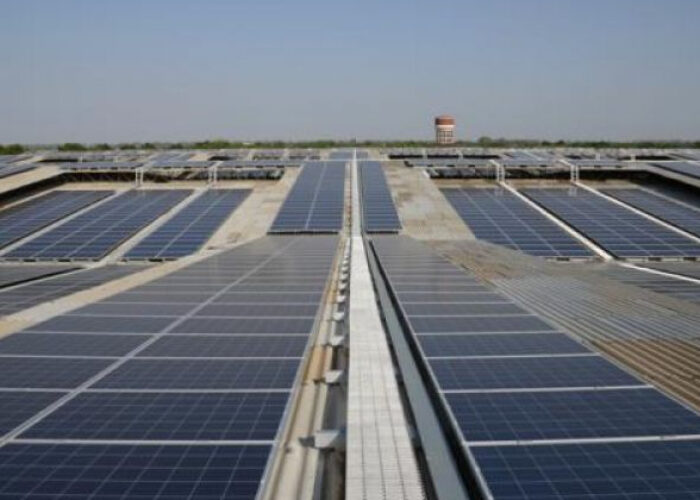
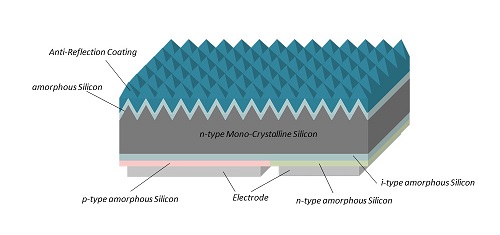
The HBC cell on a 6-inch (full-area) wafer is claimed by Sharp to be the highest efficiency reported to date. Image: Sharp

Sharp Solar, a subsidiary of Taiwan-based contract electronics giant Foxconn has reported a verified heterojunction back contact (HBC) solar cell on a large-area (6-inch) N-type monocrystalline wafer with a conversion efficiency of 25.09%.

Sharp Solar said the cell was validated by the Japan Electrical safety & Environment Technology laboratories (JET) and the R&D partially funded by Japan's New Energy and Industrial Technology Development Organization (NEDO) under the theme of “Development of Cost Reduction Technology of High Performance, High Reliability Solar Power Generation”.

This article requires Premium SubscriptionBasic (FREE) Subscription

Try Premium for just $1

  • Full premium access for the first month at only $1
  • Converts to an annual rate after 30 days unless cancelled
  • Cancel anytime during the trial period

Premium Benefits

  • Expert industry analysis and interviews
  • Digital access to PV Tech Power journal
  • Exclusive event discounts

Or get the full Premium subscription right away

Or continue reading this article for free

Back in 2014, Sharp reported a small-area wafer size conversion efficiency for its HBC cells of 25.1%

The HBC cell on a 6-inch (full-area) wafer is claimed by Sharp to be the highest efficiency reported to date.


Read Next

September 4, 2026
The US PV manufacturing sector is set to make huge strides by 2030, but with some upstream constraints unresolved and question marks over future demand drivers.
September 3, 2026
Scientists in Japan have developed a new approach which they claim can improve the durability of tin-based perovskite solar cells.
Premium
September 3, 2026
Heterojunction is emerging as the n-type technology of choice as US PV manufacturers seek to minimise IP-related risks.
September 2, 2026
In the third part of this week’s series exploring the US solar supply chain, we track how quickly announced manufacturing capacity is translating into real production.
September 1, 2026
US module production is at a near saturation point, but significant capacity gaps persist further up the supply chain, writes head of PV Tech Research, Moustafa Ramadan.
August 28, 2026
Importing solar modules to the US will “no longer make any economic sense” under new Section 232 tariffs for polysilicon-based products, according to Intertek CEA.

Upcoming Events

Solar Media Events
October 13, 2026
San Francisco Bay Area, USA
Solar Media Events
November 3, 2026
Málaga, Spain
Solar Media Events
November 24, 2026
Warsaw, Poland
Solar Media Events
February 2, 2027
London, UK