More than a quarter of the European Union’s (EU) electricity (27%) came from solar and wind in 2023, according to new analysis from energy thinktank Ember.
Renewables accounted for 44% of the EU electricity mix in 2023, the first time it passed the 40% mark, with solar generation at 36TWh, and now represents 9% of the EU’s total electricity generation.
Try Premium for just $1
- Full premium access for the first month at only $1
- Converts to an annual rate after 30 days unless cancelled
- Cancel anytime during the trial period
Premium Benefits
- Expert industry analysis and interviews
- Digital access to PV Tech Power journal
- Exclusive event discounts
Or get the full Premium subscription right away
Or continue reading this article for free
Although a record year for capacity additions from solar PV, which saw 2023 adding 56GW of capacity, Ember’s European Electricity Review shows that solar generation growth was lower in 2023, by 25% compared to 2022 when it stood at 48TWh. The cumulative installed solar capacity in the EU now stands at 263GW.
A lower irradiation level in key solar markets, such as Germany and Italy, could be attributed to the lower growth of solar generation in 2023. The report highlights that, on average, EU country’s solar irradiation was 3.4% lower than in 2022 levels.
Even though still not a major problem across member states, solar curtailments are on the rise in the EU, with the Netherlands more than trebling residential solar curtailments in the first half of 2023, compared with the same period in 2022.
Installation of battery storage could help solve the issue, while at a larger scale, it could alleviate issues of price cannibalisation, negative prices and curtailment. “Grids, storage and other enablers of system flexibility will be increasingly critical as wind and solar’s share continues to grow,” reads the report.
Many records were made last year, helped by solar and wind. Among them, the highest annual percentage falls in power sector CO2 emissions for 11 countries. In three of these – Spain, Germany and Poland – solar had a role in it, raising its share as it either replaced coal generation (Germany and Poland) or due to a fall in electricity demand (Spain).
Following the trend initiated in 2022, last year saw a decline in electricity demand by 3.4% (-94TWh) compared to 2022, and 6.4% (-186TWh) lower than in 2021 when the energy crisis began in Europe.
Sarah Brown, Europe programme director at Ember, said: “The energy crisis and Russia’s invasion of Ukraine did not lead to coal and gas resurgence — far from it. Coal is nearing phase-out, and as wind and solar grow, gas will be next to enter terminal decline. However it is not time to get complacent. The EU needs a laser focus on rapidly deploying wind, solar and flexibility to create a system free of fossil fuels.”
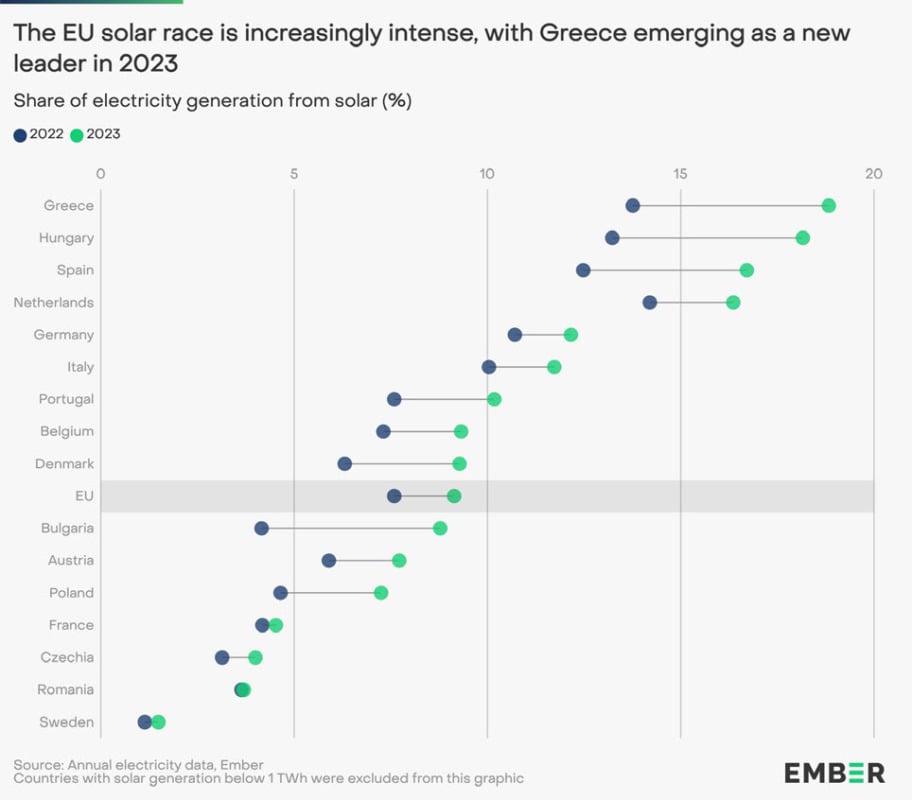
Greece leads share of electricity generation from solar
Greece’s continued growth of solar PV additions since 2019 – boosted by the feed-in premium for small ground-mounted PV until 2022 – along with a simplified permitting process, helped the country take the lead in the share of electricity generation from solar, with 19% in 2023.
Hungary (18%) and Spain (17%) closed the podium, while the Netherlands dropped from first place in 2022 to fourth. Grid congestion, lack of available space for utility-scale PV systems and the anticipated phase-out of the net metering scheme have led the Netherlands to have a lower increase between 2022 and 2023 than the other three.
Furthermore, the report highlighted some challenges the power sector faces towards a transition to renewables, such as the slow permitting process, grid infrastructure issues, and supply chain issues.
Solar’s growth was highlighted last year in EU member states’ revised National Energy and Climate Plans (NECPs), which saw a 70% increase in solar PV targets compared to the previous plan submitted four years ago. However, these new renewable goals would not meet the EU’s goals, and the European Commission called on member states to ‘enhance their efforts’ to reach them.
Two years ago, the EU significantly ramped up its renewables target and updated its REPowerEU targets, which expects to have 400GWdc of installed solar capacity by 2025 and 740GWdc by 2030, while earlier this week, it targeted a 90% reduction in net greenhouse gas emissions by 2040 compared to 1990 levels.