Solar PV and wind are now the cheapest sources of power globally, with co-located hybrid systems increasingly delivering round-the-clock electricity at fossil fuel-competitive costs in high-resource regions, according to a new report by the International Renewable Energy Agency (IRENA).
In its report titled ‘24/7 renewables: The economics of firm solar and wind’, IRENA highlighted that while renewable energy deployment has scaled rapidly on the back of falling costs, the next phase of the energy transition will be defined by system adequacy and flexibility – ensuring clean electricity is available whenever and wherever it is needed.
Try Premium for just $1
- Full premium access for the first month at only $1
- Converts to an annual rate after 30 days unless cancelled
- Cancel anytime during the trial period
Premium Benefits
- Expert industry analysis and interviews
- Digital access to PV Tech Power journal
- Exclusive event discounts
Or get the full Premium subscription right away
Or continue reading this article for free
The report introduced a new project-level metric, “firm levelised cost of electricity (LCOE)”, to assess the cost of delivering continuous electricity from hybrid systems combining solar PV, onshore wind and battery energy storage systems (BESS).
Solar-plus-storage already cost competitive in key regions
According to IRENA’s analysis, firm renewable electricity costs have declined rapidly across all major technologies and markets, driven primarily by sharp reductions in solar PV and battery storage costs.
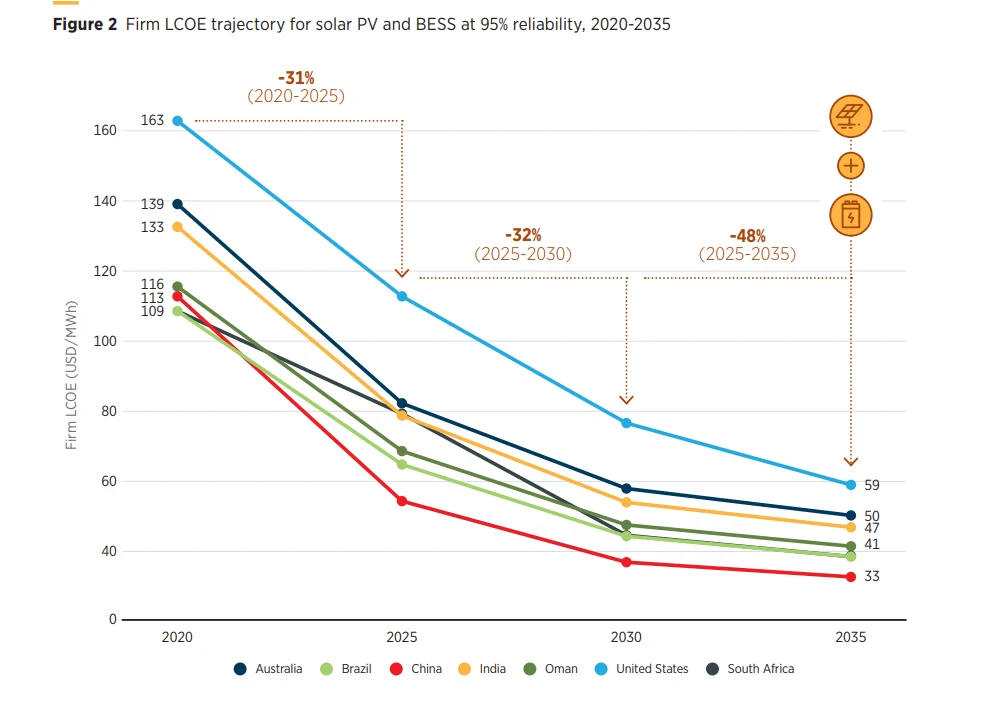
In high-quality solar resource regions, co-located solar PV and storage systems are already capable of delivering firm electricity at costs below fossil fuel benchmarks. The report said that in 2025, firm LCOE for solar-plus-storage systems in strong solar and wind regions ranged from around US$54-82/MWh, down from more than US$100/MWh in 2020.
Further cost reductions are expected, with IRENA projecting firm LCOE could fall by around 30% by 2030 and approximately 40% by 2035, bringing costs below US$50/MWh at the best-performing sites.
The agency’s analysis of 252 utility-scale solar PV projects commissioned in 2024 in China shows that a significant majority can deliver firm electricity below US$100/MWh, with minimum firm costs as low as US$30/MWh at a 90% reliability level. Even at 99% reliability, costs rise only modestly to around US$46/MWh.
Rapid cost declines across solar PV and storage
The report attributed falling firm electricity costs primarily to the rapid decline in component costs across solar PV and battery storage technologies.
Between 2010 and 2024, global weighted average total installed costs for solar PV fell by 87% to US$708/kW, while levelised costs of electricity declined by 90% to US$44/MWh.
Battery energy storage systems experienced even steeper declines, with costs falling by 93% over the same period from US$2,634/kWh in 2010 to US$197/kWh in 2024. Industry data cited in the report suggests that battery system prices fell by around 30% in 2025 alone, reaching their lowest recorded levels.
IRENA stated that continued manufacturing scale, technology learning and supply chain maturation are expected to drive further cost reductions across solar PV, wind and storage over the next five to ten years.
Hybrid solar systems emerging as firm power assets
The report highlighted that solar PV is increasingly being deployed alongside wind and battery storage in co-located hybrid configurations, enabling projects to optimise grid connections, shift generation to higher-value periods and reduce exposure to price volatility.
IRENA noted that these systems are now emerging as a distinct asset class capable of providing firm electricity supply, particularly for large energy users such as data centres, artificial intelligence workloads and advanced manufacturing facilities.
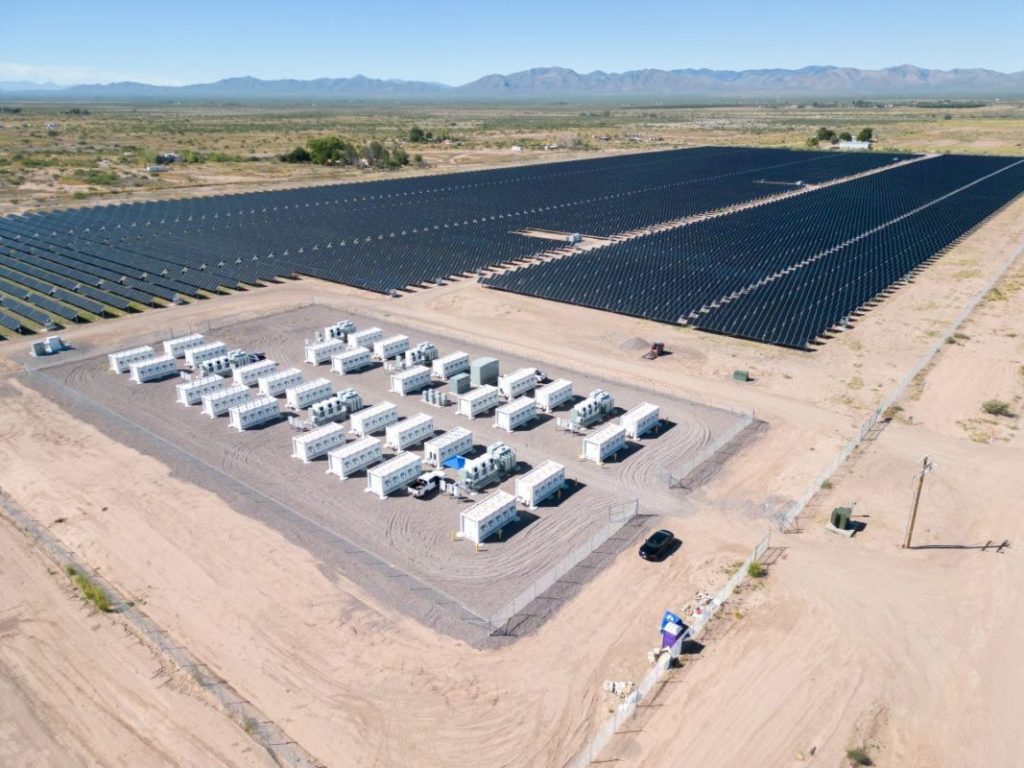
A key example cited is the Al Dhafra project in the United Arab Emirates, which will combine 5.2GW of solar PV with 19GWh of battery storage to deliver 1GW of firm clean electricity. The project has an estimated firm LCOE of around US$70/MWh.
The report added that in the US, solar-plus-storage has shifted from an exception to a standard configuration for new utility-scale solar developments, with paired storage expected to account for the majority of new solar capacity additions within this decade.
Solar cost leadership in high-irradiance markets
IRENA identified strong solar resource regions as the primary drivers of cost competitiveness for firm solar electricity. Across high-quality sites in Brazil, India, South Africa, Australia and the Gulf region, firm solar LCOEs in 2025 are estimated to range between US$65-82/MWh, with unfirmed LCOEs as low as US$29–39/MWh.
By 2030, firm costs in these regions are projected to fall to between US$44-58/MWh, reflecting continued declines in both solar PV and storage costs.
China remains the lowest-cost market globally, while the US is identified as an outlier with higher firm LCOEs due to elevated financing costs, interconnection charges and permitting complexity.
Despite regional variation, IRENA concluded that the majority of the world’s population lives within high-irradiance and strong wind zones, making the declining cost of firm solar power a development opportunity of global significance.
Technology advances driving solar efficiency gains
The report highlighted significant technological improvements in solar PV systems as a key driver of cost reductions. Between 2010 and 2024, global module efficiencies increased to between 21.7% and 23.8%, with advanced cell technologies such as n-type tunnel oxide passivated contact (TOPCon) and heterojunction (HJT) becoming standard. Bifacial modules now account for around 90% of global shipments, contributing to higher yield and improved system economics.
These advances, alongside widespread deployment of single-axis trackers and improved inverter loading ratios, have helped increase global solar capacity factors from 15% in 2010 to 17.4% in 2024.
IRENA estimated that module and inverter improvements accounted for around 60% of total installed cost reductions in solar PV systems, with balance-of-system components contributing a further 30%.
Solar PV increasingly competitive with fossil generation
The report stated that in 2025, utility-scale solar PV and onshore wind both cost around US$40/MWh globally, less than half the cost of new combined-cycle gas turbines, which exceeded US$100/MWh.
In China, firm solar-plus-storage already undercuts both new coal and gas generation, while in markets such as Saudi Arabia, firm solar electricity is approaching parity with gas-fired generation even where fuel costs are relatively low.
IRENA also noted that in several economies, co-located wind and solar systems with storage are now competitive with the operating costs of existing fossil fuel plants, challenging not only new build economics but also the viability of continued operation of legacy assets.
The report concluded that the pace of deployment of firm renewable electricity systems will be one of the most consequential factors shaping the global energy transition in the coming decade.