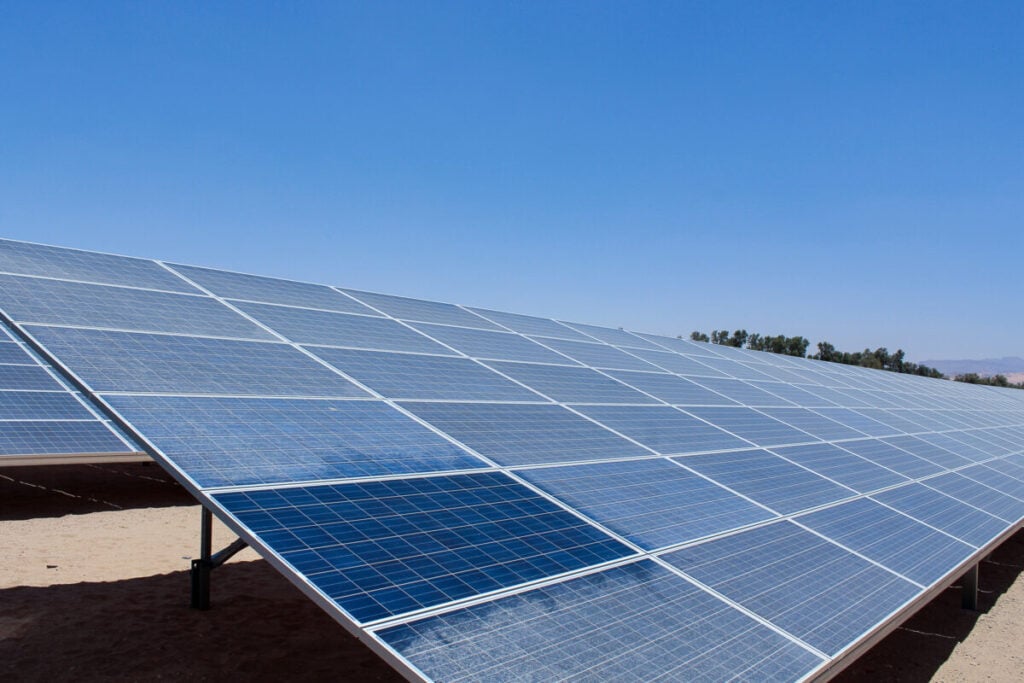
Researchers have developed a new methodology they hope will improve the modelling of the likely impact of different types of dust on PV system performance.
Soiling from the accumulation of dust on PV modules in arid and semi-arid areas can lead to significant performance losses, but its precise impact is difficult to predict in different locations due to the costs and complexities involved in collecting and evaluating local dust samples.
Try Premium for just $1
- Full premium access for the first month at only $1
- Converts to an annual rate after 30 days unless cancelled
- Cancel anytime during the trial period
Premium Benefits
- Expert industry analysis and interviews
- Digital access to PV Tech Power journal
- Exclusive event discounts
Or get the full Premium subscription right away
Or continue reading this article for free
A study by scientists from Germany’s Fraunhofer Center for Silicon Photovoltaics (CSP) and King Mongkut’s University of Technology, Bangkok, has sought to close this gap by analysing the impact of dust from several different locations on PV module performance.
The research team said the project was aimed at gaining a better understanding of the impacts on soiling, with a particular focus on the uncertainties between transmission losses and the associated short-circuit current losses caused by different types of dust.
They collected dust samples from Morocco, Qatar and two sites in Thailand and conducted soiling tests in laboratory conditions.
Each dust sample was analysed for properties such as particle size distribution and chemical composition.
Laboratory tests exposed glass samples and single-cell PV mini-modules to define soiling conditions, correlating the transmittance loss, short-circuit current loss and the dust density with the surface coverage.
This enabled an accurate comparison of the relative impact of each sample on performance, based on the gradient of the correlation lines.
The researchers reported that the analysis revealed critical insights into the relationships between transmission loss, short-circuit current loss and dust density in relation to surface coverage.
In particular, they noted a consistent overestimation of soiling loss based on transmission measurements taken from glass samples compared to measurements conducted on PV mini-modules. The soiling-related transmission loss was 16.6% higher than the short-circuit current loss. The research also highlighted a 15.5% lower measured short-circuit current loss than the standard model predicted.
“These discrepancies can be attributed primarily to variations in light paths and the scattering effects of dust on the samples,” the researchers noted. “Despite these systematic differences, we identified specific characteristics of dust that influence soiling behaviour, underscoring the phenomenon’s complexity.”
The researchers said the findings offered valuable insights for refining measurement techniques and, ultimately, optimising the performance of solar energy systems in dust-prone regions.
“This research advances our understanding of how soiling affects PV modules and lays the groundwork for future studies aimed at enhancing the accuracy of existing models,” the researchers concluded. “Ultimately, our work represents a crucial step towards improving the efficiency and durability of PV modules under real-world conditions.”
The ‘Impact of different types of dust on solar glass transmittance and PV module performance’ was published in the journal Progress in Photovoltaics.