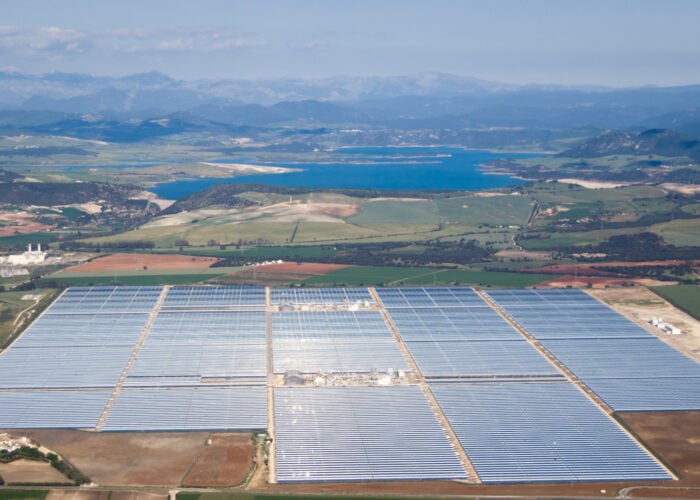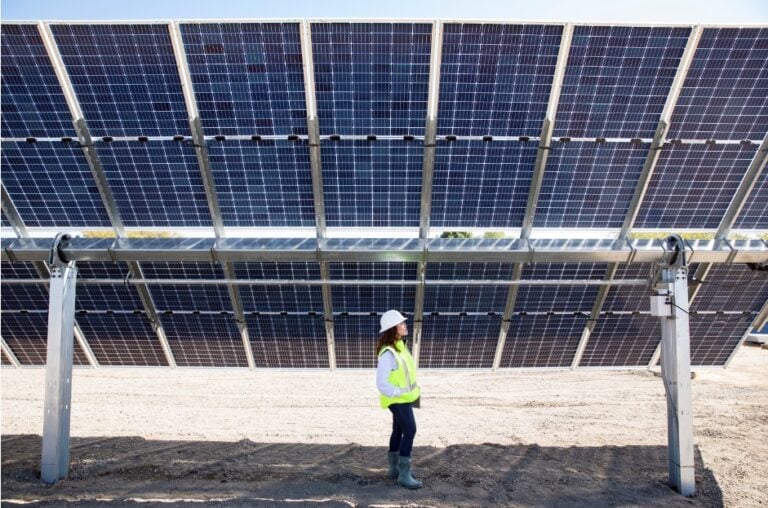
Bifacial photovoltaic (PV) technology has emerged as the new standard in the solar industry. There’s clear appeal—bifacial solar systems are more efficient as they capture sunlight on both the front and rear sides of the PV module.
However, the discussion about the ability of current PV simulation software to accurately simulate energy performance for bifacial PV modules leaves more questions than answers. Many industry simulation tools still rely on models designed for monofacial systems, leading to inaccurate estimates and financial risks.
Try Premium for just $1
- Full premium access for the first month at only $1
- Converts to an annual rate after 30 days unless cancelled
- Cancel anytime during the trial period
Premium Benefits
- Expert industry analysis and interviews
- Digital access to PV Tech Power journal
- Exclusive event discounts
Or get the full Premium subscription right away
Or continue reading this article for free
Bifacial technology requires more advanced simulation methodologies and more accurate, detailed datasets. To keep up with technological advancements in PV modules, the solar industry must evolve and move beyond legacy approaches that fail to support innovation.
In this article, I explore three essential advancements for accurate bifacial PV modeling: ray tracing technology based on the anisotropic sky model, the importance of using accurate ground albedo data and the use of high-resolution 15-minute solar and meteorological time series.
Ray tracing technology and the anisotropic sky model
Existing commercial PV simulation tools rely on the view factor model, a simplified method based on the isotropic sky model. While effective for monofacial PV systems, this approach is less accurate when estimating rear-side solar radiation for bifacial modules.
The view factor model assumes that diffuse sky radiation is uniform across the sky dome, failing to account for variations in reflections, shading from nearby objects and real-world environmental interactions. These inaccuracies often lead to overestimated PV power output predictions, which can cause suboptimal system designs and financial losses.
Backward ray tracing technology, using the anisotropic sky model, offers a near-realistic and detailed simulation of how reflected light interacts with bifacial PV modules by considering:
- Both direct and diffused light hitting front and the rear side of the modules
- The dynamic interaction of solar radiation with the ground surface
- The impact of shading from surrounding objects such as structures, nearby PV modules, trees and buildings
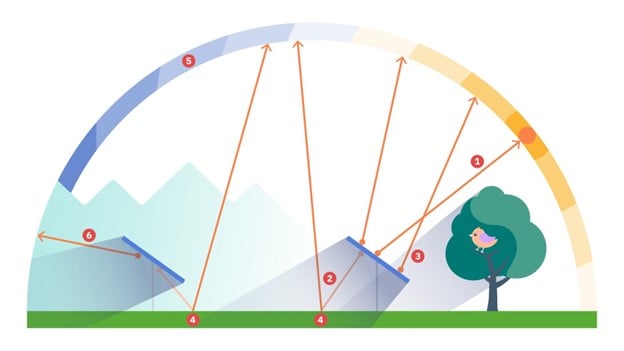
By factoring in these real-world variables and their interactions with bifacial PV modules, ray tracing and anisotropic sky models offer more reliable energy performance simulations, accurately accounting for both front and rear-side solar radiation.
Site-specific ground surface albedo data
In simplified terms, ground surface albedo measures how much solar radiation is reflected from the ground. Most industry-standard models use static or assumed albedo values, which are often inaccurate. Albedo varies significantly based on:
- Surface type, such as grass, soil, sand, snow and concrete
- Seasonal effects, such as the fact that snow-covered ground increases albedo, while vegetation changes it throughout the year
- Weather conditions, such as rain temporarily reducing albedo

Satellite-derived albedo data provides a more accurate alternative to static assumptions. These high-resolution datasets are integral to ensuring accurate bifacial PV simulations.
By post-processing and combining the model outputs with on-site measured data, reliable historical albedo values can be derived for project locations. The satellite-model ground surface albedo values are typically available in two formats: long-term monthly averages or as Time Series, aggregated to daily values.
While the long-term monthly averages are generally recommended for the pre-feasibility stage, Time Series data is more suited for the PV design and performance optimisation during a project development phase.
High-resolution time series data is crucial for bifacial PV evaluation
As mentioned above, monthly long-term averaged values and simplified datasets, such as hourly Typical Meteorological Year (TMY), could be acceptable for the pre-feasibility phase of a PV project. However, for detailed PV system evaluation – especially for bifacial systems – TMY lacks the accuracy required. Here are a few reasons why:
- Hourly data lacks granularity—it smooths out weather variations, missing critical fluctuations in irradiance
- TMY is a long-time averaged dataset—it does not capture year-over-year variability or extreme weather events
- Short-term variations in irradiance are lost, making it difficult to accurately model rear-side reflections in bifacial systems
Higher granularity datasets, such as the 15-minute time series data, are essential for accurately simulating energy yield.
Unlike TMY, 15-minute time series capture variations in solar irradiance for both front and rear sides, thus allowing developers to model real-world performance of the PV modules, strings and inverters, not just an ‘average’ scenario. Leveraging high-resolution time series data, along with satellite-based, site-specific albedo data, and ray tracing technology modeling allows solar professionals and investors to significantly increase the accuracy of PV simulations for bifacial modules, optimise system design and make informed investment decisions with confidence.
It’s time to move beyond legacy models. Adopting high-resolution PV evaluation methodology isn’t just an upgrade—it’s the new industry standard.