This interview appears alongside others on module reliability in the latest edition of our magazine, PV Tech Power issue 44.
As a solar module reliability scientist at Germany’s Fraunhofer Institute for Solar Energy Systems (ISE), Paul Gebhardt specialises in the problems that arise in solar panels and impact their performance or cause them to fail entirely.
Try Premium for just $1
- Full premium access for the first month at only $1
- Converts to an annual rate after 30 days unless cancelled
- Cancel anytime during the trial period
Premium Benefits
- Expert industry analysis and interviews
- Digital access to PV Tech Power journal
- Exclusive event discounts
Or get the full Premium subscription right away
Or continue reading this article for free
“I’m certainly biased, because my whole work revolves around the cases where modules actually fail,” he says. “It’s easy for me to say that [reliability issues] aren’t taken seriously enough, and I am aware that PV in general works quite well. The majority of modules aren’t interesting to me.”
But there is a significant rump of modules which show technical failures that pose real problems. “We see a lot of drastic changes in the technology, and these technologies enter the market without proper qualification,” Gebhardt says. “That’s clear.”
This is a major problem for the solar industry, he argues; the issues inherent in new technologies only become apparent once those products are already on the market. TOPCon modules are a case in point. Major solar manufacturers adopted TOPCon rapidly and at huge scale over the last two years, touting greater conversion efficiencies and overall better performance compared with older PERC products, and driven by the ease with which PERC production lines could be adapted to produce n-type TOPCon.
In that time, institutions like the US’ National Renewable Energy Laboratory (NREL, which was recently renamed), the University of New South Wales (UNSW) and Fraunhofer itself have published research outlining the high degradation rates of n-type modules and cells, and TOPCon in particular.
“Corrosion and UVID (ultraviolet light-induced degradation) [in TOPCon] were known about before, but how critical it is and how prevalent with the current modules only became clear once we already had a large margin of TOPCon modules in the market,” Gebhardt explains, because there’s relatively little to be learned from testing prototypes before they reach the market.
This means, on one hand, that it’s hard to predict the issues that might be found in the technologies that follow TOPCon, whether it is heterojunction technology (HJT) or, more likely, back contact (BC) modules. On the other, Gebhardt says that the rollout of TOPCon was unusually fast; “We’ve had HJT and back contact in the market for some time already, like SunPower/Maxeon have a long history of BC modules, and we have had many companies producing HJT [like] Meyer Burger.”
This might mean that the next generation of advanced PV cells and modules has fewer problems than TOPCon has had, as they have been drip-fed into the market rather than arriving in a torrent. But it’s hard to predict: “Once a technology is adopted by a larger variety of manufacturers, the properties of the modules or the materials used in these modules can actually be different, so it’s hard to predict how they will behave in testing or outdoors,” Gebhardt says.
Testing, testing…
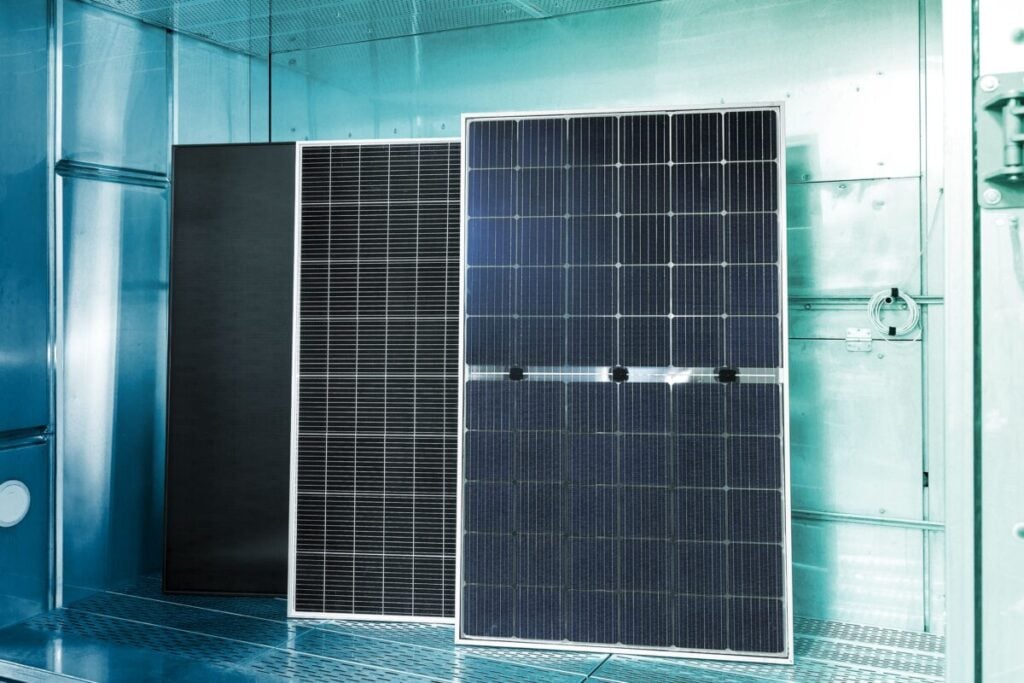
Bridging the gap between laboratory tests and real-world wear and tear isn’t easy. Fraunhofer ISE is one of the only institutions which has begun collecting real-world field data to compare actual degradation with the degradation rates in the lab. That research has collected around two years of data so far, Gebhardt says, and the degradation is continuing; “So that evaluation is not finished, it will just take longer outdoors, which is natural.”
There have been questions raised over how effective current laboratory tests are at providing meaningful models and estimations of field performance. Gebhardt authored a paper published in 2024 which said that the current standards for commercial modules only test for total failure or safety concerns, rather than recording power loss through gradual degradation.
“I think it’s always important to remind of the purpose and the scope of the certification standards,” he tells us. “So with PV modules, we talk about 25 or 30 years of lifetime. But the standards [generally the International Electrotechnical Commission (IEC) 61215 and 61730 certifications] actually don’t cover the whole lifetime, and at least the certification standard is only designed to expose major design flaws that would lead to failure of the module early in the lifetime.”
But, given the fact that module technologies reach the market before many of their major flaws have been exposed, tests have to play catch-up, too. “That means the standard is not really sufficient to prove the reliability of a new technology at the moment when it hits the market,” Gebhardt says. Which is an issue.
Module manufacturers, power plant owners, EPCs (or all of the above) need to evaluate “the stresses the module will face in an outdoor environment,” he continues, to evaluate the financial and energy generation risk of degradation or failure over time. UVID testing, for example, has been known about for some time, going back to PERC technology. “But there’s just not enough UVID testing in the standard certification, even in the extended stress test standard, it doesn’t really cover the UV degradation of the cell [in the real world].”
Put simply, real-world conditions are far more chaotic, with far more inputs and factors affecting a module’s performance and reliability, than even the most sophisticated lab tests. “Outside there are so many influences that it’s hard to pinpoint it to one issue,” Gebhardt says.
Seeing clearly
This is most clear in the case of glass breakage, which Gebhardt says is the most complex and concerning issue with modern solar modules, even more than UVID. UVID affects module performance, but is increasingly well-understood and doesn’t lead to complete failure; the same is broadly true for corrosion problems.
“The glass breakage topic is really complicated,” Gebhardt says. “It can lead to the complete failure of the module and there is no good test to determine the probability of glass breakage in advance.”
This is largely due to the range of factors affecting glass breakage; hail and wind are obvious factors, but Gebhart says that it is even hard to characterise the properties and quality of different module glass once it is assembled. Then, factoring in the orientation of the module, its mounting structure and random local factors like stones flying from grass mowers, makes accounting for glass breakage a near impossible task. This is all exacerbated by the penny-pinching of major manufacturers as they have tried to turn a profit amid oversupply and plummeting module prices, often turning to thinner glass to save money.
Financial implications
Industry headlines and research papers focus on UVID and other cell-related degradations, particularly in TOPCon. So do the financial backers of solar projects, Gebhardt says; “There is a lot of pressure now from banks back to the technical people who plan the projects and purchase the modules to check and exclude risks for UVID specifically. And the pass-fail criteria [in these cases] is quite strict.”
He says that “ambitious” 25-to-30-year warranties from module manufacturers play into these concerns. “I am not aware of a technical procedure that would generate the numbers we read in these warranties,” he continues, “simply because there is no method to accurately determine the lifetime of a module. [A warranty] is something that can be expressed in terms of financial risk, and since UVID is relevant from the beginning of the module’s lifetime, I think banks are much more sensitive to this issue.”
The solar industry must address these competing pressures to ensure the long-term reliability of advanced PV modules and its own credibility. In an ideal world, the industry would adopt a more cautious approach to rolling out new technologies, ensuring they are thoroughly tested before large-scale deployment, but commercial realities usually dictate otherwise.
In the absence of that, Gebhardt’s key messages provide a useful roadmap for a way forward: improving testing standards to better reflect real-world conditions, expanding the scope of certifications to account for gradual degradation and maintaining pressure on manufacturers to balance cost-cutting measures with the need for durable, high-quality materials to prevent issues such as glass breakage.
Fraunhofer ISE’s ongoing research into real-world degradation is a step in the right direction, providing valuable data to bridge the gap between lab tests and outdoor performance. Through this and similar efforts, the solar industry can build greater confidence among financial backers, project developers and end-users, paving the way for a sustainable and reliable future
An altered version of this piece appears in the latest edition of our magazine, PV Tech Power, alongside other interviews on the subject of module reliability and testing.