Making investment decisions based on the value of an entire renewable energy portfolio, rather than the merits of an individual project, has become the norm for Europe’s renewable energy investors.
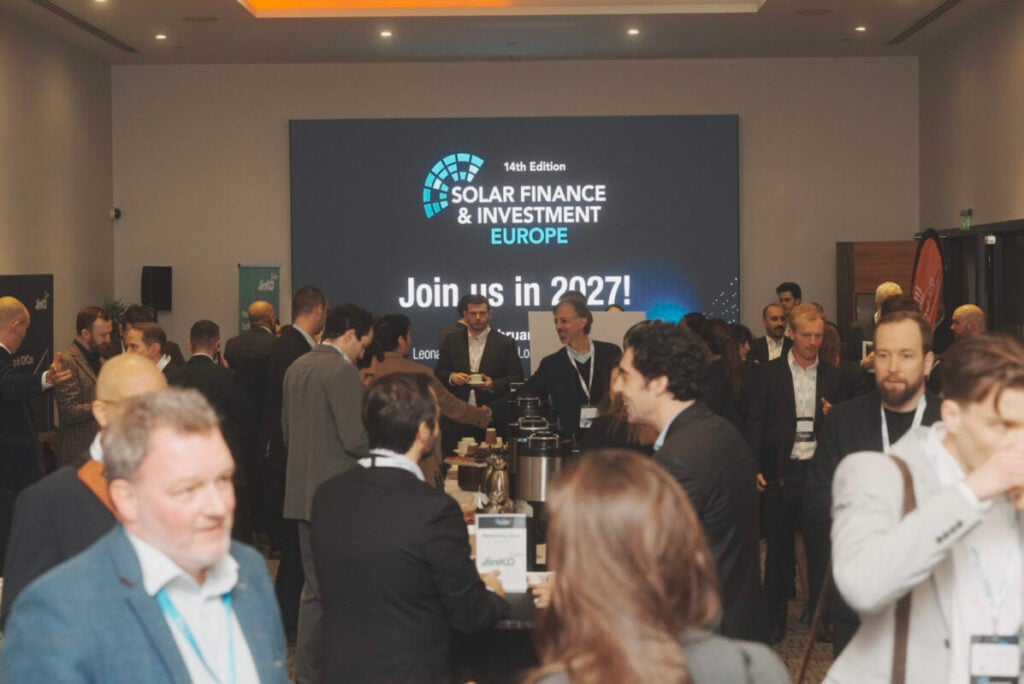
This was a key takeaway from Solar Media’s Solar Finance & Investment Europe event, held earlier this month in London and bringing together more than 350 renewable energy finance experts to discuss Europe’s renewable energy investment landscape, which has only grown in scale and complexity over time.
Try Premium for just $1
- Full premium access for the first month at only $1
- Converts to an annual rate after 30 days unless cancelled
- Cancel anytime during the trial period
Premium Benefits
- Expert industry analysis and interviews
- Digital access to PV Tech Power journal
- Exclusive event discounts
Or get the full Premium subscription right away
Or continue reading this article for free
“It is important to think about this in terms of portfolios,” said Scott Douglas, senior director and head of debt advisory at Centrus, who surmised this shift to portfolio-based decision-making during a panel discussion at the event.
Douglas’ comments come as the sheer volume of capital flowing into the European clean energy space—figures from the International Energy Agency (IEA) suggest that a record US$191.9 billion (€162.2 billion) of investment in clean energy generation alone in 2025—in addition to the size and technical sophistication of renewable energy portfolios means that investment decisions need to be made based on this larger scale, rather than focusing on individual projects.
Macro-economic trends and macro-level portfolio decisions
Douglas also argued that some of the more popular market mechanisms used in the renewable energy space are becoming less commonplace, which is changing the decision-making landscape for investors. He argued that power purchase agreements (PPAs) are “getting shorter” and feed-in-tariffs (FiTs) are “becoming less available”.
Not only will the decline of well-established financial mechanisms inherently lead to an uptick in uncertainty, but these mechanisms were also used explicitly to reduce investors’ and generators’ exposure to some of the variability inherent in renewable energy generation; the primary purpose of a PPA is to insulate a generator’s revenues from the volatility of power prices.
“I think it’s about risk mitigation and diversification, from multiple angles,” Douglas told PV Tech Premium exclusively following his panel, highlighting how these macro-economic trends have led to an increased focus on minimising risk on a portfolio scale.
“From an investor and developer perspective, [the goal is] balancing risk, not just in terms of technologies but in terms of different revenue models and different geographies as well,” he continued. “That carries through into the financing market as well; lenders like that diversification and that portfolio effect.”
The need to minimise risk is, of course, nothing new from an investment perspective, but the scale and complexity of Europe’s solar portfolios mean that there are now more companies active in the space than ever before. Some of these new actors, and the industries they represent, can bring an element of stability and predictability to an industry that is looking for greater revenue security.
“What we do is kind of predictable, so we know what parks are ageing [and] when they’re coming back,” explained Dr. Jan-Philipp Mai, CEO of German solar panel recycling firm Solar Materials, who spoke to PV Tech Premium at the event, and whose comments are available in full in the video above.
Panel recycling is a relatively young industry, compared to other parts of the solar sector, but it is one that is seeing increased attention from developers whose projects are coming towards the end of their operational life. Solar Materials, for instance, announced that it had doubled its total recycling capacity to 14,000 tons in January of this year, reflecting an increased demand for its services; Mai said that this demand is a justification for the company’s business model, and creates new opportunities to extract value from solar projects.
“What became more obvious now, in discussions with the investors of solar parks, is that there’s value connected to the end-of-life solar panels, which hasn’t been [there] before,” he said. “It’s a completely new business case for them to extract some of that value, and that gives us an additional push for our expansion as well.”
Ultimately, bigger and more complicated portfolios can create uncertainty, but also opportunities for new, stable revenue streams in European solar; according to Douglas, investing in a range of “geographies, technologies and revenue profiles” is considered good practice at present, which is only possible when investments are considered on the scale of whole portfolios, rather than individual projects.
Storage is ‘another mitigant for market volatility’
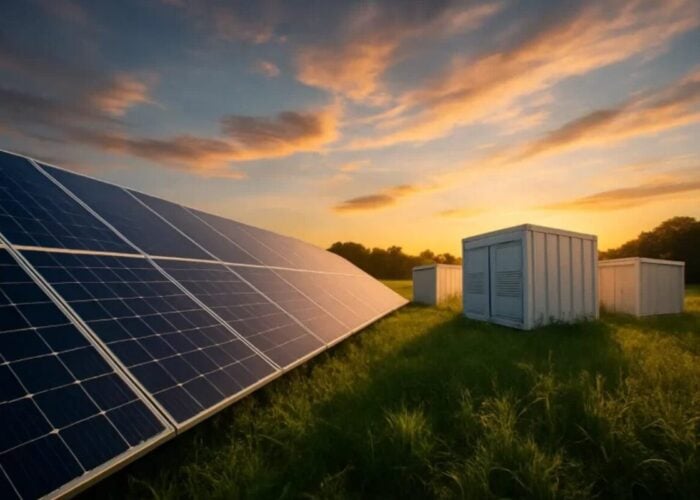
While Douglas did not specify which of the “technologies” could be the most impactful when investing in a renewable energy portfolio, several speakers and attendees at the event pointed to battery energy storage systems (BESS) as the technology most likely to have an impact on investors’ decision-making process.
“You definitely will be seeing activities around those types of investment, around batteries-plus-solar,” explained Marta Valien, managing director and head of asset management at the Foresight Group, who spoke to PV Tech Premium at the event.
Beatriz Llorente Blanco, head of growth, Iberia, at Sonnedix, agreed, telling us that storage is “another mitigant for market volatility”.
While there is considerable optimism for solar-plus-storage on the global scale—figures from DNV suggest that around half of the world’s solar capacity will be co-located with storage by 2060, up from just 2% in 2024—Valien said that storage must be invested in carefully, and that simply adding batteries to a solar portfolio is not a guarantee of more flexible power supply and more predictable revenues.
“It’s definitely happening, but you need to analyse [other factors] as it’s not something straightforward,” she explained. “From the financial point, you need to be analysing the investment [and] how much the capex [is going to be] for deploying that asset, compared to the return that you’re expecting to have. So you need to be super clear on that.”
However, Llorente Blanco argued that storage, if invested in properly, could help plug some of the gaps left behind by market mechanisms, such as long-term PPAs, that have become less popular as portfolios have become larger and more complicated.
“It’s all about how we sell energy and how we adapt our generation to the demand. That is mandatory,” she told PV Tech Premium; her comments are available in full in the video above. “We’re not any more in the [world of] tariffs and the pay-as-produce PPAs, we have to adapt to consumers. That is where the batteries play a role.”
Llorente Blanco’s comments also come as Spain, a key area of focus in her position as head of Iberia, grapples with spiralling curtailment. The country saw almost 4TWh of solar curtailment in 2024, and while figures from commodity analyst Kpler show this declined 11% year-on-year in the first six months of 2025, Spain still leads Europe in total curtailment volumes in the first half of last year.
“Having a PV profile that generates in peaks, where there is no demand, just results in generation being thrown away, and that makes no sense from an investment perspective,” added Llorente Blanco, suggesting that batteries, like Mai’s comments on panel recycling, are an opportunity for a new stable business case in European solar. “Therefore, the batteries—precisely those that help shape a profile more adapted to the consumers—are the drivers for those investments.”
More moving parts and more revenue opportunities
Valien stressed, however, that working with global, multi-technology portfolios is not “straightforward”, and that managing today’s multi-faceted portfolios simply necessitates management of more moving parts.
“You need to be looking at different factors, it’s not so straightforward as going in one direction or the other one [between solar and storage],” she said. “You need to look at the jurisdiction [and] what kind of benefits [are in] that jurisdiction; for example in Spain we have a capacity market that will be giving out a more robust business case for investing in the technology, whereas here in the UK, it’s getting to the point where we would say it’s starting to get mature.”
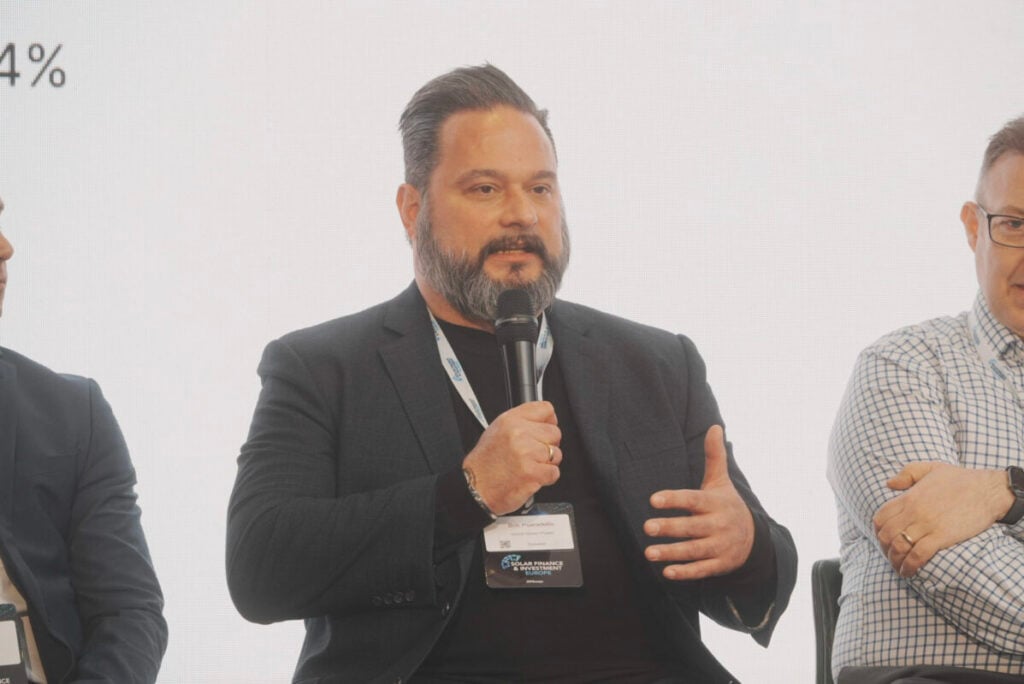
She goes on to describe the UK solar and storage market as “years ahead compared to other jurisdictions”, and her comments were supported by Bob Psaradellis, CEO of Island Green Power, who said at the event that the UK’s contracts for difference (CfD) programme is the “gold standard” for government support for renewable energy projects.
However, while working in different markets and in different policy landscapes can present challenges, this kind of high-level, portfolio-scale thinking can bring security. According to Mai, solar is “a long-term game” and thinking holistically and long-term about a solar project, up to and including its end-of-life-care, can create new revenue opportunities, rather than being just an added layer of complexity to an already overwhelming myriad of moving parts.
“Talking about a park 20 years from now is quite far in the future, but it means a kind of planability, and that’s important for our perspective and the investor’s perspective of a solar park,” he explained. “They do not want to be surprised when it comes to recycling costs, so bridging the different industries, views and players along the value chain, and creating this long-term picture, is super important.”
Ultimately, making decisions on a portfolio level makes those decisions more complicated, but that is no reason not to make those decisions. Indeed, making that kind of a range of decisions has become part and parcel of the solar investment landscape; as Valien told us: “You have to analyse what you have in terms of resources, the legal framework you have in that jurisdiction [and] what is the appetite of the financing that you have behind.”
Read all of our coverage of the event, including in-depth analysis of the panel discussions mentioned in this article, here.