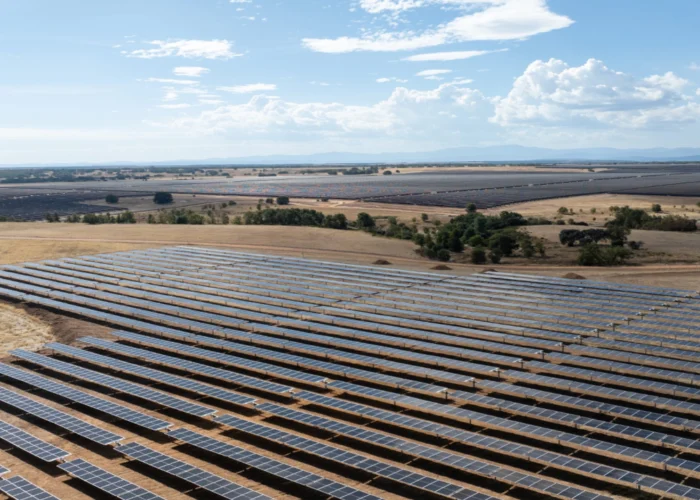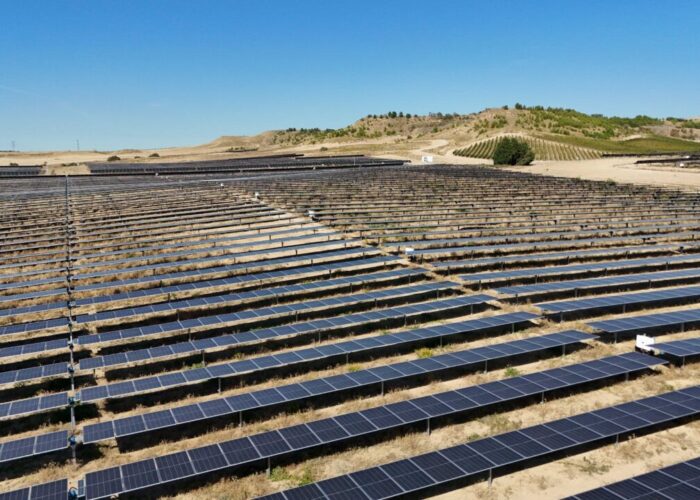
The world is on pace to exceed 3TW of cumulative solar installations by the end of the year, but “urgent actions in all sectors” would be required if the world is to meet its 2050 net-zero goals.
These are some of the key conclusions drawn by DNV’s 2025 ‘Energy Transition Outlook’, unveiled last week at an event in Amsterdam. The event included two panel discussions on energy security and finance—covered last week on PV Tech Premium—and the report itself includes a number of positive figures for the global solar sector.
Try Premium for just $1
- Full premium access for the first month at only $1
- Converts to an annual rate after 30 days unless cancelled
- Cancel anytime during the trial period
Premium Benefits
- Expert industry analysis and interviews
- Digital access to PV Tech Power journal
- Exclusive event discounts
Or get the full Premium subscription right away
Or continue reading this article for free
Chief among these is the forecast that, by 2060, solar power will account for 47% of the world’s electricity generation, increasing five-fold from last year. The report attributes solar’s “meteoric” rise to the shift of the world’s solar manufacturing bases from Europe to China during the 2010s, but that China’s dominance of global PV installations will not continue indefinitely.
Indeed, the report expects China’s share of global solar generation capacity to peak next year, accounting for just under half of global solar generation, before steadily decreasing below 35% by 2060.
Distributed solar and battery co-location
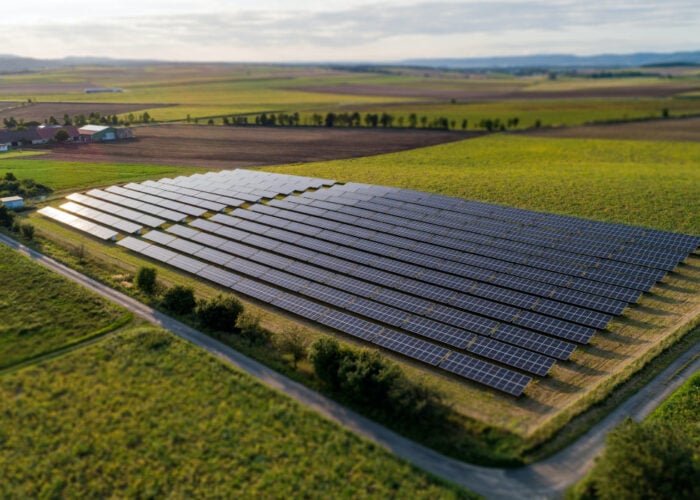
The report also notes that distributed solar will play an increasingly significantly role in the global solar sector. In 2024, distributed solar accounted for 31% of global solar capacity, and this is expected to increase to 40% by 2050.
The report expects annual distributed capacity additions to exceed annual utility-scale additions in Europe and North America in the 2030s, and China by the 2040s, noting that “grid congestion and price cannibalisation” will make commissioning new utility-scale projects increasingly challenging in the years to come. This is a trend that has already affected the work of developers and investors in both the US and mainland Europe.
The most notable exception to this trend is in the Indian subcontinent, where utility-scale solar is expected to continue to dominate the sector. Even as late as the 20503, utility-scale solar additions will exceed 1.5TW, while distributed solar installations will have yet to exceed the 1TW threshold.
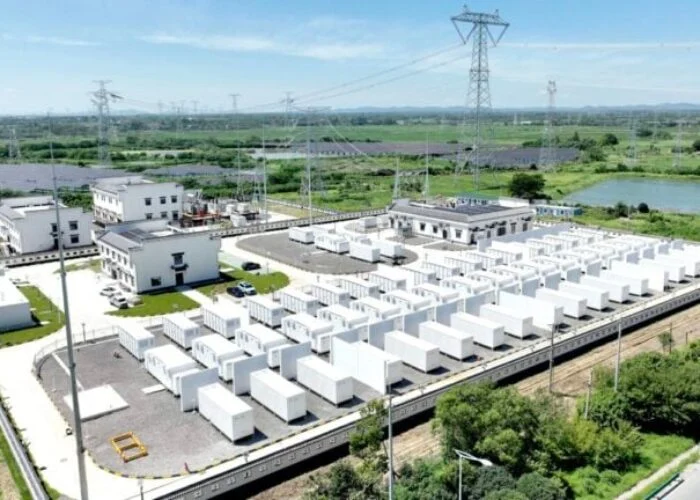
Across all regions, however, the report notes that an increasingly large proportion of solar projects are expected to be co-located with battery energy storage systems (BESS). The report notes that around half of the world’s solar capacity will be co-located with storage as early as 2060, up from just 2% in 2024.
There is also a regional aspect to this trend, too. The report expects the Middle East and North Africa, the Indian Subcontinent, Southeast Asia and Sub-Saharan Africa to each have a greater operational capacity of solar-plus-storage than standalone solar by 2060.
However, the report notes that, despite these encouraging growth figures, global carbon emissions will remain well above the levels needed to reach the 2050 net zero goals. While the shift away from fossil fuels and towards renewables is expected to slash carbon dioxide emissions—from 35Gt in 2024 to 34Gt in 2030 and 11.3Gt by 2060—much of the damage has already been done.

DNV anticipates that the world will exhaust its 1.5 degrees Celsius budget—the volume of emissions that can be produced if the world is to limit global warming to just 1.5 degrees Celsius—as early as 2029. Indeed, the report expects that by 2100, the world will produce 345Gt more carbon dioxide than would be possible to limit global warming to 2 degrees Celsius, estimating that the world will be 2.2 degrees Celsius warmer than pre-industrial levels by 2100.
Finance, batteries and energy security
In order to have any hope of meeting these environmental targets, greater investment in the renewable energy sector will be needed; it was encouraging to hear, then, at last week’s panels, that solar investments remain affordable.
“There’s a lot of appetite and capital available for the energy transition; Rabobank has already been involved in renewable project structures for over 30 years,” said Karin van Selm, CEO of wholesale Europe, Africa and Asia at Rabobank, who suggested that interest in new solar projects is matched by the affordability of those investments.
The panel discussions also focused on the growing role of storage in the global solar sector, particularly from an investment perspective, and how investments in one aspect of the solar industry could quickly spread to another.
“Coupled with all these financing structures that allow low interest rates, a lot of entrepreneurs and industrial players could be looking at behind-the-meter to be deployed first, and then gradually, as they see the benefits, the market can grow,” explained Ray See, executive president of the Americas at CATL.
Panellists throughout the event also spoke about the importance of renewable power in the context of energy security, with domestic renewable energy projects, often teamed with storage, seen as a more secure source of electricity than importing power, particularly from fossil fuel sources, from overseas.
“Countries are scrambling for influence over markets and control over critical resources; not just oil and gas but clean tech supply chains,” said Tom Middendorp, chair of the International Military Council on Climate and Security. “Strategic competition over resources is intensifying, supply chains and markets are repeatedly disrupted by shocks.
Read our full coverage of the day’s panel discussions here.