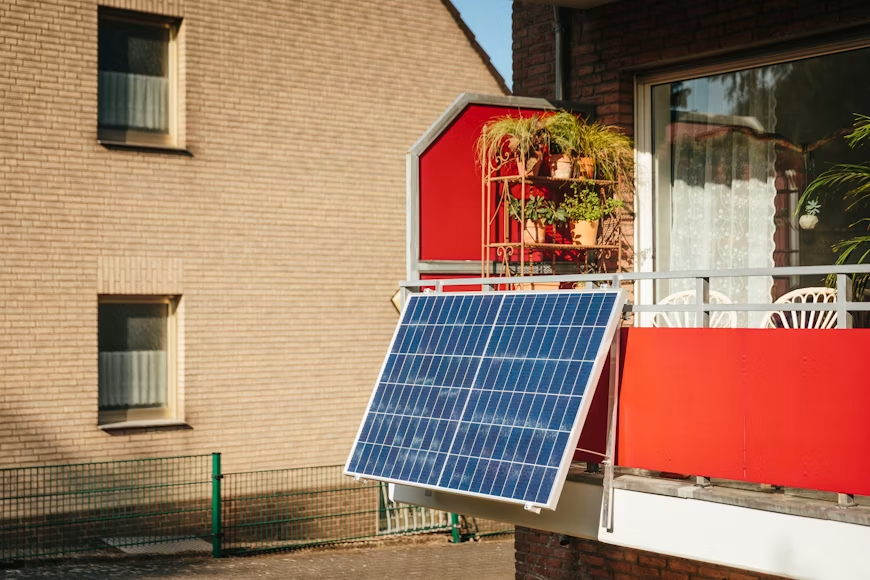
Plug-in or “balcony” solar refers to small-scale PV systems that connect to a building’s electrical supply through a conventional power outlet rather than requiring a dedicated rooftop installation.
Unlike conventional rooftop PV, plug-in systems generally require little or no electrical installation work and can be deployed without specialist technical expertise. This has driven adoption as a low-cost, accessible form of distributed generation, particularly in Europe.
Try Premium for just $1
- Full premium access for the first month at only $1
- Converts to an annual rate after 30 days unless cancelled
- Cancel anytime during the trial period
Premium Benefits
- Expert industry analysis and interviews
- Digital access to PV Tech Power journal
- Exclusive event discounts
Or get the full Premium subscription right away
Or continue reading this article for free
The most common configuration consists of one or more PV modules connected to a microinverter, with the AC output plugged into a household circuit. Generation is consumed by building loads in real time, while surplus electricity can be exported to the grid, subject to local regulations and system configuration.
Other configurations incorporate batteries, allowing appliances to be powered directly from storage or combining battery systems with a connection to the building’s electrical supply. More advanced systems include dedicated circuits and smart controls, including export-limiting functionality. Higher-power systems can also connect to dedicated 240V circuits, depending on local requirements.
Balcony PV systems are substantially smaller than conventional residential rooftop installations. In the US, state-level legislation governing portable solar generation devices includes limits of 1.2kW or less.
In a report published earlier in 2026, energy market analyst Wood Mackenzie identifies US balcony solar as an emerging growth area for the year ahead. The report notes broad bipartisan support for plug-in solar devices.
Several US states are advancing balcony solar adoption, with Colorado, Maine and Virginia already enacting plug-in solar legislation. California, New Jersey and New York and are also among the states progressing with legislation to enable plug-in solar deployment.
PV Tech Premium spoke to Joseph Shangraw, research analyst for solar supply chains at Wood Mackenzie, about the challenges facing the plug-in solar market in the US and the path forward.
Europe versus the US: different paths for balcony solar
According to Shangraw: “Germany was the first country to successfully adopt plug-in solar off the ground.” At its peak, “about 20%-25% of all residential solar sold by capacity was plug-in solar.”
The appeal is simple: plug-in solar provides consumers with a low-cost entry point into renewable energy while avoiding many barriers associated with rooftop installations. Europe sees “several benefits to giving people access to a cheap way to buy solar,” according to Shangraw, including “a way to get pretty quick payback on your savings.”
The biggest advantage is reduced installation complexity and cost: “because of the simple system, consumers avoid all of those soft costs of interconnection, construction and installation.”
However, the conditions supporting European growth do not directly translate to the US. Electricity economics are a key difference, and as Shangraw notes: “electricity rates tend to be lower on average in the US than in Europe,” meaning “for the same equipment you buy, the same amount of power you generate, you’re saving less in the US in a dollar amount.”
This weakens the consumer proposition. “It always is going to come down to cost,” he says. “People will buy a product if it’s going to save them money.”
Housing patterns also differ. In Europe, plug-in solar fits naturally into dense residential markets, where balconies and flats are common and suitable for solar installations. “A large majority of people [in Europe] live in apartments or flats that have balconies and porches,” says Shangraw.
In contrast, “people in the US tend to live in single family homes,” while apartment residents are often renters who “maybe have less interest in making an upfront investment like this.”
Supply chains add another challenge. “Almost all of these systems are using Chinese-made parts in order to be cheap and affordable,” says Shangraw, who estimates that the current tariff environment in the US means consumers will have to pay 20-50% more in upfront costs than in Europe.
He adds that this could result in “a 50% longer payback period before you actually feel like you’re making money off of this.”
What needs to be solved for plug-in solar to scale in the US?
While plug-in solar gains momentum in Europe, scaling the technology in the US requires overcoming a different set of technical and regulatory challenges, with safety at the centre of the discussion.
Shangraw explains that one of the biggest barriers is the difference in electrical systems between the two regions. “Because [the US] grid operates at half the voltage, electrical challenges are inevitable,” he says.
With the same size plug-in solar system delivering power at a lower voltage, “there’s now twice the amperage, twice the current going through that system,” creating concerns around residential wiring capacity.
According to Shangraw, this can lead to “overloading circuits or exceeding the rated capacity of the wiring within our homes.” Systems considered relatively straightforward in Europe may require additional safeguards in the US, where “you’re starting to push those safety limits around that 800W to 1200W mark.”
He suggests establishing clear certification standards should be a priority for plug-in solar deployment in the US, with UL 3700 providing an initial framework to define safety requirements and build confidence among regulators, utilities and consumers.
He calls for nationally recognised certification standards to create consistent market rules and reduce approval uncertainty. He also stresses the need for updates to the National Electrical Code to define safe, certified residential installation methods for plug-in solar systems. Aligning product standards, electrical codes and regulations will be critical to scaling adoption while maintaining safety and accountability.
Beyond technical and regulatory hurdles, plug-in solar must overcome the challenge of proving consumer value in the US market.
“It always comes down to cost,” Shangraw says, explaining that mass adoption depends on whether consumers see clear financial benefits. “People will buy a product if it’s going to save them money.” Higher equipment costs, regulatory requirements and installation barriers all affect customer payback periods.
For plug-in solar to move beyond early adopters and become a mainstream residential solution in the US, the industry must address not only the technology challenge but also affordability, simplicity and consumer confidence.
Lower system costs and greater product availability
According to Shangraw, the next phase of balcony solar growth depends on lower system costs and greater product availability. While regulatory approvals are expanding, adoption remains constrained by economics, with high upfront costs limiting wider uptake.
He expects more products and fully certified kits to enter the market, improving accessibility for consumers. However, he emphasises that significant cost reductions remain necessary for balcony solar to move beyond a niche market.
Shangraw sees plug-in energy storage as a key development opportunity for balcony solar, improving system economics by increasing self-consumption and enabling households to use solar generation beyond daylight hours. He says, “plug-in storage is going to be a big component of this,” adding that storage-integrated systems could become more attractive than standalone solar kits by delivering greater value for consumers.